Hattori Yoshiyuki, Nakamura Ayako, Arai Shohei, Nishigaki Mayu, Ohkura Hiroyuki, Kawano Kumi, Maitani Yoshie, Yonemochi Etsuo
Institute of Medicinal Chemistry, Hoshi University, Ebara 2-4-41, Shinagawa-ku, Tokyo 142-8501, Japan.
Results Pharma Sci. 2014 Jan 25;4:1-7. doi: 10.1016/j.rinphs.2014.01.001. eCollection 2014.
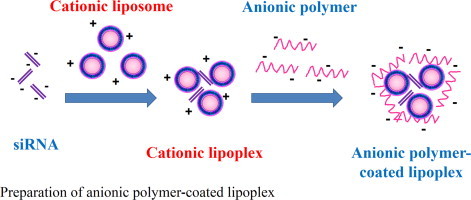
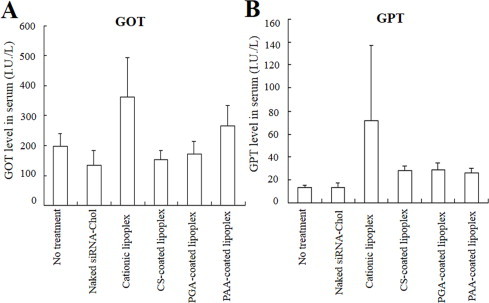
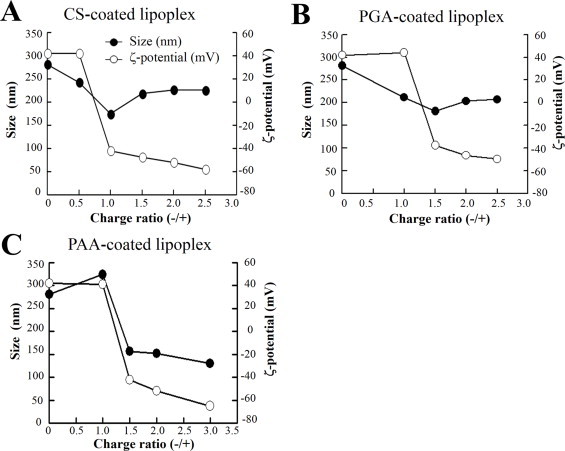
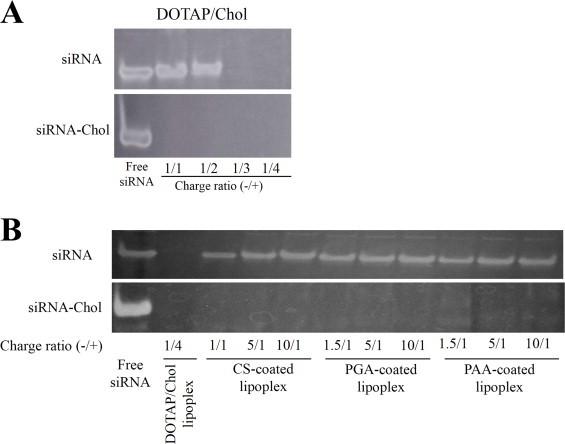
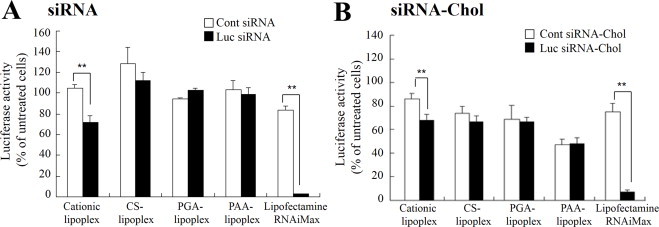
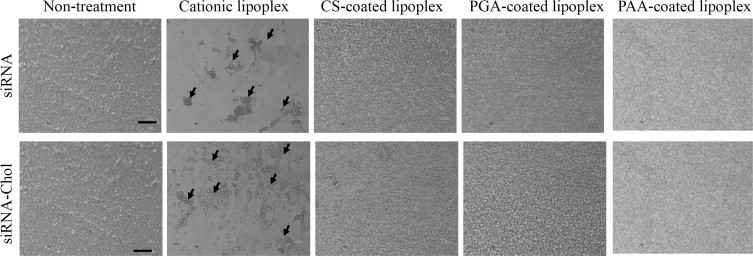
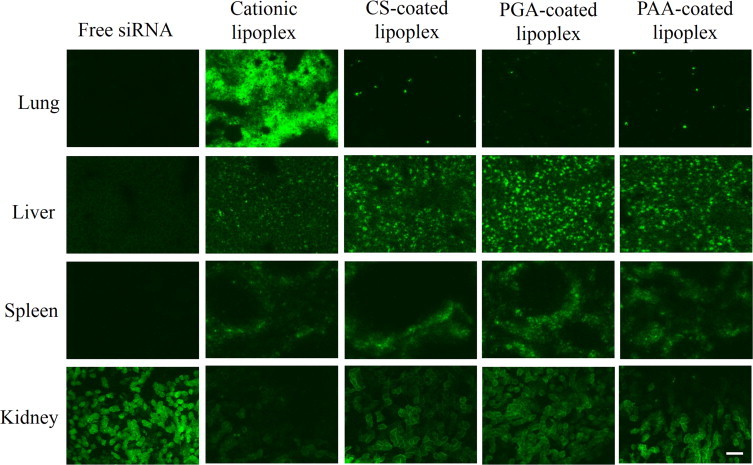
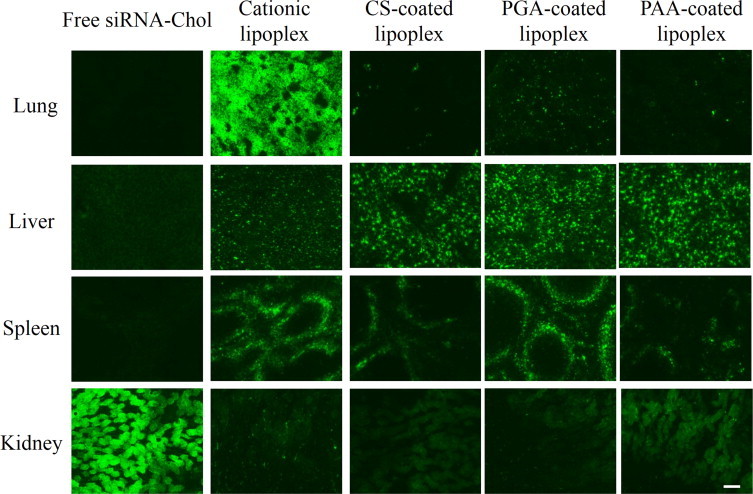
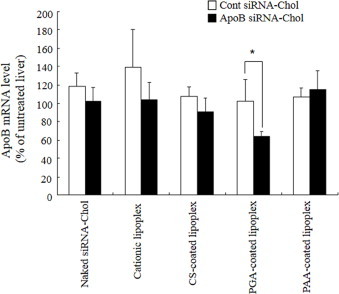
In this study, we developed anionic polymer-coated liposome/siRNA complexes (lipoplexes) with chondroitin sulfate C (CS), poly-l-glutamic acid (PGA) and poly-aspartic acid (PAA) for siRNA delivery by intravenous injection, and evaluated the biodistribution and gene silencing effect in mice. The sizes of CS-, PGA- and PAA-coated lipoplexes were about 200?nm and their ?-potentials were negative. CS-, PGA- and PAA-coated lipoplexes did not induce agglutination after mixing with erythrocytes. In terms of biodistribution, siRNAs after intravenous administration of cationic lipoplexes were largely observed in the lungs, but those of CS-, PGA- and PAA-coated lipoplexes were in both the liver and the kidneys, indicating that siRNA might be partially released from the anionic polymer-coated lipoplexes in the blood circulation and accumulate in the kidney, although the lipoplexes can prevent the agglutination with blood components. To increase the association between siRNA and cationic liposome, we used cholesterol-modified siRNA (siRNA-Chol) for preparation of the lipoplexes. When CS-, PGA- and PAA-coated lipoplexes of siRNA-Chol were injected into mice, siRNA-Chol was mainly observed in the liver, not in the kidneys. In terms of the suppression of gene expression in vivo, apolipoprotein B (ApoB) mRNA in the liver was significantly reduced 48?h after single intravenous injection of PGA-coated lipoplex of ApoB siRNA-Chol (2.5?mg?siRNA/kg), but not cationic, CS- and PAA-coated lipoplexes. In terms of toxicity after intravenous injection, CS-, PGA- and PAA-coated lipoplexes did not increase GOT and GPT concentrations in blood. From these findings, PGA coatings for cationic lipoplex of siRNA-Chol might produce a systemic vector of siRNA to the liver.
在本研究中,我们开发了用硫酸软骨素C(CS)、聚-L-谷氨酸(PGA)和聚天冬氨酸(PAA)包被的阴离子聚合物脂质体/siRNA复合物(脂质复合物),用于通过静脉注射递送siRNA,并评估了其在小鼠体内的生物分布和基因沉默效果。CS、PGA和PAA包被的脂质复合物大小约为200纳米,其ζ电位为负。CS、PGA和PAA包被的脂质复合物与红细胞混合后不会诱导凝集。在生物分布方面,阳离子脂质复合物静脉给药后,siRNA主要在肺部被观察到,但CS、PGA和PAA包被的脂质复合物的siRNA在肝脏和肾脏中均有分布,这表明尽管脂质复合物可以防止与血液成分凝集,但siRNA可能在血液循环中从阴离子聚合物包被的脂质复合物中部分释放出来并在肾脏中积累。为了增加siRNA与阳离子脂质体之间的结合,我们使用胆固醇修饰的siRNA(siRNA-Chol)来制备脂质复合物。当将siRNA-Chol的CS、PGA和PAA包被的脂质复合物注射到小鼠体内时,siRNA-Chol主要在肝脏中被观察到,而不是在肾脏中。在体内基因表达抑制方面,单次静脉注射ApoB siRNA-Chol(2.5毫克siRNA/千克)的PGA包被脂质复合物后48小时,肝脏中的载脂蛋白B(ApoB)mRNA显著降低,但阳离子、CS和PAA包被的脂质复合物则没有。在静脉注射后的毒性方面,CS、PGA和PAA包被的脂质复合物不会增加血液中的谷草转氨酶(GOT)和谷丙转氨酶(GPT)浓度。从这些发现来看,siRNA-Chol阳离子脂质复合物的PGA包被可能会产生一种将siRNA递送至肝脏的全身载体。