De Vrieze Jo, Raport Linde, Willems Bernard, Verbrugge Silke, Volcke Eveline, Meers Erik, Angenent Largus T, Boon Nico
Laboratory of Microbial Ecology and Technology (LabMET), Ghent University, Coupure Links 653, Gent, B-9000, Belgium.
Innolab, Derbystraat 223, Sint-Denijs-Westrem, 9051, Belgium.
Microb Biotechnol. 2015 Sep;8(5):776-86. doi: 10.1111/1751-7915.12268. Epub 2015 Mar 10.
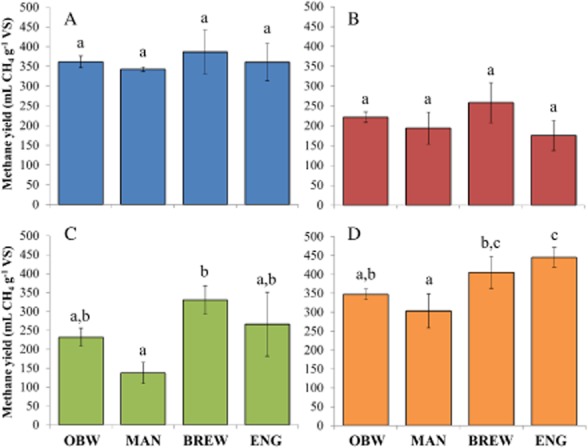
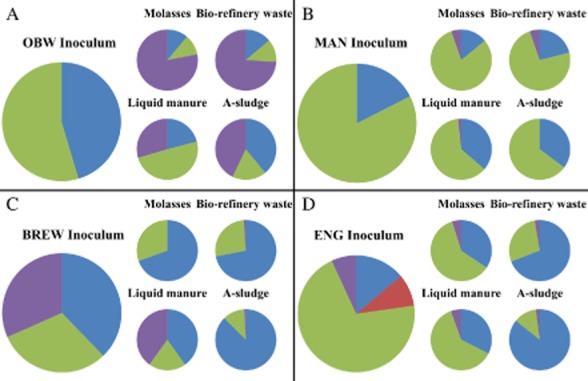
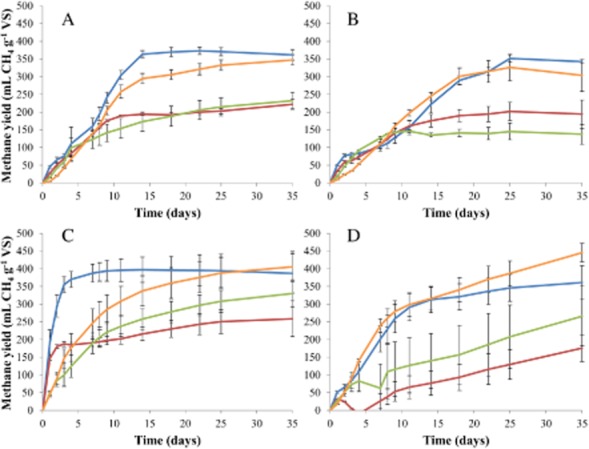
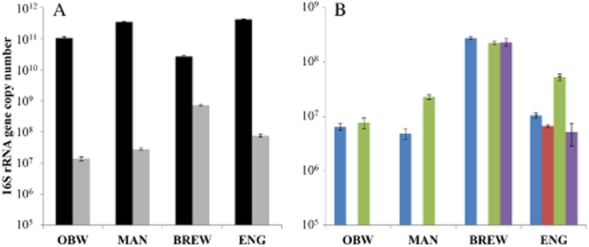
Obtaining a reliable estimation of the methane potential of organic waste streams in anaerobic digestion, for which a biochemical methane potential (BMP) test is often used, is of high importance. Standardization of this BMP test is required to ensure inter-laboratory repeatability and accuracy of the BMP results. Therefore, guidelines were set out; yet, these do not provide sufficient information concerning origin of and the microbial community in the test inoculum. Here, the specific contribution of the methanogenic community on the BMP test results was evaluated. The biomethane potential of four different substrates (molasses, bio-refinery waste, liquid manure and high-rate activated sludge) was determined by means of four different inocula from full-scale anaerobic digestion plants. A significant effect of the selected inoculum on the BMP result was observed for two out of four substrates. This inoculum effect could be attributed to the abundance of methanogens and a potential inhibiting effect in the inoculum itself, demonstrating the importance of inoculum selection for BMP testing. We recommend the application of granular sludge as an inoculum, because of its higher methanogenic abundance and activity, and protection from bulk solutions, compared with other inocula.
获得有机废物流在厌氧消化中甲烷潜力的可靠估计非常重要,通常采用生化甲烷潜力(BMP)测试来进行。需要对该BMP测试进行标准化,以确保实验室间BMP结果的可重复性和准确性。因此,制定了相关指南;然而,这些指南并未提供有关测试接种物的来源和微生物群落的足够信息。在此,评估了产甲烷群落对BMP测试结果的具体贡献。通过来自全规模厌氧消化厂的四种不同接种物,测定了四种不同底物(糖蜜、生物精炼厂废料、液体粪肥和高速活性污泥)的生物甲烷潜力。对于四种底物中的两种,观察到所选接种物对BMP结果有显著影响。这种接种物效应可归因于产甲烷菌的丰度以及接种物本身的潜在抑制作用,这表明接种物选择对于BMP测试的重要性。我们建议使用颗粒污泥作为接种物,因为与其他接种物相比,它具有更高的产甲烷丰度和活性,并且能免受大量溶液的影响。