Herrador Zaida, Gherasim Alin, Jimenez B Carolina, Granados Maria del sol, San Martín Juan Victor, Aparicio Pilar
National Centre for Tropical Medicine, Health Institute Carlos III (ISCIII in Spanish), Madrid, Spain; Network Biomedical Research on Tropical Diseases (RICET in Spanish), Madrid, Spain.
National Centre for Tropical Medicine, Health Institute Carlos III (ISCIII in Spanish), Madrid, Spain.
PLoS Negl Trop Dis. 2015 Mar 10;9(3):e0003594. doi: 10.1371/journal.pntd.0003594. eCollection 2015 Mar.
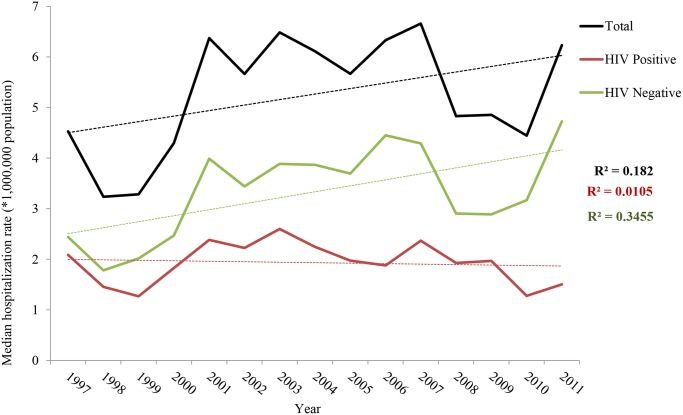
In Spain, Leishmania infantum is endemic, human visceral and cutaneous leishmaniasis cases occurring both in the Peninsula, as well as in the Balearic Islands. We aimed to describe the clinical characteristics of leishmaniasis patients and the changes in the disease evolution after the introduction of antiretroviral therapy in 1997. In this descriptive study, we used Spanish Centralized Hospital Discharge Database for the hospitalized leishmaniasis cases between 1997 and 2011. We included in the analysis only the records having leishmaniasis as the first registered diagnosis and calculated the hospitalization rates. Disease trend was described taking into account the HIV status. Adjusted odds-ratio was used to estimate the association between clinical and socio-demographic factors and HIV co-infection. Of the total 8010 Leishmaniasis hospitalizations records, 3442 had leishmaniasis as first diagnosis; 2545/3442 (75.6%) were males and 2240/3442 (65.1%) aged between 14-65 years. Regarding disease forms, 2844/3442 (82.6%) of hospitalizations were due to visceral leishmaniasis (VL), while 118/3442 (3.4%) hospitalizations were cutaneous leishmaniasis (CL). Overall, 1737/2844 of VL (61.1%) were HIV negatives. An overall increasing trend was observed for the records with leishmaniasis as first diagnosis (p=0.113). Non-HIV leishmaniasis increased during this time period (p=0.021) while leishmaniasis-HIV co-infection hospitalization revealed a slight descending trend (p=0.717). Leishmaniasis-HIV co-infection was significantly associated with male sex (aOR=1.6; 95% CI: 1.25-2.04), 16-64 years age group (aOR=17.4; 95%CI: 2.1-143.3), visceral leishmaniasis aOR=6.1 (95%CI: 3.27-11.28) and solid neoplasms 4.5 (95% CI: 1.65-12.04). The absence of HIV co-infection was associated with lymph/hematopoietic neoplasms (aOR=0.3; 95%CI:0.14-0.57), other immunodeficiency (aOR=0.04; 95% CI:0.01-0.32) and transplant (aOR=0.01; 95%CI:0.00-0.07). Our findings suggest a significant increase of hospitalization in the absence of HIV co-infection, with a predomination of VL. We consider that clinicians in Spain should be aware of leishmaniasis not only in the HIV population but also in non HIV patients, especially for those having immunosuppression as an associate condition.
在西班牙,婴儿利什曼原虫病呈地方性流行,在伊比利亚半岛以及巴利阿里群岛均有人类内脏利什曼病和皮肤利什曼病病例发生。我们旨在描述利什曼病患者的临床特征以及1997年引入抗逆转录病毒疗法后疾病演变的变化情况。在这项描述性研究中,我们使用了西班牙中央医院出院数据库,以获取1997年至2011年间住院的利什曼病病例。我们仅将利什曼病作为首个登记诊断的记录纳入分析,并计算住院率。考虑到艾滋病毒感染状况来描述疾病趋势。使用调整后的优势比来估计临床和社会人口学因素与艾滋病毒合并感染之间的关联。在总共8010例利什曼病住院记录中,3,442例以利什曼病作为首个诊断;2545/3442(75.6%)为男性,2240/3442(65.1%)年龄在14 - 65岁之间。关于疾病类型,2844/3442(82.6%)的住院病例是由于内脏利什曼病(VL),而118/3442(3.4%)的住院病例是皮肤利什曼病(CL)。总体而言,1737/2844例VL(61.1%)为艾滋病毒阴性。以利什曼病作为首个诊断的记录总体呈上升趋势(p = 0.113)。在此期间,非艾滋病毒相关的利什曼病有所增加(p = 0.021),而艾滋病毒合并感染的利什曼病住院病例呈轻微下降趋势(p = 0.717)。艾滋病毒合并感染的利什曼病与男性(调整后的优势比 = 1.6;95%置信区间:1.25 - 2.04)、16 - 64岁年龄组(调整后的优势比 = 17.4;95%置信区间:2.1 - 143.3)、内脏利什曼病(调整后的优势比 = 6.1;95%置信区间:3.27 - 11.28)以及实体肿瘤(调整后的优势比 = 4.5;95%置信区间:1.65 - 12.04)显著相关。未合并艾滋病毒感染与淋巴/造血系统肿瘤(调整后的优势比 = 0.3;95%置信区间:0.14 - 0.57)、其他免疫缺陷(调整后的优势比 = 0.04;95%置信区间:0.01 - 0.32)以及移植(调整后的优势比 = 0.01;95%置信区间:0.00 - 0.07)相关。我们的研究结果表明,在未合并艾滋病毒感染的情况下住院率显著增加,且以内脏利什曼病为主。我们认为,西班牙的临床医生不仅应关注艾滋病毒感染者中的利什曼病,还应关注非艾滋病毒患者中的利什曼病,尤其是那些伴有免疫抑制情况的患者。