Fieber Christina, Janos Marton, Koestler Tina, Gratz Nina, Li Xiao-Dong, Castiglia Virginia, Aberle Marion, Sauert Martina, Wegner Mareike, Alexopoulou Lena, Kirschning Carsten J, Chen Zhijian J, von Haeseler Arndt, Kovarik Pavel
Max F. Perutz Laboratories, University of Vienna, Vienna, Austria.
Center for Integrative Bioinformatics Vienna, Max F. Perutz Laboratories, University of Vienna, Medical University of Vienna, Vienna, Austria.
PLoS One. 2015 Mar 10;10(3):e0119727. doi: 10.1371/journal.pone.0119727. eCollection 2015.
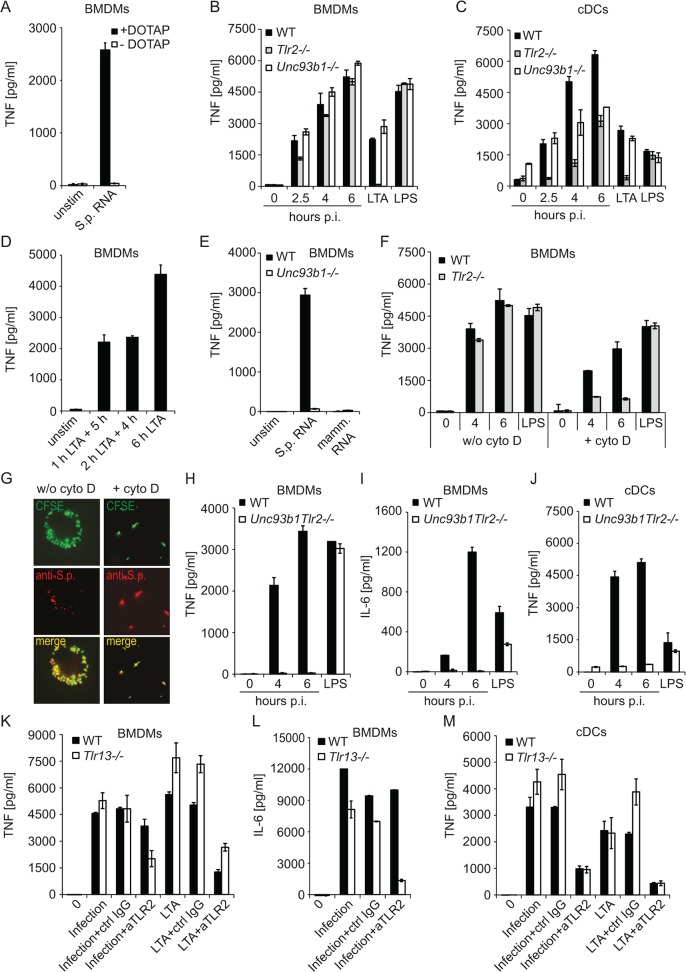
Innate immune recognition of the major human-specific Gram-positive pathogen Streptococcus pyogenes is not understood. Here we show that mice employ Toll-like receptor (TLR) 2- and TLR13-mediated recognition of S. pyogenes. These TLR pathways are non-redundant in the in vivo context of animal infection, but are largely redundant in vitro, as only inactivation of both of them abolishes inflammatory cytokine production by macrophages and dendritic cells infected with S. pyogenes. Mechanistically, S. pyogenes is initially recognized in a phagocytosis-independent manner by TLR2 and subsequently by TLR13 upon internalization. We show that the TLR13 response is specifically triggered by S. pyogenes rRNA and that Tlr13-/- cells respond to S. pyogenes infection solely by engagement of TLR2. TLR13 is absent from humans and, remarkably, we find no equivalent route for S. pyogenes RNA recognition in human macrophages. Phylogenetic analysis reveals that TLR13 occurs in all kingdoms but only in few mammals, including mice and rats, which are naturally resistant against S. pyogenes. Our study establishes that the dissimilar expression of TLR13 in mice and humans has functional consequences for recognition of S. pyogenes in these organisms.
对主要的人类特异性革兰氏阳性病原体化脓性链球菌的天然免疫识别尚不清楚。在此我们表明,小鼠利用Toll样受体(TLR)2和TLR13介导对化脓性链球菌的识别。在动物感染的体内环境中,这些TLR途径并非冗余,但在体外很大程度上是冗余的,因为只有两者都失活才会消除被化脓性链球菌感染的巨噬细胞和树突状细胞产生炎性细胞因子。从机制上讲,化脓性链球菌最初以吞噬作用非依赖性方式被TLR2识别,随后在被内化时被TLR13识别。我们表明,TLR13反应是由化脓性链球菌rRNA特异性触发的,并且Tlr13-/-细胞仅通过TLR2的参与对化脓性链球菌感染作出反应。人类不存在TLR13,而且值得注意的是,我们在人类巨噬细胞中未发现识别化脓性链球菌RNA的等效途径。系统发育分析表明,TLR13存在于所有生物界,但仅在少数哺乳动物中存在,包括对化脓性链球菌天然具有抗性的小鼠和大鼠。我们的研究证实,TLR13在小鼠和人类中的不同表达对这些生物体中化脓性链球菌的识别具有功能影响。