Zhang Hang, Minnich Austin J
Division of Engineering and Applied Science California Institute of Technology Pasadena,CA 91125.
Sci Rep. 2015 Mar 11;5:8995. doi: 10.1038/srep08995.
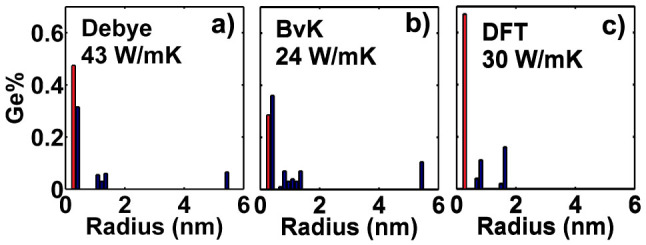
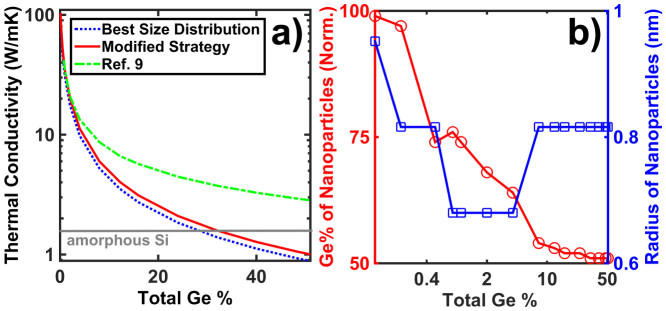
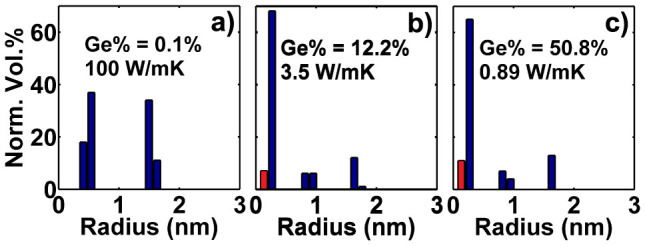
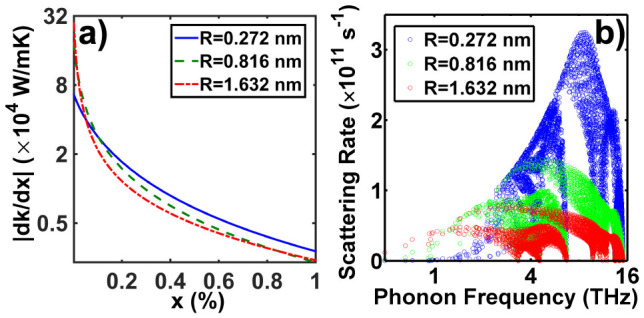
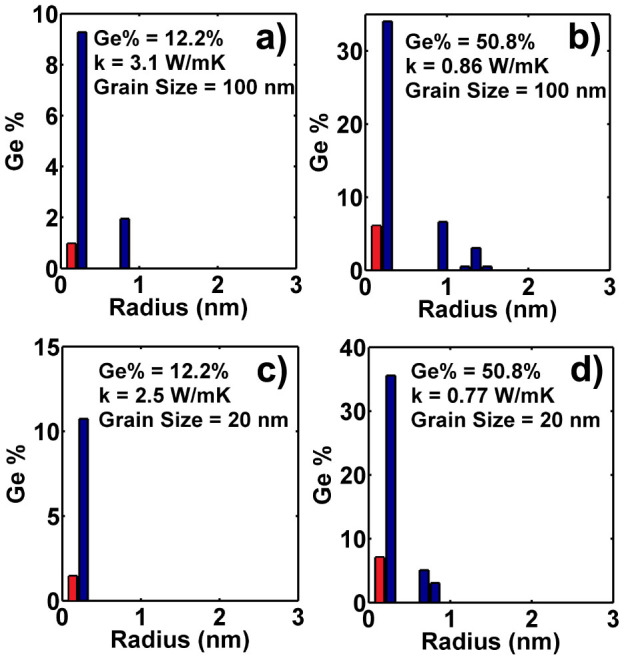
Which sizes of nanoparticles embedded in a crystalline solid yield the lowest thermal conductivity? Nanoparticles have long been demonstrated to reduce the thermal conductivity of crystals by scattering phonons, but most previous works assumed the nanoparticles to have a single size. Here, we use optimization methods to show that the best nanoparticle size distribution to scatter the broad thermal phonon spectrum is not a similarly broad distribution but rather several discrete peaks at well-chosen nanoparticle radii. For SiGe, the best size distribution yields a thermal conductivity below that of amorphous silicon. Further, we demonstrate that a simplified distribution yields nearly the same low thermal conductivity and can be readily fabricated. Our work provides important insights into how to manipulate the full spectrum of phonons and will guide the design of more efficient thermoelectric materials.
嵌入晶体固体中的哪种尺寸的纳米颗粒能产生最低的热导率?长期以来,纳米颗粒已被证明可通过散射声子来降低晶体的热导率,但之前的大多数研究都假定纳米颗粒具有单一尺寸。在此,我们使用优化方法表明,用于散射宽热声子谱的最佳纳米颗粒尺寸分布并非类似的宽分布,而是在精心选择的纳米颗粒半径处出现的几个离散峰。对于硅锗,最佳尺寸分布产生的热导率低于非晶硅。此外,我们证明了一种简化的分布产生的热导率几乎相同且易于制造。我们的工作为如何操控整个声子谱提供了重要见解,并将指导更高效热电材料的设计。