Hehl Adrian B, Basso Walter U, Lippuner Christoph, Ramakrishnan Chandra, Okoniewski Michal, Walker Robert A, Grigg Michael E, Smith Nicholas C, Deplazes Peter
Institute of Parasitology-University of Zurich, Winterthurerstrasse 266a, Zürich, 8057, Switzerland.
Current address: Department of Anaesthesiology and Pain Medicine, Inselspital, University of Bern, Freiburgstrasse, Bern, 3010, Switzerland.
BMC Genomics. 2015 Feb 13;16(1):66. doi: 10.1186/s12864-015-1225-x.
The apicomplexan parasite Toxoplasma gondii is cosmopolitan in nature, largely as a result of its highly flexible life cycle. Felids are its only definitive hosts and a wide range of mammals and birds serve as intermediate hosts. The latent bradyzoite stage is orally infectious in all warm-blooded vertebrates and establishes chronic, transmissible infections. When bradyzoites are ingested by felids, they transform into merozoites in enterocytes and expand asexually as part of their coccidian life cycle. In all other intermediate hosts, however, bradyzoites differentiate exclusively to tachyzoites, and disseminate extraintestinally to many cell types. Both merozoites and tachyzoites undergo rapid asexual population expansion, yet possess different effector fates with respect to the cells and tissues they develop in and the subsequent stages they differentiate into.
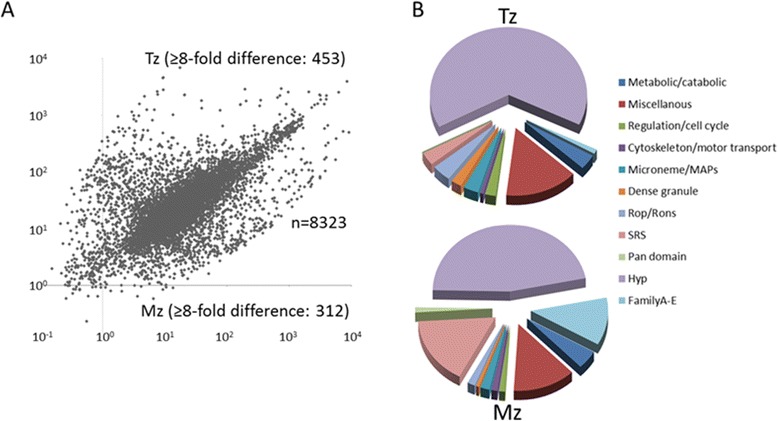
To determine whether merozoites utilize distinct suites of genes to attach, invade, and replicate within feline enterocytes, we performed comparative transcriptional profiling on purified tachyzoites and merozoites. We used high-throughput RNA-Seq to compare the merozoite and tachyzoite transcriptomes. 8323 genes were annotated with sequence reads across the two asexually replicating stages of the parasite life cycle. Metabolism was similar between the two replicating stages. However, significant stage-specific expression differences were measured, with 312 transcripts exclusive to merozoites versus 453 exclusive to tachyzoites. Genes coding for 177 predicted secreted proteins and 64 membrane- associated proteins were annotated as merozoite-specific. The vast majority of known dense-granule (GRA), microneme (MIC), and rhoptry (ROP) genes were not expressed in merozoites. In contrast, a large set of surface proteins (SRS) was expressed exclusively in merozoites.
The distinct expression profiles of merozoites and tachyzoites reveal significant additional complexity within the T. gondii life cycle, demonstrating that merozoites are distinct asexual dividing stages which are uniquely adapted to their niche and biological purpose.
顶复门寄生虫刚地弓形虫在自然界中广泛存在,这主要归因于其高度灵活的生命周期。猫科动物是其唯一的终末宿主,而多种哺乳动物和鸟类作为中间宿主。潜伏的缓殖子阶段对所有温血脊椎动物具有经口传染性,并能建立慢性、可传播的感染。当缓殖子被猫科动物摄入后,它们在肠上皮细胞中转化为裂殖子,并作为其球虫生命周期的一部分进行无性繁殖。然而,在所有其他中间宿主中,缓殖子仅分化为速殖子,并在肠外扩散到多种细胞类型。裂殖子和速殖子都经历快速的无性群体扩张,但在它们发育的细胞和组织以及随后分化的阶段方面具有不同的效应子命运。
为了确定裂殖子是否利用不同的基因组合在猫科动物肠上皮细胞内附着、侵入和复制,我们对纯化的速殖子和裂殖子进行了比较转录谱分析。我们使用高通量RNA测序来比较裂殖子和速殖子的转录组。在寄生虫生命周期的两个无性繁殖阶段,共有8323个基因被序列读取注释。两个繁殖阶段的代谢情况相似。然而,我们检测到了显著的阶段特异性表达差异,其中312个转录本是裂殖子特有的,而453个是速殖子特有的。编码177种预测分泌蛋白和64种膜相关蛋白的基因被注释为裂殖子特异性。绝大多数已知的致密颗粒(GRA)、微线体(MIC)和棒状体(ROP)基因在裂殖子中不表达。相反,一大组表面蛋白(SRS)仅在裂殖子中表达。
裂殖子和速殖子不同的表达谱揭示了刚地弓形虫生命周期内显著的额外复杂性,表明裂殖子是独特的无性分裂阶段,它们独特地适应了其生态位和生物学目的。