Tang Xiao-Fang, Han Ya-Ling, Zhang Jia-Hui, Wang Jing, Zhang Yin, Xu Bo, Gao Zhan, Qiao Shu-Bin, Chen Jue, Wu Yuan, Chen Ji-Lin, Gao Run-Lin, Yang Yue-Jin, Yuan Jin-Qing
Department of Cardiology, Centre for Coronary Heart Disease, State Key Laboratory of Cardiovascular Disease, Fuwai Hospital, National Center for Cardiovascular Diseases, Chinese Academy of Medical Sciences and Peking Union Medical College, Beijing 100037, China.
Chin Med J (Engl). 2015 Mar 20;128(6):774-9. doi: 10.4103/0366-6999.152611.
Several platelet function tests are currently used to measure responsiveness to antiplatelet therapy. This study was to compare two tests, light transmittance aggregometry (LTA) and modified thrombelastography (mTEG), for predicting clinical outcomes in Chinese patients after percutaneous coronary intervention (PCI).
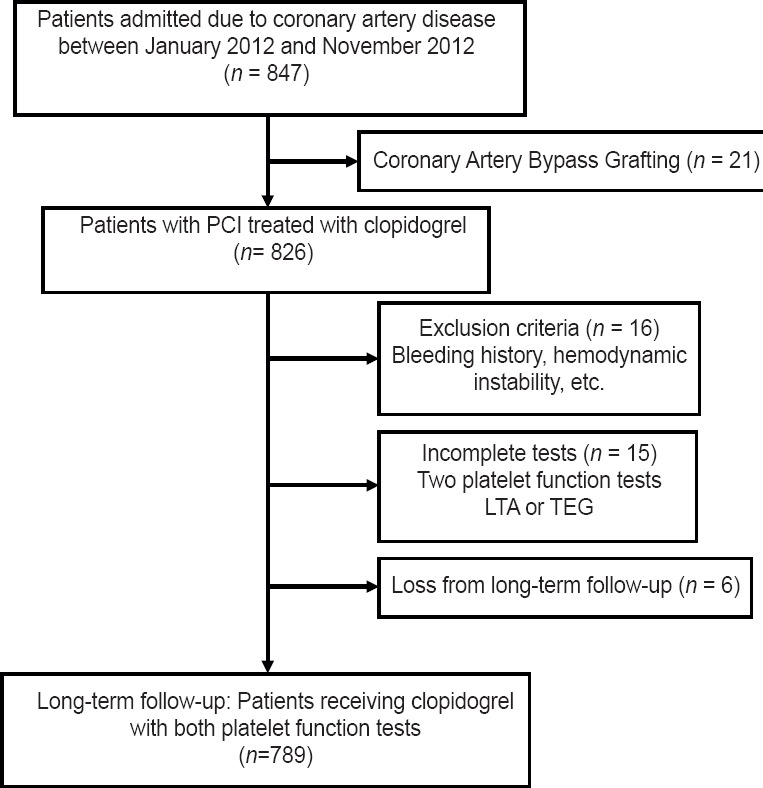
Prospective, observational, single-center study of 789 Chinese patients undergoing PCI was enrolled. This study was investigated the correlations between the two tests and performed receiver operating characteristic curve (ROC) analysis for major adverse cardiovascular events (MACEs) at 1-year follow-up.
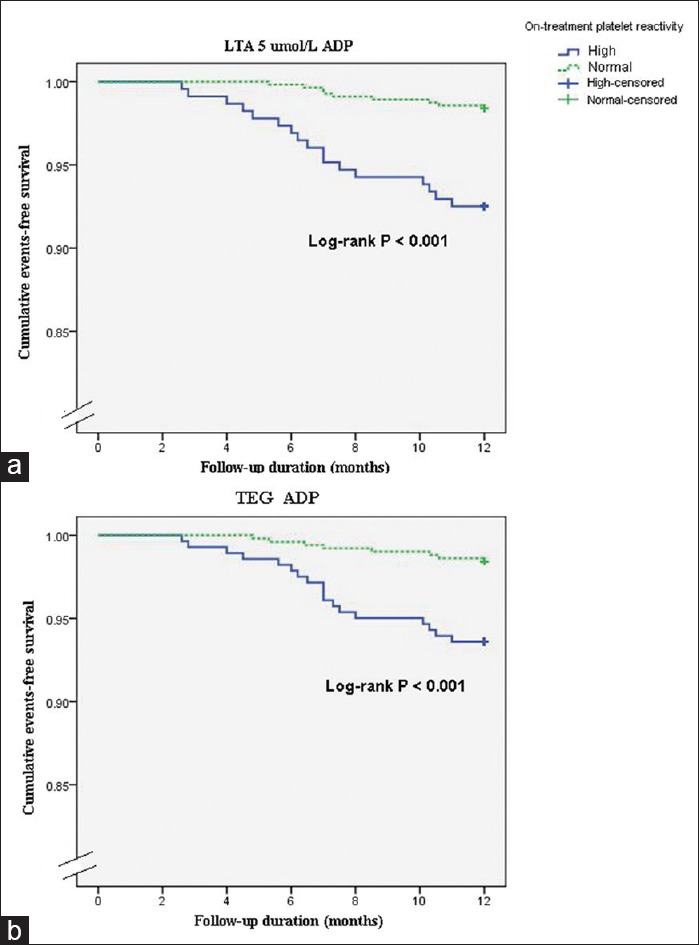
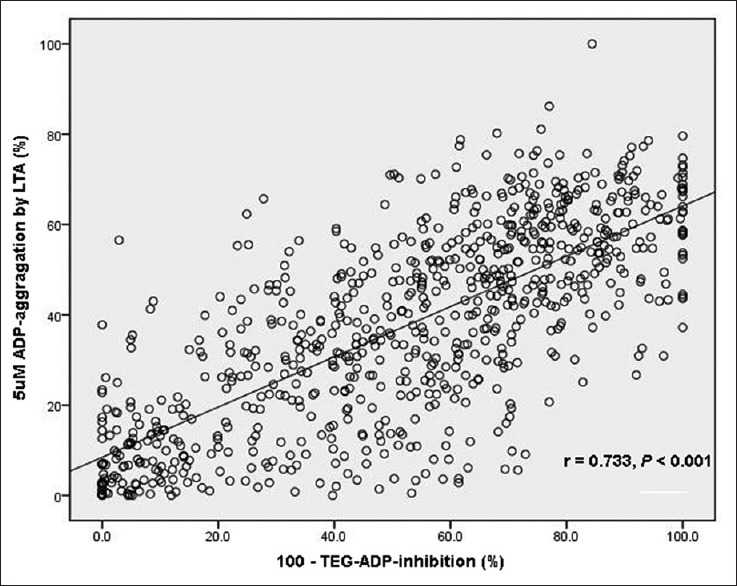
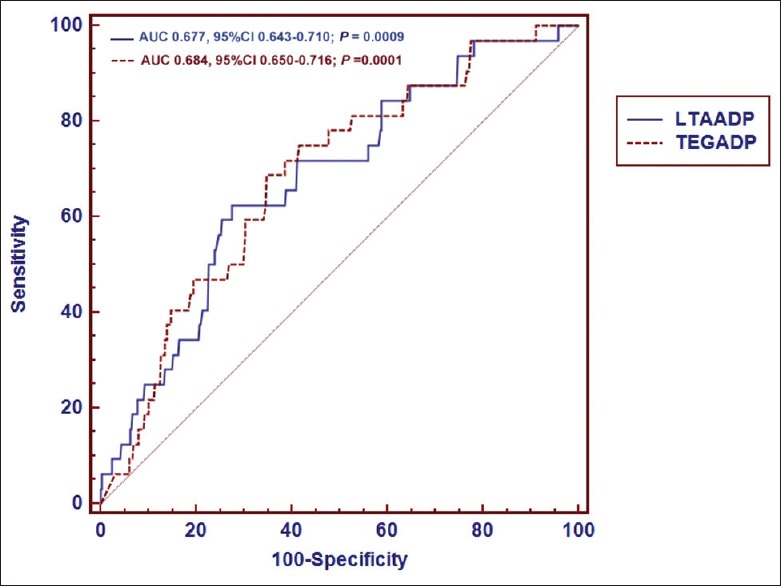
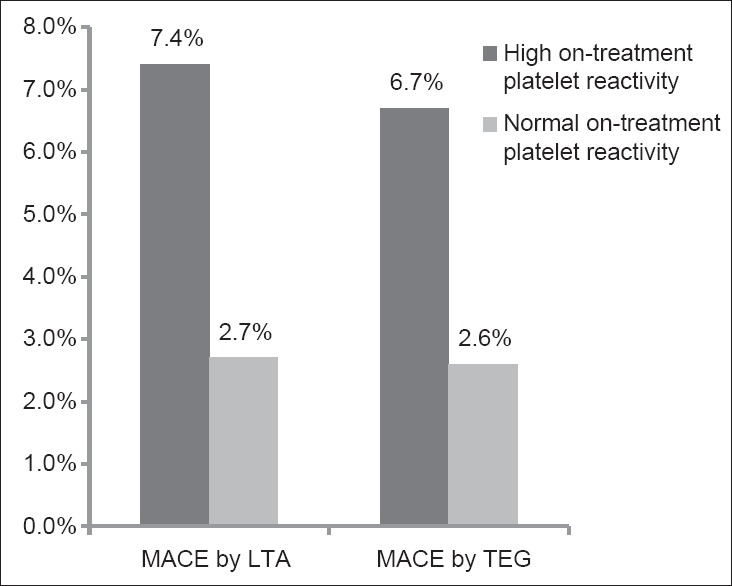
MACEs occurred in 32 patients (4.1%). Correlations were well between the two tests in the adenosine diphosphate induced platelet reactivity (Spearman r = 0.733, P < 0.001). ROC-curve analysis demonstrated that LTA (area under the curve [AUC]: 0.677; 95% confidence interval [CI]: 0.643-0.710; P = 0.0009), and mTEG (AUC: 0.684; 95% CI: 0.650-0.716; P = 0.0001) had moderate ability to discriminate between patients with and without MACE. MACE occurred more frequently in patients with high on-treatment platelet reactivity (HPR) when assessed by LTA (7.4% vs. 2.7%; P < 0.001), and by TEG (6.7% vs. 2.6%; P < 0.001). Kaplan-Meier analysis demonstrated that HPR based on the LTA and mTEG was associated with almost 3-fold increased risk of MACE at 1-year follow-up.
The correlation between LTA and mTEG is relatively high in Chinese patients. HPR measured by LTA and mTEG were significantly associated with MACE in Chinese patients undergoing PCI.
目前有几种血小板功能测试用于测量对抗血小板治疗的反应性。本研究旨在比较透光率聚集法(LTA)和改良血栓弹力图(mTEG)这两种测试方法,以预测中国患者经皮冠状动脉介入治疗(PCI)后的临床结局。
对789例接受PCI的中国患者进行前瞻性、观察性、单中心研究。本研究调查了这两种测试之间的相关性,并对1年随访时的主要不良心血管事件(MACE)进行了受试者操作特征曲线(ROC)分析。
32例患者(4.1%)发生了MACE。在二磷酸腺苷诱导的血小板反应性方面,两种测试之间的相关性良好(Spearman r = 0.733,P < 0.001)。ROC曲线分析表明,LTA(曲线下面积[AUC]:0.677;95%置信区间[CI]:0.643 - 0.710;P = 0.0)和mTEG(AUC:0.684;95% CI:0.650 - 0.716;P = 0.0001)在区分有和没有MACE的患者方面具有中等能力。当通过LTA评估时,高治疗期血小板反应性(HPR)患者发生MACE的频率更高(7.4%对2.7%;P < 0.001),通过TEG评估时也是如此(6.7%对2.6%;P < 0.001)。Kaplan - Meier分析表明,基于LTA和mTEG的HPR与1年随访时MACE风险增加近3倍相关。
在中国患者中,LTA和mTEG之间的相关性相对较高。通过LTA和mTEG测量的HPR与接受PCI的中国患者的MACE显著相关。