MacIntyre David A, Chandiramani Manju, Lee Yun S, Kindinger Lindsay, Smith Ann, Angelopoulos Nicos, Lehne Benjamin, Arulkumaran Shankari, Brown Richard, Teoh Tiong Ghee, Holmes Elaine, Nicoholson Jeremy K, Marchesi Julian R, Bennett Phillip R
Imperial College Parturition Research Group, Division of the Institute of Reproduction and Developmental Biology, Imperial College London, UK.
School of Biosciences, Cardiff University, UK.
Sci Rep. 2015 Mar 11;5:8988. doi: 10.1038/srep08988.
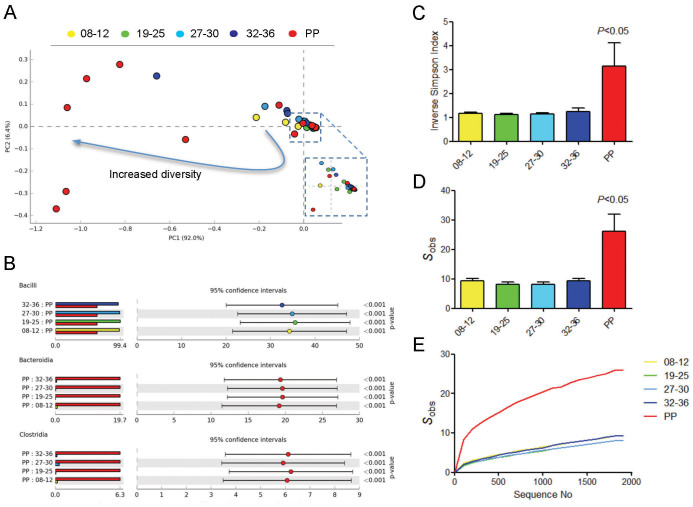
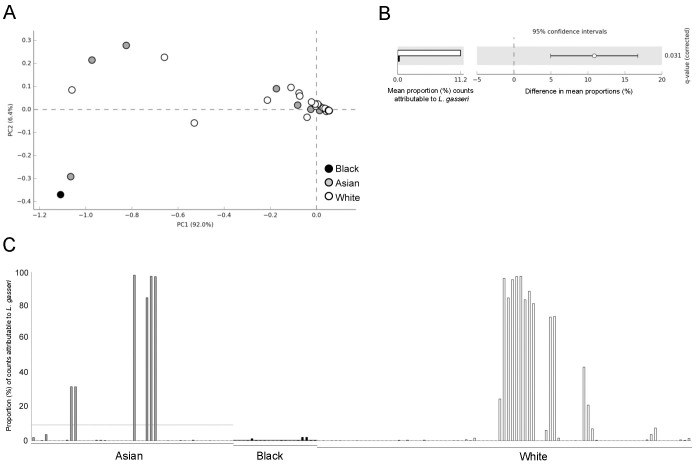
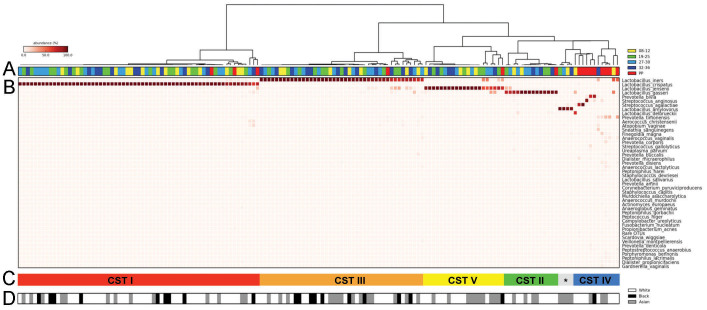
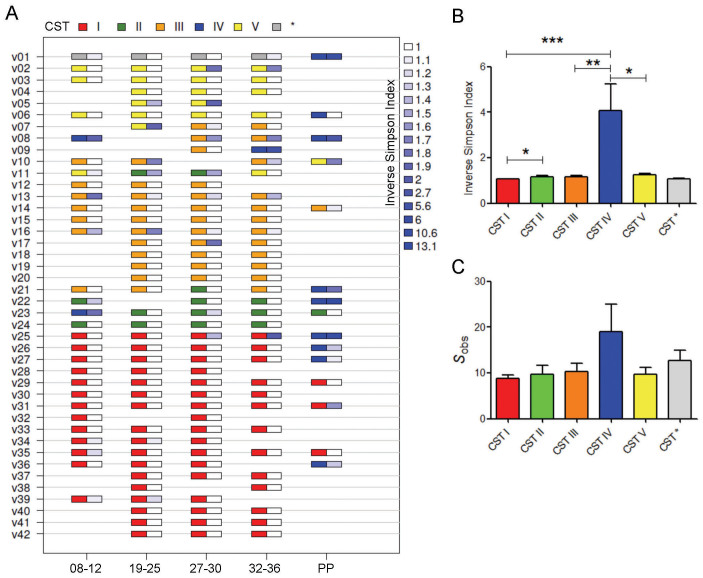
The composition and structure of the pregnancy vaginal microbiome may influence susceptibility to adverse pregnancy outcomes. Studies on the pregnant vaginal microbiome have largely been limited to Northern American populations. Using MiSeq sequencing of 16S rRNA gene amplicons, we characterised the vaginal microbiota of a mixed British cohort of women (n = 42) who experienced uncomplicated term delivery and who were sampled longitudinally throughout pregnancy (8-12, 20-22, 28-30 and 34-36 weeks gestation) and 6 weeks postpartum. We show that vaginal microbiome composition dramatically changes postpartum to become less Lactobacillus spp. dominant with increased alpha-diversity irrespective of the community structure during pregnancy and independent of ethnicity. While the pregnancy vaginal microbiome was characteristically dominated by Lactobacillus spp. and low alpha-diversity, unlike Northern American populations, a significant number of pregnant women this British population had a L. jensenii-dominated microbiome characterised by low alpha-diversity. L. jensenii was predominantly observed in women of Asian and Caucasian ethnicity whereas L. gasseri was absent in samples from Black women. This study reveals new insights into biogeographical and ethnic effects upon the pregnancy and postpartum vaginal microbiome and has important implications for future studies exploring relationships between the vaginal microbiome, host health and pregnancy outcomes.
孕期阴道微生物群的组成和结构可能会影响不良妊娠结局的易感性。关于孕期阴道微生物群的研究主要局限于北美人群。我们使用16S rRNA基因扩增子的MiSeq测序,对一组英国混合队列女性(n = 42)的阴道微生物群进行了特征分析,这些女性经历了无并发症的足月分娩,并在整个孕期(妊娠8 - 12周、20 - 22周、28 - 30周和34 - 36周)以及产后6周进行了纵向采样。我们发现,产后阴道微生物群组成发生显著变化,乳酸杆菌属的优势减弱,α多样性增加,这与孕期的群落结构无关,也与种族无关。虽然孕期阴道微生物群通常以乳酸杆菌属为主且α多样性较低,但与北美人群不同的是,在这组英国人群中,有相当数量的孕妇其微生物群以詹氏乳酸杆菌为主,α多样性较低。詹氏乳酸杆菌主要在亚洲和白种族女性中观察到,而在黑人女性的样本中未检测到加氏乳酸杆菌。这项研究揭示了生物地理学和种族对孕期及产后阴道微生物群的影响的新见解,对未来探索阴道微生物群、宿主健康和妊娠结局之间关系的研究具有重要意义。