Shikino Kiyoshi, Ikusaka Masatomi, Ohira Yoshiyuki, Miyahara Masahito, Suzuki Shingo, Hirukawa Misa, Noda Kazutaka, Tsukamoto Tomoko, Uehara Takanori
Department of General Medicine, Chiba University Hospital, Chiba, Chiba Prefecture, Japan.
Adv Med Educ Pract. 2015 Feb 20;6:143-8. doi: 10.2147/AMEP.S77315. eCollection 2015.
This study aimed to clarify the influence of predicting a correct diagnosis from the history on physical examination by comparing the diagnostic accuracy of auscultation with and without clinical information.
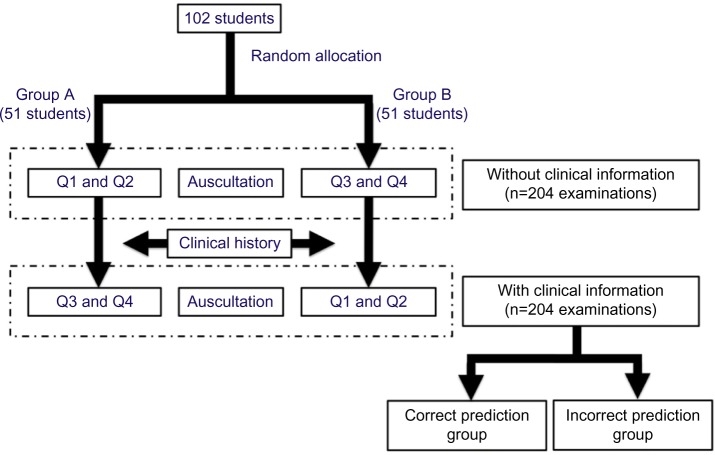
The participants were 102 medical students from the 2013 clinical clerkship course. Auscultation was performed with a cardiology patient simulator. Participants were randomly assigned to two groups. Each group listened to a different simulated heart murmur and then made a diagnosis without clinical information. Next, a history suggesting a different murmur was provided to each group and they predicted the diagnosis. Finally, the students listened to a murmur corresponding to the history provided and again made a diagnosis. Correct and incorrect diagnosis rates of auscultation were compared between students with and without clinical information, between students predicting a correct or incorrect diagnosis from the history (correct and incorrect prediction groups, respectively), and between students without clinical information and those making an incorrect prediction.
For auscultation with or without clinical information, the correct diagnosis rate was 62.7% (128/204 participants) versus 54.4% (111/204 participants), showing no significant difference (P=0.09). After receiving clinical information, a correct diagnosis was made by 102/117 students (87.2%) in the correct prediction group versus 26/87 students (29.9%) in the incorrect prediction group, showing a significant difference (P=0.006). The correct diagnosis rate was also significantly lower in the incorrect prediction group than when the students performed auscultation without clinical information (54.4% versus 29.9%, P<0.001).
Obtaining a history alone does not improve the diagnostic accuracy of physical examination. However, accurately predicting the diagnosis from the history is associated with higher diagnostic accuracy of physical examination, while incorrect prediction is associated with lower diagnostic accuracy of examination.
本研究旨在通过比较有无临床信息时听诊的诊断准确性,阐明根据病史预测正确诊断对体格检查的影响。
参与者为2013年临床实习课程的102名医学生。使用心脏病患者模拟器进行听诊。参与者被随机分为两组。每组听取不同的模拟心脏杂音,然后在无临床信息的情况下进行诊断。接下来,为每组提供提示不同杂音的病史,他们据此预测诊断。最后,学生们听取与所提供病史对应的杂音并再次进行诊断。比较有无临床信息的学生之间、根据病史预测正确或错误诊断的学生之间(分别为正确和错误预测组)以及无临床信息和做出错误预测的学生之间听诊的正确和错误诊断率。
对于有无临床信息的听诊,正确诊断率分别为62.7%(128/204名参与者)和54.4%(111/204名参与者),差异无统计学意义(P = 0.09)。在获得临床信息后,正确预测组的102/117名学生(87.2%)做出了正确诊断,而错误预测组的26/87名学生(29.9%)做出了正确诊断,差异有统计学意义(P = 0.006)。错误预测组的正确诊断率也显著低于学生在无临床信息时进行听诊的情况(54.4%对29.9%,P < 0.001)。
仅获取病史并不能提高体格检查的诊断准确性。然而,根据病史准确预测诊断与更高的体格检查诊断准确性相关,而错误预测则与更低的检查诊断准确性相关。