Department of Cell Biology and Histology, Academic Medical Center, University of Amsterdam , Amsterdam , Netherlands.
Department of Clinical Immunology and Rheumatology, Academic Medical Center, University of Amsterdam , Amsterdam , Netherlands.
Front Immunol. 2015 Feb 24;6:79. doi: 10.3389/fimmu.2015.00079. eCollection 2015.
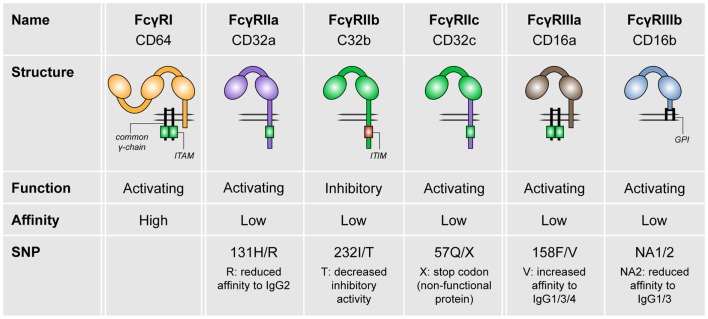
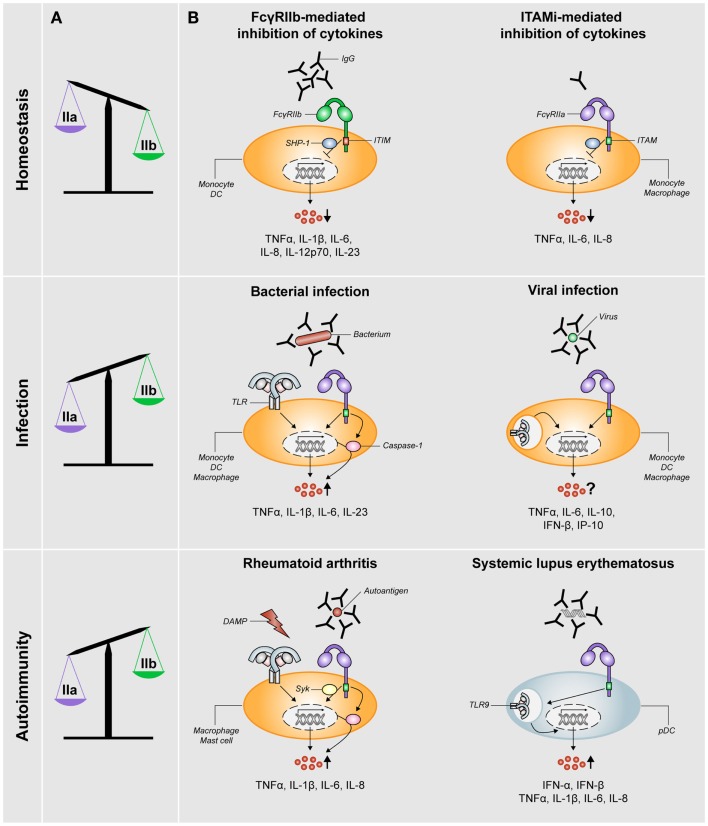
Control of cytokine production by immune cells is pivotal for counteracting infections via orchestration of local and systemic inflammation. Although their contribution has long been underexposed, it has recently become clear that human Fc gamma receptors (FcγRs), which are receptors for the Fc region of immunoglobulin G (IgG) antibodies, play a critical role in this process by controlling tissue- and pathogen-specific cytokine production. Whereas individual stimulation of FcγRs does not evoke cytokine production, FcγRs cell-type specifically interact with various other receptors for selective amplification or inhibition of particular cytokines, thereby tailoring cytokine responses to the immunological context. The physiological function of FcγR-mediated control of cytokine production is to counteract infections with various classes of pathogens. Upon IgG opsonization, pathogens are simultaneously recognized by FcγRs as well as by various pathogen-sensing receptors, leading to the induction of pathogen class-specific immune responses. However, when erroneously activated, the same mechanism also contributes to the development of autoimmune diseases such as rheumatoid arthritis and systemic lupus erythematosus. In this review, we discuss control of cytokine production as a novel function of FcγRs in human innate immune cells in the context of homeostasis, infection, and autoimmunity and address the possibilities for future therapeutic exploitation.
免疫细胞中细胞因子的产生控制对于通过局部和全身炎症的协调来对抗感染至关重要。尽管它们的作用长期以来一直被低估,但最近已经清楚的是,人类 Fc γ受体(FcγR)作为免疫球蛋白 G(IgG)抗体 Fc 区的受体,通过控制组织和病原体特异性细胞因子的产生,在这个过程中发挥着关键作用。虽然单独刺激 FcγR 不会引起细胞因子的产生,但 FcγR 细胞类型特异性地与各种其他受体相互作用,以选择性地放大或抑制特定的细胞因子,从而根据免疫背景调整细胞因子反应。FcγR 介导的细胞因子产生控制的生理功能是抵抗各种病原体类别的感染。在 IgG 调理后,病原体同时被 FcγR 以及各种病原体感应受体识别,导致诱导病原体类别特异性免疫反应。然而,当错误激活时,同一机制也有助于类风湿关节炎和系统性红斑狼疮等自身免疫性疾病的发展。在这篇综述中,我们讨论了 FcγR 在人类先天免疫细胞中作为细胞因子产生控制的新功能,讨论了在稳态、感染和自身免疫中的作用,并探讨了未来治疗利用的可能性。