Wang Rui, Li Yumei, Hou Yueyue, Yang Qingling, Chen Sulian, Wang Xi, Wang Zishu, Yang Yan, Chen Changjie, Wang Zhiwei, Wu Qiong
Department of Medical Oncology, First Affiliated Hospital of Bengbu Medical College, Bengbu, Anhui, China.
Department of Biochemistry and Molecular Biology, Bengbu Medical College, Anhui, China.
Oncotarget. 2015 Mar 30;6(9):7000-10. doi: 10.18632/oncotarget.3193.
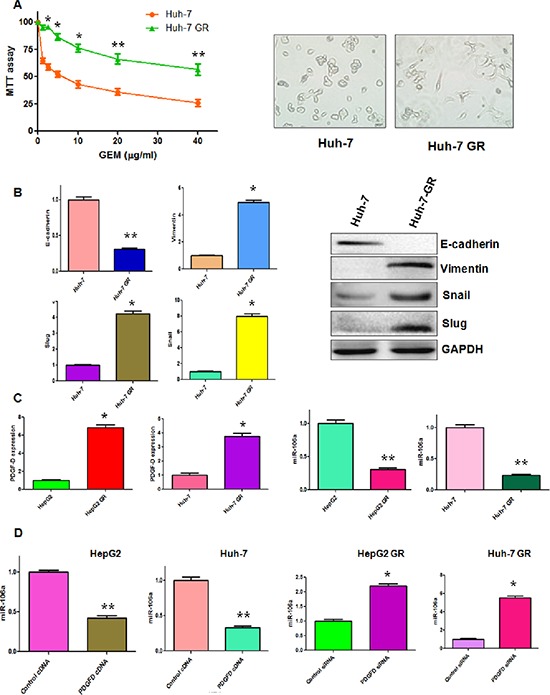
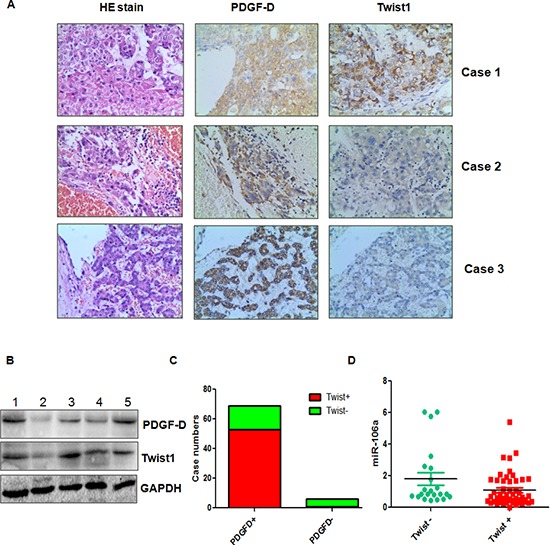
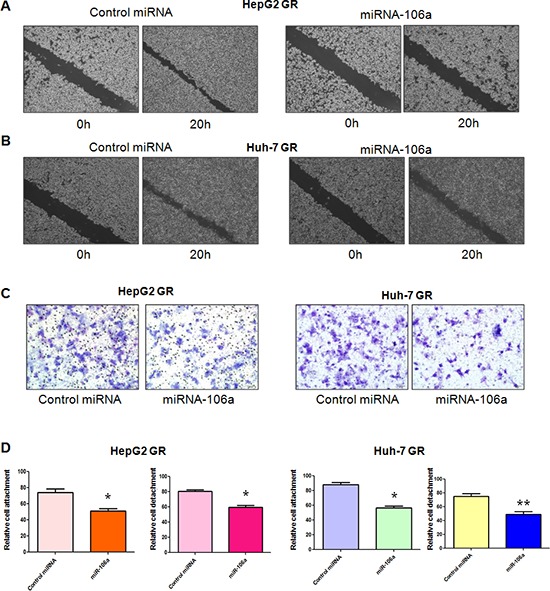
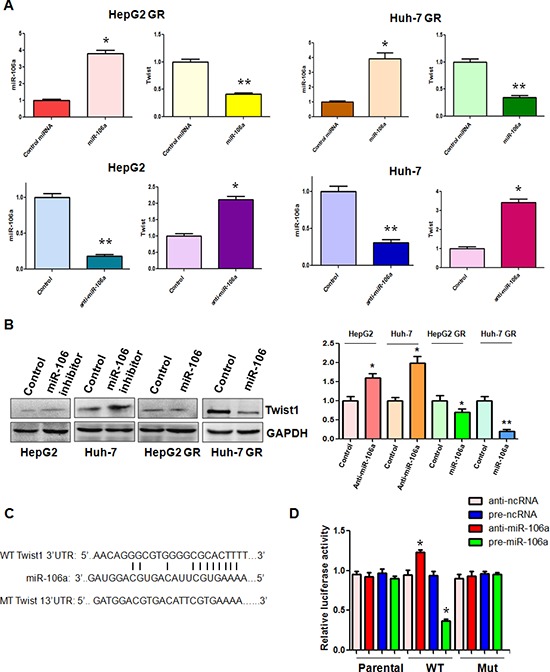
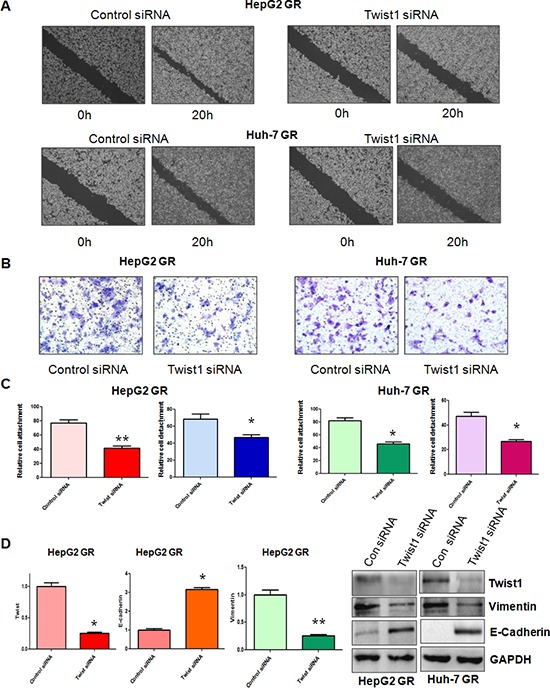
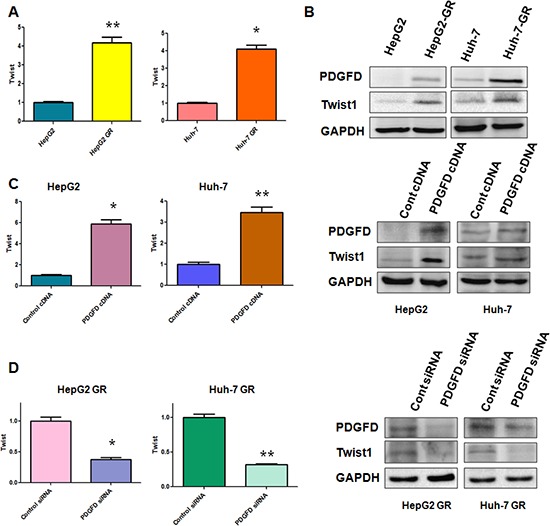
Emerging evidence demonstrates that platelet-derived growth factor-D (PDGF-D) plays a critical role in epithelial-mesenchymal transition (EMT) and drug resistance in hepatocellular carcinoma (HCC) cells. However, the underlying mechanism has not been fully elucidated. The objective is to explore the molecular mechanism of PDGF-D-mediated EMT in drug resistance HCC cells. To achieve our goal, we used multiple approaches including Western blotting, real-time RT-PCR, wound healing assay, invasion assay, luciferase activity assay, transfection, and immunohistochemistry. We found that PDGF-D is highly expressed in gemcitabine-resistant (GR) HCC cells. Moreover, PDGF-D markedly inhibited miR-106a expression and subsequently upregulated Twist1 expression. Notably, PDGF-D expression was associated with miR-106a and Twist1 in HCC patients. Our findings provide a possible molecular mechanism for understanding GR chemoresistance in HCC cells. Therefore, inactivation of PDGF-D/Twist or activation of miR-106a could be a novel strategy for the treatment of HCC.
新出现的证据表明,血小板衍生生长因子-D(PDGF-D)在肝细胞癌(HCC)细胞的上皮-间质转化(EMT)和耐药性中起关键作用。然而,其潜在机制尚未完全阐明。目的是探讨PDGF-D介导的EMT在耐药性HCC细胞中的分子机制。为实现我们的目标,我们使用了多种方法,包括蛋白质免疫印迹法、实时逆转录-聚合酶链反应、伤口愈合试验、侵袭试验、荧光素酶活性测定、转染和免疫组织化学。我们发现,PDGF-D在吉西他滨耐药(GR)HCC细胞中高表达。此外,PDGF-D显著抑制miR-106a表达,随后上调Twist1表达。值得注意的是,在HCC患者中,PDGF-D表达与miR-106a和Twist1相关。我们的研究结果为理解HCC细胞中的GR化疗耐药性提供了一种可能的分子机制。因此,使PDGF-D/Twist失活或激活miR-106a可能是治疗HCC的一种新策略。