Department of Anatomy and Neurobiology, Central South University School of Basic Medical Science Changsha, China ; Department of Neurology, The First Hospital of Changsha Changsha, China.
Department of Anatomy and Neurobiology, Central South University School of Basic Medical Science Changsha, China ; School of Nursing, Xiangtan Vocational and Technical College Xiangtan, China.
Front Neuroanat. 2015 Feb 16;9:11. doi: 10.3389/fnana.2015.00011. eCollection 2015.
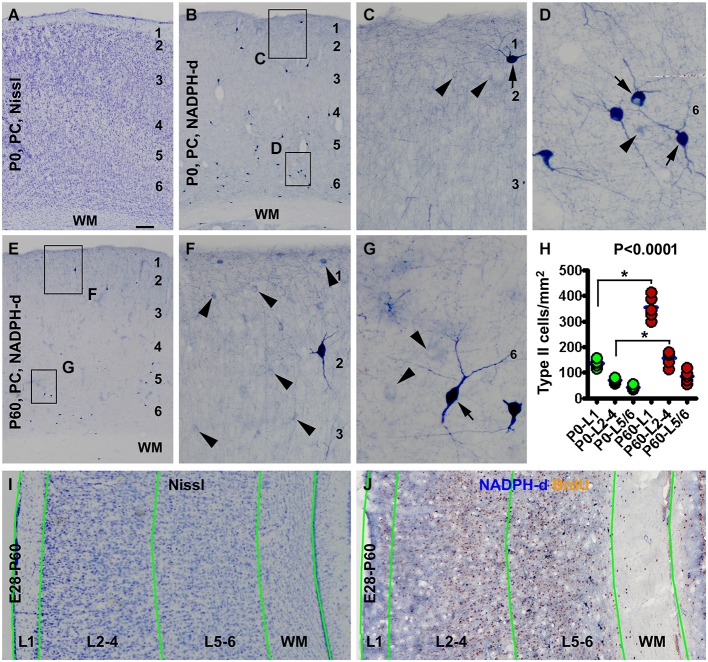
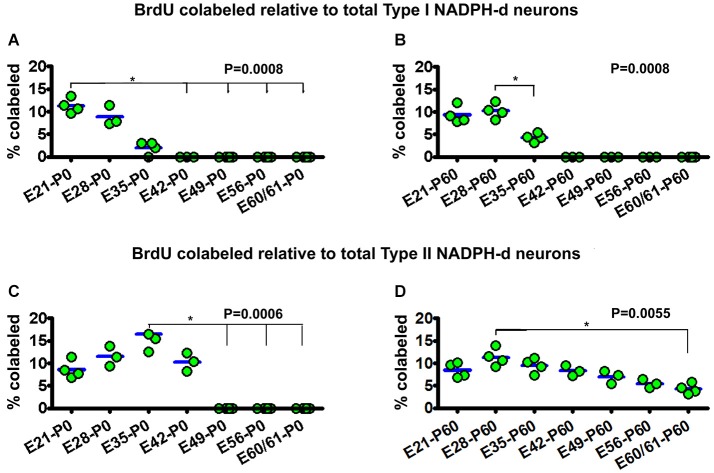
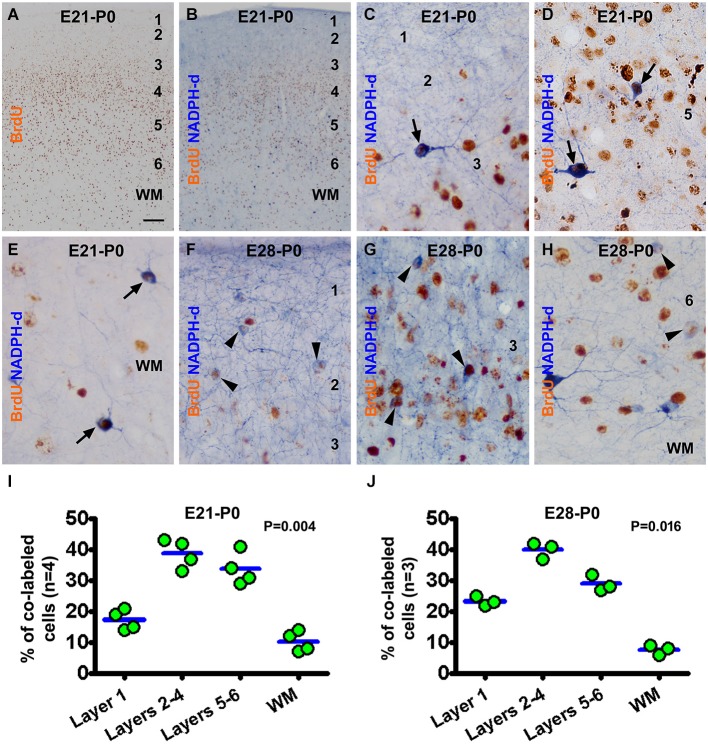
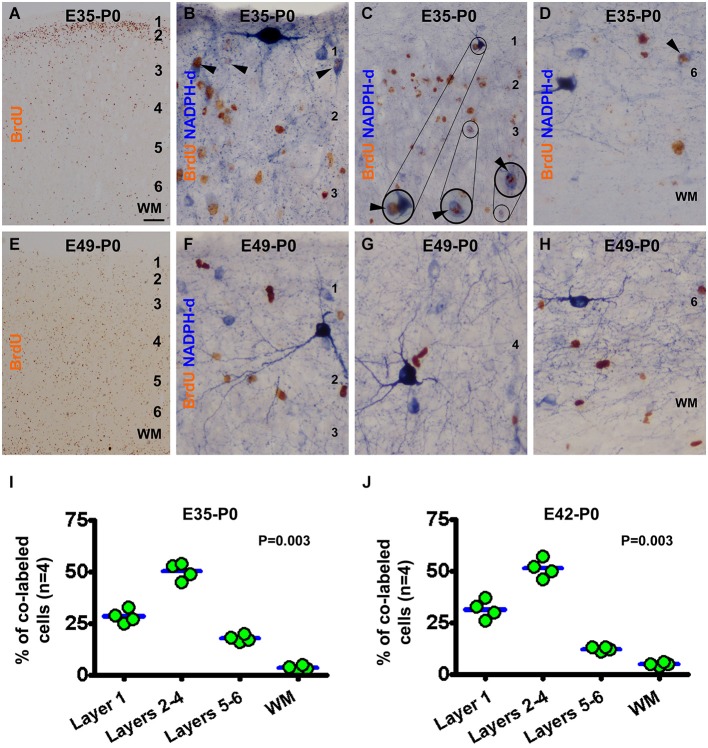
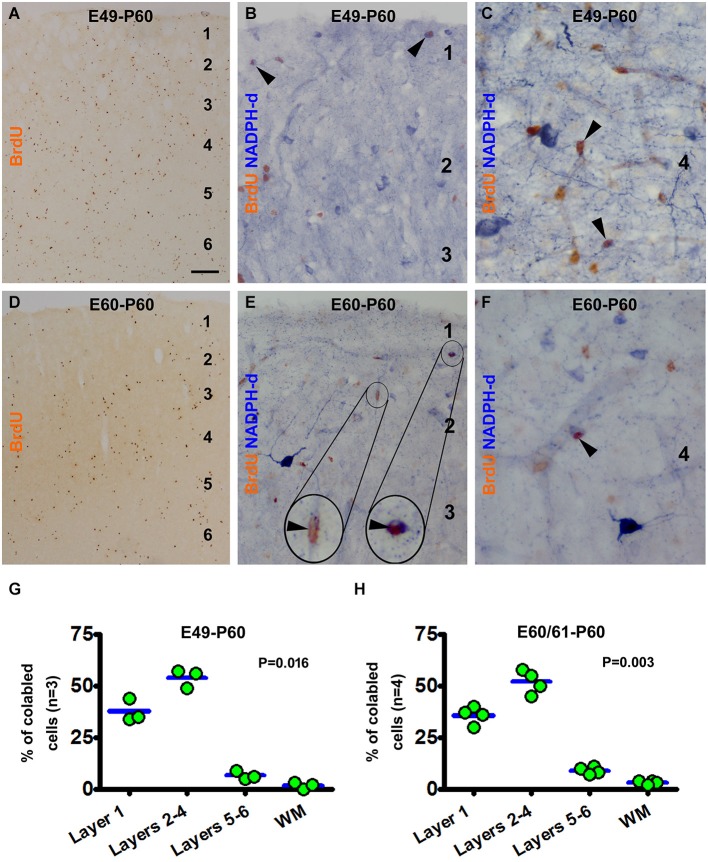
In mammalian cerebrum there exist two distinct types of interneurons expressing nitric oxide synthase (NOS). Type I neurons are large in size and exhibit heavy nicotinamide adenine dinucleotide phosphate diaphorase (NADPH-d) histochemical reaction, while type II cells are small with light NADPH-d reactivity. The time of origin of these cortical neurons relative to corticogenesis remains largely unclear among mammals. Here we explored this issue in guinea pigs using cell birth-dating and double-labeling methods. Bromodeoxyuridine (BrdU) pulse-chasing (2 doses at 50 mg/kg, 12 h apart) was given to time-pregnant mothers, followed by quantification of NADPH-d/BrdU colocalization in the parietal and temporal neocortex in offspring at postnatal day 0 (P0), P30 and P60. Type I neurons were partially colabeled with BrdU at P0, P30 and P60 following pulse-chasing at embryonic day 21 (E21), E28 and E35, varied from 2-11.3% of total population of these neurons for the three time groups. Type II neurons were partially colabeled for BrdU following pulse-chasing at E21, E28, E35 and E42 at P0 (8.6%-16.5% of total population for individual time groups). At P60, type II neurons were found to co-express BrdU (4.8-11.3% of total population for individual time groups) following pulse-chasing at E21, E28, E35, E42, E49, E56 and E60/61. These results indicate that in guinea pigs type I neurons are generated during early corticogenesis, whereas type II cells are produced over a wide prenatal time window persisting until birth. The data also suggest that type II nitrinergic neurons may undergo a period of development/differentiation, for over 1 month, before being NADPH-d reactive.
在哺乳动物大脑中存在两种表达一氧化氮合酶 (NOS) 的不同类型的中间神经元。I 型神经元体积较大,呈现强烈的烟酰胺腺嘌呤二核苷酸磷酸脱氢酶 (NADPH-d) 组织化学反应,而 II 型细胞体积较小,NADPH-d 反应较弱。这些皮质神经元相对于皮质发生的起源时间在哺乳动物中仍然很大程度上不清楚。在这里,我们使用细胞出生标记和双重标记方法在豚鼠中探索了这个问题。将溴脱氧尿苷 (BrdU) 脉冲追踪(2 次剂量为 50mg/kg,间隔 12 小时)给予处于妊娠中期的母亲,然后在后代出生后第 0 天(P0)、第 30 天(P30)和第 60 天(P60)时定量分析顶叶和颞叶新皮质中 NADPH-d/BrdU 的共定位。在胚胎第 21 天(E21)、E28 和 E35 进行脉冲追踪后,I 型神经元在 P0、P30 和 P60 时部分与 BrdU 共标记,占这些神经元总数的 2-11.3%。在 P0 时,在 E21、E28、E35 和 E42 进行脉冲追踪后,II 型神经元部分与 BrdU 共标记,占各时间组神经元总数的 8.6%-16.5%。在 P60 时,发现 II 型神经元在 E21、E28、E35、E42、E49、E56 和 E60/61 进行脉冲追踪后共表达 BrdU(各时间组神经元总数的 4.8-11.3%)。这些结果表明,在豚鼠中,I 型神经元在皮质发生早期产生,而 II 型细胞在出生前的广泛时间窗口中产生,持续到出生后。该数据还表明,II 型亚硝酰合酶能神经元可能在 NADPH-d 反应之前经历一个月以上的发育/分化期。