Kim Jaeuk U, Lee Yu Jung, Lee Jeon, Kim Jong Yeol
Medical Engineering R&D Group, Korea Institute of Oriental Medicine, Daejeon 305-811, Republic of Korea.
Medical Engineering R&D Group, Korea Institute of Oriental Medicine, Daejeon 305-811, Republic of Korea ; Johns Hopkins University School of Medicine, Baltimore, MD 21205-2196, USA.
Evid Based Complement Alternat Med. 2015;2015:381634. doi: 10.1155/2015/381634. Epub 2015 Feb 11.
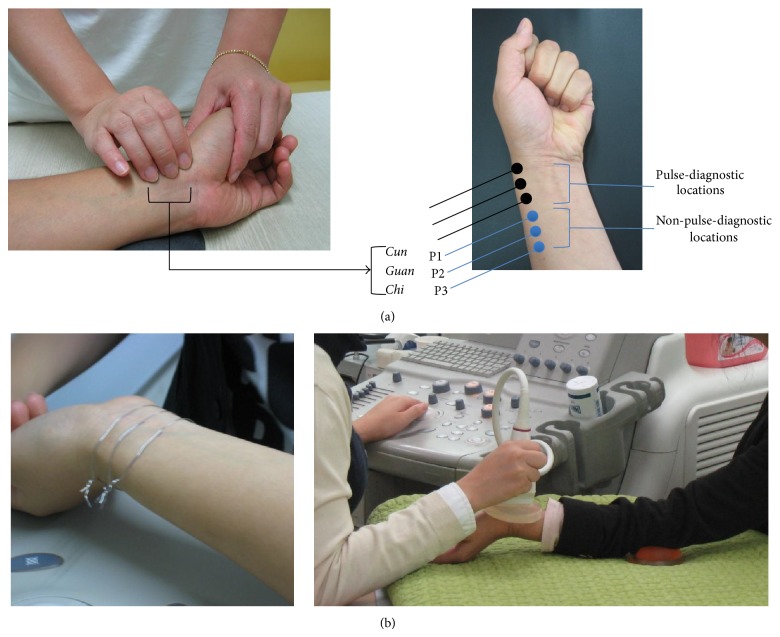
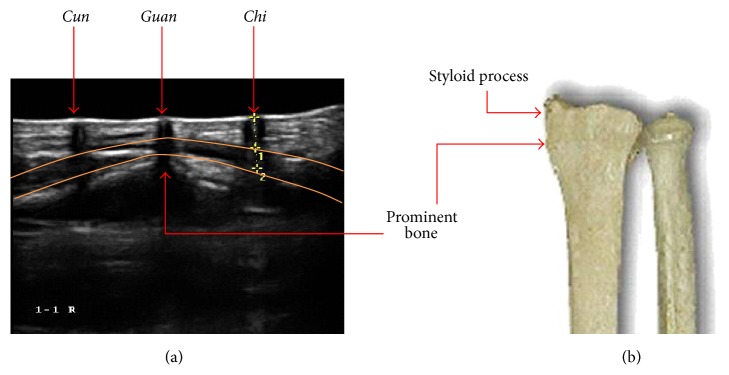
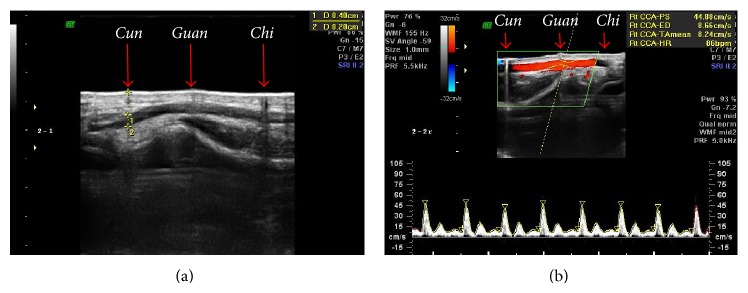
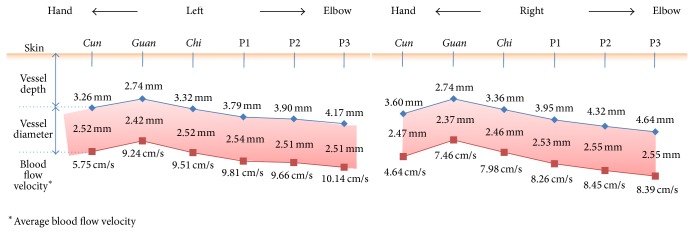
Aim of the Study. The three conventional pulse-diagnostic palpation locations (PLs) on both wrists are Cun, Guan, and Chi, and each location reveals different clinical information. To identify anatomical or hemodynamic specificity, we used ultrasonographic imaging to determine the arterial diameter, radial artery depth, and arterial blood flow velocity at the three PLs and at nearby non-PL segments. Methods. We applied an ultrasound scanner to 44 subjects and studied the changes in the arterial diameter and depth as well as in the average/maximum blood flow velocities along the radial artery at three PLs and three non-PLs located more proximally than Chi. Results. All of the measurements at all of the PLs were significantly different (P < 0.01). Artery depth was significantly different among the non-PLs; however, this difference became insignificant after normalization to the arm circumference. Conclusions. Substantial changes in the hemodynamic and anatomical properties of the radial artery around the three PLs were insignificant at the nearby non-PLs segments. This finding may provide a partial explanation for the diagnostic use of "Cun, Guan, and Chi.".
研究目的。手腕两侧的三个传统脉诊触诊部位(PLs)为寸、关、尺,每个部位揭示不同的临床信息。为了确定解剖学或血流动力学特异性,我们使用超声成像来测定三个脉诊部位及附近非脉诊部位段的动脉直径、桡动脉深度和动脉血流速度。方法。我们对44名受试者应用超声扫描仪,研究三个脉诊部位以及位于尺部近端的三个非脉诊部位处桡动脉的动脉直径、深度以及平均/最大血流速度的变化。结果。所有脉诊部位的所有测量值均有显著差异(P < 0.01)。非脉诊部位之间的动脉深度有显著差异;然而,在根据臂围进行标准化后,这种差异变得不显著。结论。三个脉诊部位周围桡动脉的血流动力学和解剖学特性的显著变化在附近的非脉诊部位段并不明显。这一发现可能为“寸、关、尺”的诊断应用提供部分解释。