Biosciences Division, Oak Ridge National Laboratory, Oak Ridge, TN 37830 USA ; BioEnergy Science Center, Oak Ridge National Laboratory, Oak Ridge, TN 37830 USA ; Current address: Centre for Rural Development and Technology, Indian Institute of Technology Delhi, Hauz Khas, New Delhi, 110016 India.
BioEnergy Science Center, Oak Ridge National Laboratory, Oak Ridge, TN 37830 USA ; Thayer School of Engineering at Dartmouth College, Hanover, NH 03755 USA.
Biotechnol Biofuels. 2015 Feb 12;8:20. doi: 10.1186/s13068-015-0204-4. eCollection 2015.
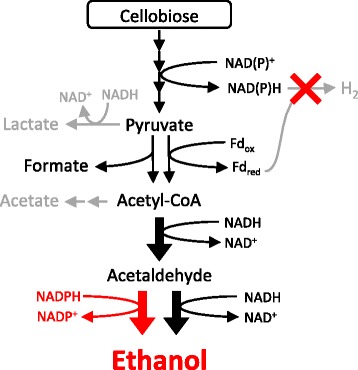
The native ability of Clostridium thermocellum to rapidly consume cellulose and produce ethanol makes it a leading candidate for a consolidated bioprocessing (CBP) biofuel production strategy. C. thermocellum also synthesizes lactate, formate, acetate, H2, and amino acids that compete with ethanol production for carbon and electrons. Elimination of H2 production could redirect carbon flux towards ethanol production by making more electrons available for acetyl coenzyme A reduction to ethanol.
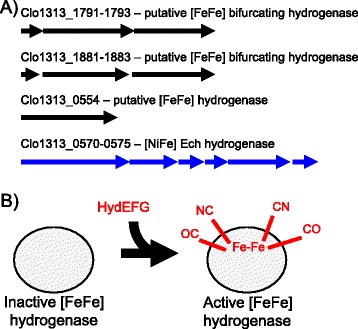
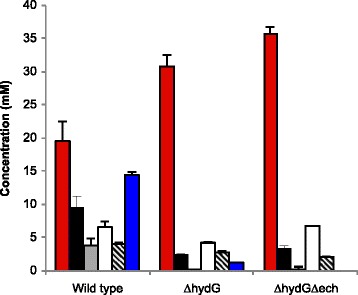
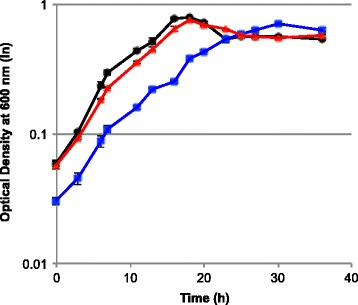
H2 production in C. thermocellum is encoded by four hydrogenases. Rather than delete each individually, we targeted hydrogenase maturase gene hydG, involved in converting the three [FeFe] hydrogenase apoenzymes into holoenzymes. Further deletion of the [NiFe] hydrogenase (ech) resulted in a mutant that functionally lacks all four hydrogenases. H2 production in ∆hydG∆ech was undetectable, and the ethanol yield nearly doubled to 64% of the maximum theoretical yield. Genomic analysis of ∆hydG revealed a mutation in adhE, resulting in a strain with both NADH- and NADPH-dependent alcohol dehydrogenase activities. While this same adhE mutation was found in ethanol-tolerant C. thermocellum strain E50C, ∆hydG and ∆hydG∆ech are not more ethanol tolerant than the wild type, illustrating the complicated interactions between redox balancing and ethanol tolerance in C. thermocellum.
The dramatic increase in ethanol production suggests that targeting protein post-translational modification is a promising new approach for simultaneous inactivation of multiple enzymes.
嗜热梭菌具有快速消耗纤维素并生产乙醇的固有能力,使其成为整合生物加工(CBP)生物燃料生产策略的首选。嗜热梭菌还合成乳酸盐、甲酸盐、乙酸盐、H2 和与乙醇生产竞争碳和电子的氨基酸。消除 H2 的产生可以通过为乙酰辅酶 A 还原为乙醇提供更多的电子,从而将碳通量重新定向到乙醇生产。
嗜热梭菌中的 H2 生产由四种氢化酶编码。我们没有单独删除每个基因,而是针对参与将三种[FeFe]氢化酶脱辅基酶转化为全酶的氢化酶成熟酶基因 hydG。进一步删除[NiFe]氢化酶(ech)导致一种功能上缺乏所有四种氢化酶的突变体。在 ∆hydG∆ech 中几乎检测不到 H2 的产生,乙醇产率几乎翻了一番,达到最大理论产率的 64%。对 ∆hydG 的基因组分析显示 adhE 发生突变,导致具有 NADH 和 NADPH 依赖性醇脱氢酶活性的菌株。虽然在乙醇耐受型嗜热梭菌菌株 E50C 中也发现了相同的 adhE 突变,但 ∆hydG 和 ∆hydG∆ech 并不比野生型更耐受乙醇,这说明了在嗜热梭菌中氧化还原平衡和乙醇耐受性之间的复杂相互作用。
乙醇产量的大幅增加表明,针对蛋白质翻译后修饰是同时失活多种酶的一种很有前途的新方法。