Humanities, Arts and Social Sciences, Singapore University of Technology and Design Singapore.
Front Psychol. 2015 Feb 26;6:164. doi: 10.3389/fpsyg.2015.00164. eCollection 2015.
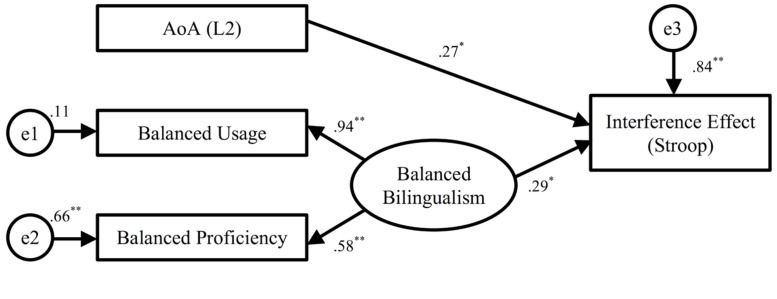
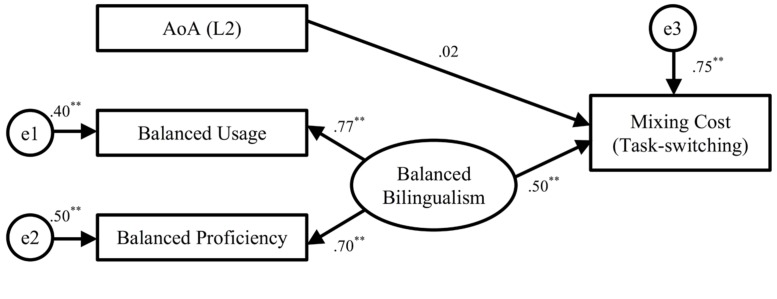
Recent studies revealed inconsistent evidences of a bilingual advantage in executive processing. One potential source of explanation is the multifaceted experience of the bilinguals in these studies. This study seeks to test whether bilinguals who engage in language selection more frequently would perform better in executive control tasks than those bilinguals who engage in language selection less frequently. We examined the influence of the degree of bilingualism (i.e., language proficiency, frequency of use of two languages, and age of second language acquisition) on executive functioning in bilingual young adults using a comprehensive battery of executive control tasks. Seventy-two 18- to 25-years-old English-Mandarin bilinguals performed four computerized executive function (EF) tasks (Stroop, Eriksen flanker, number-letter switching, and n-back task) that measure the EF components: inhibition, mental-set shifting, and information updating and monitoring. Results from multiple regression analyses, structural equation modeling, and bootstrapping supported the positive association between age of second language acquisition and the interference cost in the Stroop task. Most importantly, we found a significant effect of balanced bilingualism (balanced usage of and balanced proficiency in two languages) on the Stroop and number-letter task (mixing cost only), indicating that a more balanced use and a more balanced level of proficiency in two languages resulted in better executive control skills in the adult bilinguals. We did not find any significant effect of bilingualism on flanker or n-back task. These findings provided important insights to the underlying mechanisms of the bilingual cognitive advantage hypothesis, demonstrating that regular experience with extensive practice in controlling attention to their two language systems results in better performance in related EFs such as inhibiting prepotent responses and global set-shifting.
最近的研究揭示了双语者在执行加工方面存在优势的证据不一致。一个潜在的解释来源是这些研究中双语者的多方面经验。本研究旨在测试在执行控制任务中,经常进行语言选择的双语者是否比那些较少进行语言选择的双语者表现更好。我们使用综合执行控制任务测试了双语程度(即语言熟练程度、两种语言使用频率和第二语言习得年龄)对双语年轻成年人执行功能的影响。72 名 18 至 25 岁的英语-普通话双语者完成了四项计算机执行功能(EF)任务(Stroop、Eriksen 侧翼、数字-字母转换和 n-back 任务),这些任务衡量了 EF 成分:抑制、心理定势转换、信息更新和监控。多元回归分析、结构方程建模和自举的结果支持了第二语言习得年龄与 Stroop 任务干扰成本之间的正相关。最重要的是,我们发现平衡双语(两种语言的平衡使用和平衡熟练程度)对 Stroop 和数字-字母任务(仅混合成本)有显著影响,这表明在两种语言中更平衡的使用和更平衡的熟练程度导致了成年双语者更好的执行控制技能。我们没有发现双语对侧翼或 n-back 任务有任何显著影响。这些发现为双语认知优势假设的潜在机制提供了重要的见解,表明经常在控制对其两种语言系统的注意力方面进行广泛练习会导致在相关执行功能(如抑制优势反应和全局定势转换)方面表现更好。