Clarke Philip M, Gregory Robert, Salomon Joshua A
*Centre for Health Policy, School of Population and Global Health, University of Melbourne, Melbourne, VIC †Research School of Economics, Australian National University, Canberra, ACT, Australia ‡Department of Global Health and Population, Harvard T.H. Chan School of Public Health, Boston, MA.
Med Care. 2015 May;53(5):401-8. doi: 10.1097/MLR.0000000000000336.
Recent combat operations have involved large numbers of personnel. Long-term health effects of military deployment remain largely unknown.
To examine patterns and trends in long-term disability among combat veterans and to relate disability to aspects of wartime experience.
A total of 60,228 Australian military personnel deployed between 1962 and 1975 during the Vietnam War, and 82,877 military personnel who were not deployed overseas.
Accepted physician-assessed disability claims were evaluated over follow-up periods up to 50 years after deployment, and compared with age-matched controls. Multivariable analysis was used to examine differences by service branch, rank, age, and deployment duration.
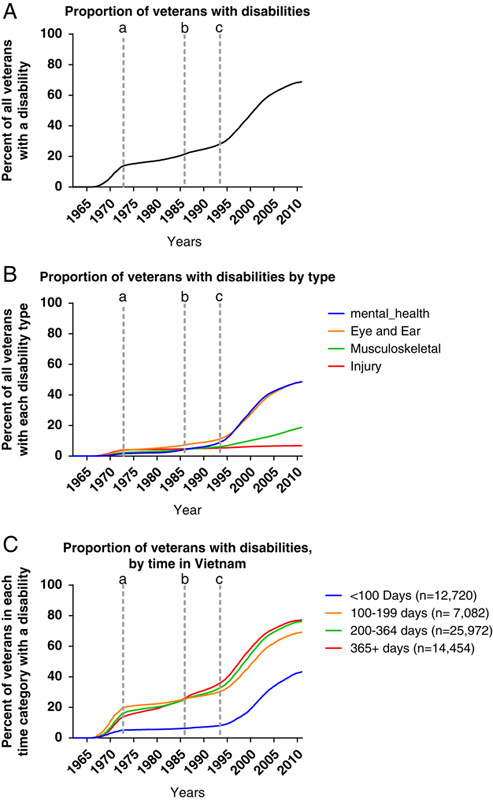
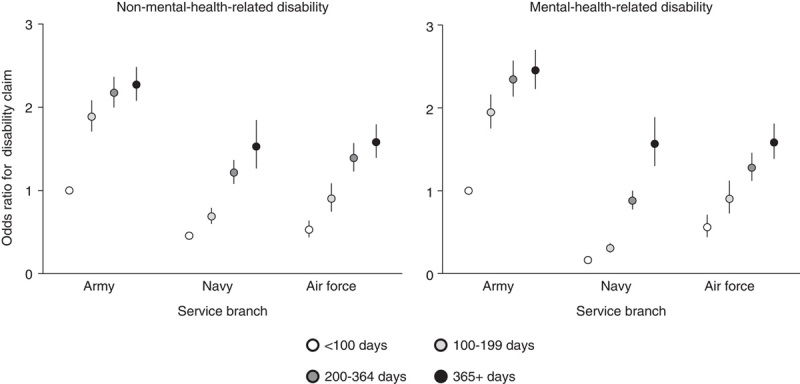
The steepest rise in disability incidence was observed among Vietnam veterans starting in the 1990s, around 20-30 years after deployment for most veterans. After 1994, when Statements of Principles were introduced to guide evaluation of disability claims, the hazard ratio for disability incidence was 1.53 (95% confidence interval, 1.32-1.77) compared with the prior period. By January 2011, after an average follow-up of 42.5 years, 69.7% (95% confidence interval, 69.4%-70.1%) of veterans had at least 1 war-related disability. Many veterans had multiple disabilities, with leading causes being eye and ear disorders (48.0%), mental health conditions (47.9%), and musculoskeletal disorders (18.4%). For specific categories of disability, relative risks for accepted claims among veterans compared with controls were highest for mental health disorders, at 22.9 (21.9-24.0) and lowest for injuries, at 1.5 (1.4-1.6) with a relative risk for any disability of 3.7 (3.7-3.8). Veterans with service of >1 year were 2.5 (2.2-2.7) times more likely to have a mental health disability than those who served <100 days, and 2.3 (2.1-2.5) times more likely to have other disabilities.
Long-term effects of deployment into military conflicts are substantial, and likelihood of war-related disability is associated with service history. If similar patterns follow from more recent conflicts, significant additional resources will be needed to prevent and treat long-term health conditions among veterans.
近期的军事行动涉及大量人员。军事部署对健康的长期影响在很大程度上仍不为人知。
研究退伍军人长期残疾的模式和趋势,并将残疾与战时经历的各个方面联系起来。
共有60228名在1962年至1975年越南战争期间部署的澳大利亚军事人员,以及82877名未被部署到海外的军事人员。
在部署后长达50年的随访期内,对经医生评估认可的残疾索赔进行评估,并与年龄匹配的对照组进行比较。采用多变量分析来研究不同军种、军衔、年龄和部署时长之间的差异。
在20世纪90年代开始观察到,越南退伍军人中残疾发生率上升最为显著,这一时间距离大多数退伍军人部署大约20至30年。1994年引入《原则声明》以指导残疾索赔评估后,与之前时期相比,残疾发生率的风险比为1.53(95%置信区间,1.32 - 1.77)。到2011年1月,平均随访42.5年后,69.7%(95%置信区间,69.4% - 70.1%)的退伍军人至少有1项与战争相关的残疾。许多退伍军人有多种残疾,主要原因是眼耳疾病(48.0%)、心理健康状况(47.9%)和肌肉骨骼疾病(18.4%)。对于特定类别的残疾,退伍军人与对照组相比,认可索赔的相对风险在心理健康障碍方面最高,为22.9(21.9 - 24.0),在损伤方面最低,为1.5(1.4 - 1.6),任何残疾的相对风险为3.7(3.7 - 3.8)。服役超过1年的退伍军人患心理健康残疾的可能性是服役少于100天者的2.5(2.2 - 2.7)倍,患其他残疾的可能性是其2.3(2.1 - 2.5)倍。
军事冲突部署的长期影响巨大,与战争相关的残疾可能性与服役经历有关。如果近期冲突出现类似模式,将需要大量额外资源来预防和治疗退伍军人的长期健康问题。