Gould Gillian Sandra, Watt Kerrianne, McEwen Andy, Cadet-James Yvonne, Clough Alan R
College of Public Health, Medical and Veterinary Sciences, James Cook University, Cairns, Queensland, Australia School of Medicine and Public Health, The University of Newcastle, University Drive, Callaghan, New South Wales, Australia.
College of Public Health, Medical and Veterinary Sciences, James Cook University, Townsville, Queensland, Australia.
BMJ Open. 2015 Mar 13;5(3):e007020. doi: 10.1136/bmjopen-2014-007020.
To assess the predictors of intentions to quit smoking in a community sample of Aboriginal smokers of reproductive age, in whom smoking prevalence is slow to decline.
DESIGN, SETTING AND PARTICIPANTS: A cross-sectional survey involved 121 Aboriginal smokers, aged 18-45 years from January to May 2014, interviewed at community events on the Mid-North Coast NSW. Qualitative and quantitative data were collected on smoking and quitting attitudes, behaviours and home smoking rules. Perceived efficacy for quitting, and perceived threat from smoking, were uniquely assessed with a validated Risk Behaviour Diagnosis (RBD) Scale.
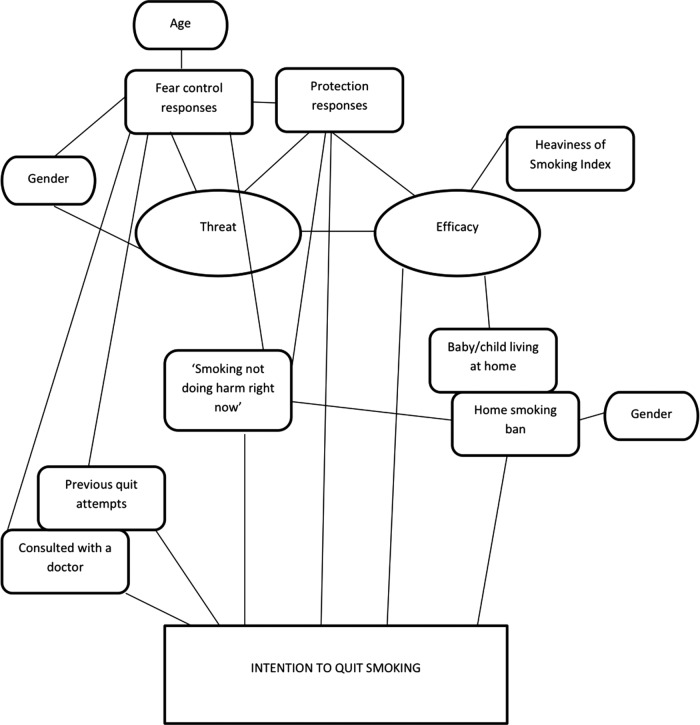
Logistic regression explored the impact of perceived efficacy, perceived threat and consulting previously with a doctor or health professional (HP) on self-reported intentions to quit smoking, controlling for potential confounders, that is, protection responses and fear control responses, home smoking rules, gender and age. Participants' comments regarding smoking and quitting were investigated via inductive analysis, with the assistance of Aboriginal researchers.
Two-thirds of smokers intended to quit within 3 months. Perceived efficacy (OR=4.8; 95% CI 1.78 to 12.93) and consulting previously with a doctor/HP about quitting (OR=3.82; 95% CI 1.43 to 10.2) were significant predictors of intentions to quit. 'Smoking is not doing harm right now' was inversely associated with quit intentions (OR=0.25; 95% CI 0.08 to 0.8). Among those who reported making a quit attempt, after consulting with a doctor/HP, 40% (22/60) rated the professional support received as low (0-2/10). Qualitative themes were: the negatives of smoking (ie, disgust, regret, dependence and stigma), health effects and awareness, quitting, denial, 'smoking helps me cope' and social aspects of smoking.
Perceived efficacy and consulting with a doctor/HP about quitting may be important predictors of intentions to quit smoking in Aboriginal smokers of reproductive age. Professional support was generally perceived to be low; thus, it could be improved for these Aboriginal smokers. Aboriginal participants expressed strong sentiments about smoking and quitting.
在育龄原住民吸烟者的社区样本中评估戒烟意愿的预测因素,该群体吸烟率下降缓慢。
设计、背景与参与者:一项横断面调查纳入了2014年1月至5月期间年龄在18 - 45岁的121名原住民吸烟者,于新南威尔士州中北海岸的社区活动中进行访谈。收集了关于吸烟和戒烟态度、行为及家庭吸烟规定的定性和定量数据。使用经过验证的风险行为诊断(RBD)量表专门评估了戒烟的感知效能以及吸烟的感知威胁。
逻辑回归分析探讨了感知效能、感知威胁以及之前是否咨询过医生或健康专业人员(HP)对自我报告的戒烟意愿的影响,并控制了潜在混杂因素,即保护反应和恐惧控制反应、家庭吸烟规定、性别和年龄。在原住民研究人员的协助下,通过归纳分析对参与者关于吸烟和戒烟的评论进行了调查。
三分之二的吸烟者打算在3个月内戒烟。感知效能(比值比[OR]=4.8;95%置信区间[CI]为1.78至12.93)以及之前咨询过医生/HP关于戒烟(OR = 3.82;95% CI为1.43至10.2)是戒烟意愿的显著预测因素。“吸烟目前没有造成危害”与戒烟意愿呈负相关(OR = 0.25;95% CI为0.08至0.8)。在那些报告曾尝试戒烟的人中,在咨询医生/HP后,40%(22/60)将获得的专业支持评为低(0 - 2/10)。定性主题包括:吸烟的负面影响(即厌恶、后悔、依赖和耻辱)、健康影响和意识、戒烟、否认、“吸烟帮助我应对”以及吸烟的社会方面。
感知效能以及咨询医生/HP关于戒烟可能是育龄原住民吸烟者戒烟意愿的重要预测因素。普遍认为专业支持较低;因此,对于这些原住民吸烟者,专业支持可以得到改善。原住民参与者表达了对吸烟和戒烟的强烈看法。