Chen Szu-Jung, Lin Pei-Wen, Lin Hsin-Ping, Huang Shenq-Shyang, Lai Feng-Jie, Sheu Hamm-Ming, Hsu Li-Jin, Chang Nan-Shan
Institute of Molecular Medicine, National Cheng Kung University College of Medicine, Tainan, Taiwan, ROC.
Department of Dermatology, Chi-Mei Medical Center, Tainan, Taiwan, ROC.
Oncotarget. 2015 Apr 10;6(10):8007-18. doi: 10.18632/oncotarget.3153.
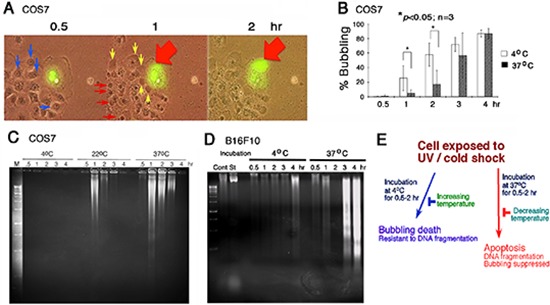
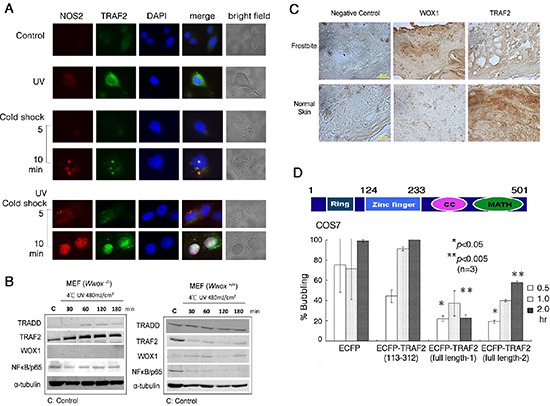
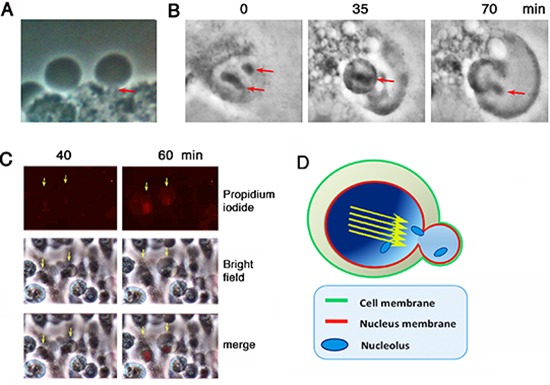
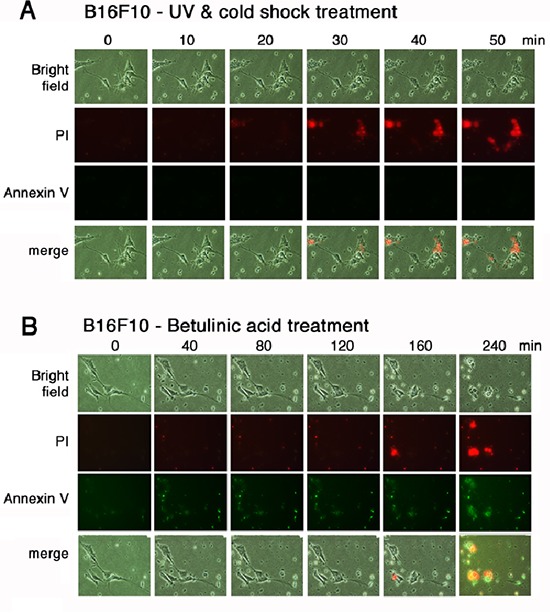
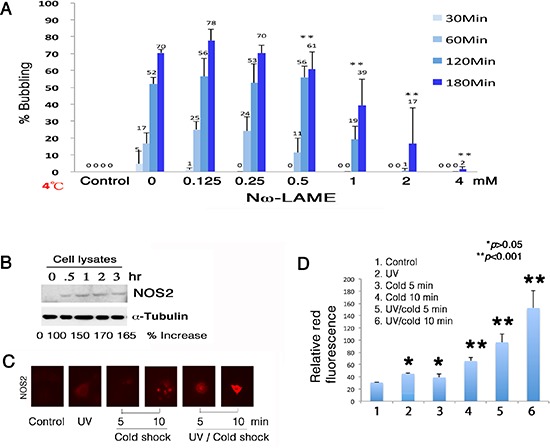
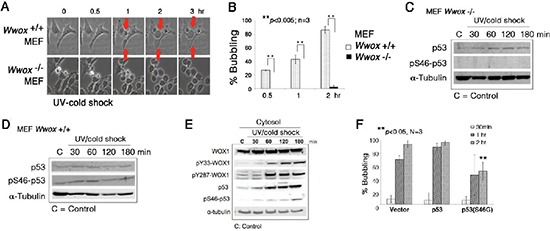
When COS7 fibroblasts and other cells were exposed to UVC irradiation and cold shock at 4°C for 5 min, rapid upregulation and nuclear accumulation of NOS2, p53, WWOX, and TRAF2 occurred in 10-30 min. By time-lapse microscopy, an enlarging gas bubble containing nitric oxide (NO) was formed in the nucleus in each cell that finally popped out to cause "bubbling death". Bubbling occurred effectively at 4 and 22°C, whereas DNA fragmentation was markedly blocked at 4°C. When temperature was increased to 37°C, bubbling was retarded and DNA fragmentation occurred in 1 hr, suggesting that bubbling death is switched to apoptosis with increasing temperatures. Bubbling occurred prior to nuclear uptake of propidium iodide and DAPI stains. Arginine analog Nω-LAME inhibited NO synthase NOS2 and significantly suppressed the bubbling death. Unlike apoptosis, there were no caspase activation and flip-over of membrane phosphatidylserine (PS) during bubbling death. Bubbling death was significantly retarded in Wwox knockout MEF cells, as well as in cells overexpressing TRAF2 and dominant-negative p53. Together, UV/cold shock induces bubbling death at 4°C and the event is switched to apoptosis at 37°C. Presumably, proapoptotic WWOX and p53 block the protective TRAF2 to execute the bubbling death.
当COS7成纤维细胞和其他细胞暴露于紫外线C照射并在4°C下冷休克5分钟时,在10 - 30分钟内会迅速出现一氧化氮合酶2(NOS2)、p53、WWOX和肿瘤坏死因子受体相关因子2(TRAF2)的上调和核积累。通过延时显微镜观察,每个细胞的细胞核中会形成一个不断扩大的含有一氧化氮(NO)的气泡,最终气泡破裂导致“气泡死亡”。气泡在4°C和22°C时有效形成,而在4°C时DNA片段化明显受阻。当温度升至37°C时,气泡形成受阻,1小时后发生DNA片段化,这表明随着温度升高,气泡死亡转变为凋亡。气泡在碘化丙啶和4',6-二脒基-2-苯基吲哚(DAPI)染色剂进入细胞核之前就已形成。精氨酸类似物Nω-硝基-L-精氨酸甲酯(Nω-LAME)抑制一氧化氮合酶NOS2并显著抑制气泡死亡。与凋亡不同,在气泡死亡过程中没有半胱天冬酶激活和膜磷脂酰丝氨酸(PS)外翻。在WWOX基因敲除的小鼠胚胎成纤维细胞(MEF)以及过表达TRAF2和显性负性p53的细胞中,气泡死亡明显延迟。总之,紫外线/冷休克在4°C时诱导气泡死亡,在37°C时该事件转变为凋亡。据推测,促凋亡的WWOX和p53阻断了具有保护作用的TRAF2以执行气泡死亡。