Lee Dong Kun, Jeong Jae Hoon, Oh Seunghoon, Jo Young-Hwan
Division of Endocrinology, Department of Medicine, Albert Einstein College of Medicine of Yeshiva University, 1300 Morris Park Avenue, Bronx, NY, 10461, United States of America.
Department of Physiology, College of Medicine, Dankook University, Cheonan City, 330-714, Republic of Korea.
PLoS One. 2015 Mar 17;10(3):e0119457. doi: 10.1371/journal.pone.0119457. eCollection 2015.
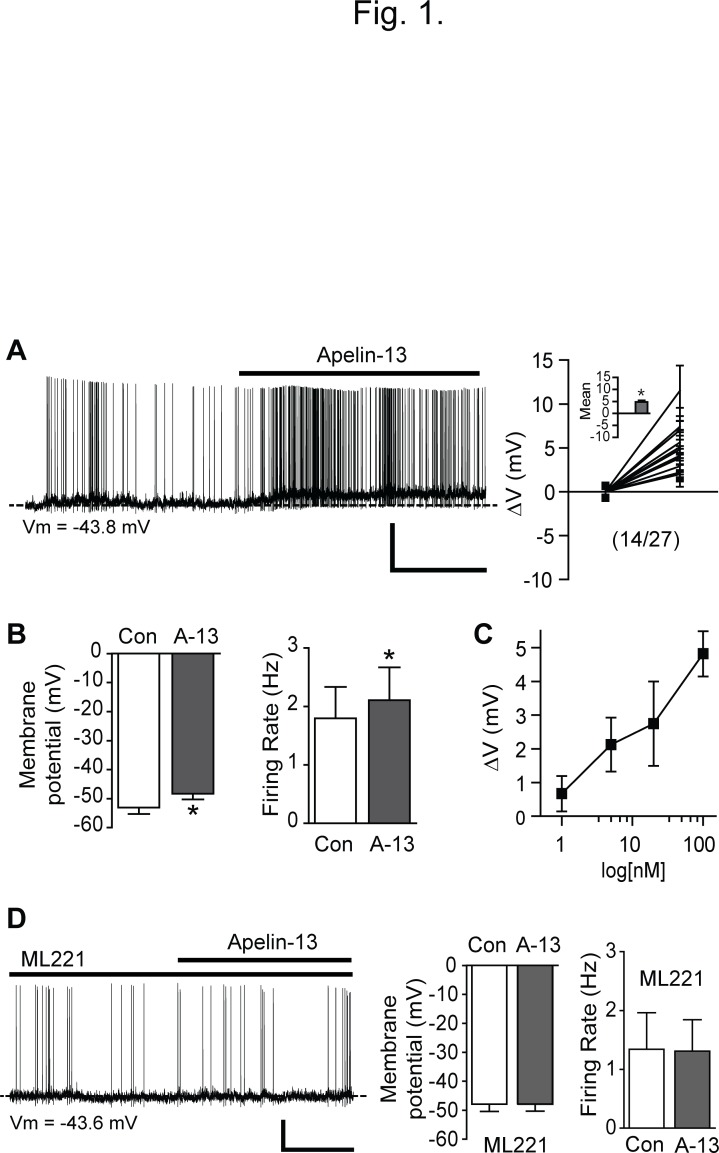
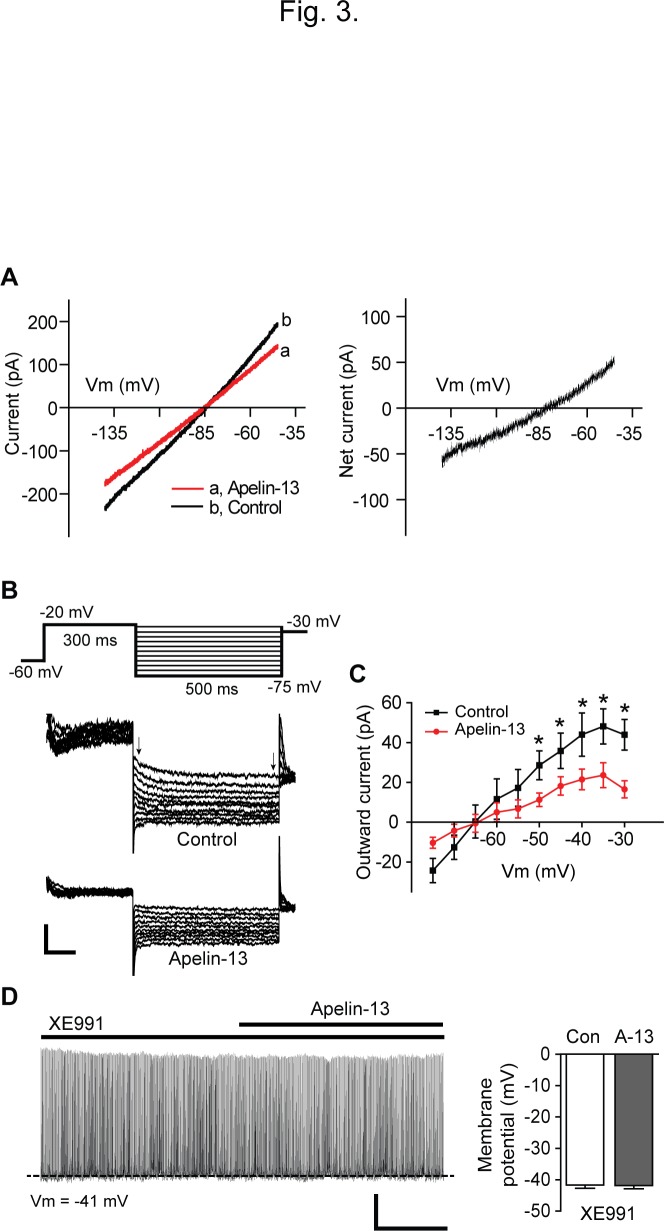
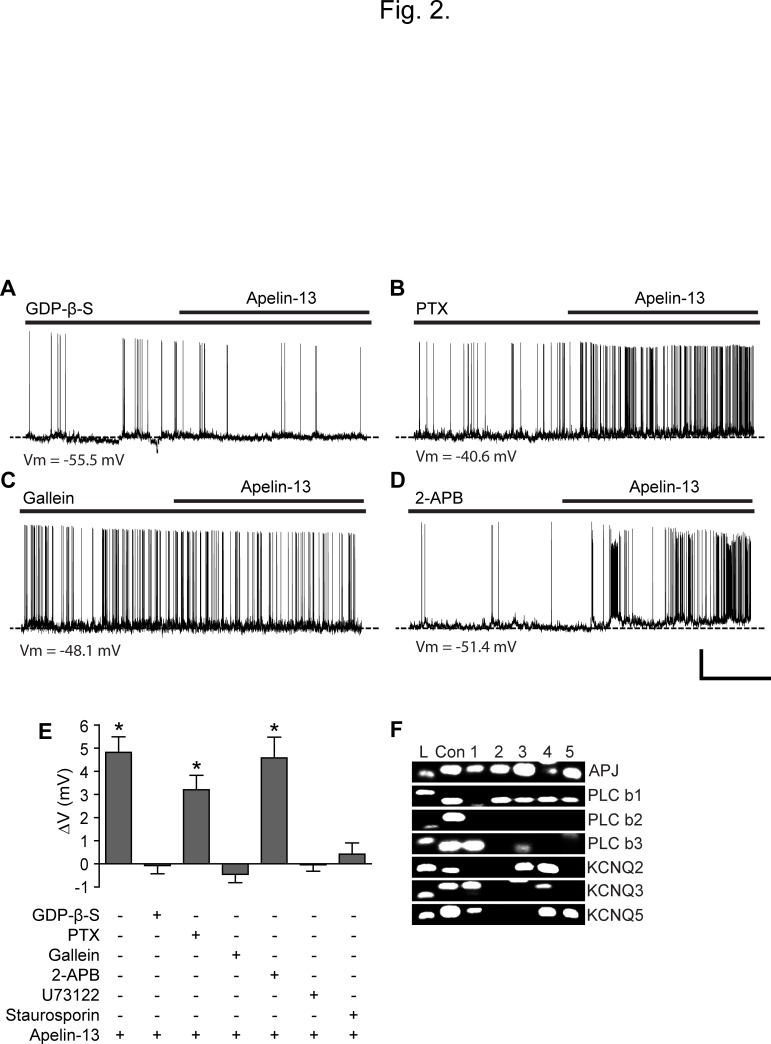
The hypothalamus is a key element of the neural circuits that control energy homeostasis. Specific neuronal populations within the hypothalamus are sensitive to a variety of homeostatic indicators such as circulating nutrient levels and hormones that signal circulating glucose and body fat content. Central injection of apelin secreted by adipose tissues regulates feeding and glucose homeostasis. However, the precise neuronal populations and cellular mechanisms involved in these physiological processes remain unclear. Here we examine the electrophysiological impact of apelin-13 on proopiomelanocortin (POMC) neuron activity. Approximately half of POMC neurons examined respond to apelin-13. Apelin-13 causes a dose-dependent depolarization. This effect is abolished by the apelin (APJ) receptor antagonist. POMC neurons from animals pre-treated with pertussis toxin still respond to apelin, whereas the Gβγ signaling inhibitor gallein blocks apelin-mediated depolarization. In addition, the effect of apelin is inhibited by the phospholipase C and protein kinase inhibitors. Furthermore, single-cell qPCR analysis shows that POMC neurons express the APJ receptor, PLC-β isoforms, and KCNQ subunits (2, 3 and 5) which contribute to M-type current. Apelin-13 inhibits M-current that is blocked by the KCNQ channel inhibitor. Therefore, our present data indicate that apelin activates APJ receptors, and the resultant dissociation of the Gαq heterotrimer triggers a Gβγ-dependent activation of PLC-β signaling that inhibits M-current.
下丘脑是控制能量稳态的神经回路的关键组成部分。下丘脑内特定的神经元群体对多种稳态指标敏感,如循环中的营养水平以及能反映循环血糖和体脂含量的激素。脂肪组织分泌的阿片肽经中枢注射可调节进食和葡萄糖稳态。然而,参与这些生理过程的精确神经元群体和细胞机制仍不清楚。在此,我们研究了阿片肽 -13 对阿黑皮素原(POMC)神经元活动的电生理影响。所检测的 POMC 神经元中约有一半对阿片肽 -13 有反应。阿片肽 -13 引起剂量依赖性去极化。阿片肽(APJ)受体拮抗剂可消除这种效应。用百日咳毒素预处理动物后得到的 POMC 神经元仍对阿片肽有反应,而 Gβγ 信号抑制剂加莱因可阻断阿片肽介导的去极化。此外,阿片肽的效应受到磷脂酶 C 和蛋白激酶抑制剂的抑制。此外,单细胞定量 PCR 分析表明,POMC 神经元表达 APJ 受体、PLC-β 亚型以及对 M 型电流有贡献的 KCNQ 亚基(2、3 和 5)。阿片肽 -13 抑制被 KCNQ 通道抑制剂阻断的 M 电流。因此,我们目前的数据表明,阿片肽激活 APJ 受体,由此导致的 Gαq 异源三聚体解离触发了 Gβγ 依赖性的 PLC-β 信号激活,进而抑制 M 电流。