Kornides Melanie L, Kitsantas Panagiota, Lindley Lisa L, Wu Huichuan
J Midwifery Womens Health. 2015 Mar-Apr;60(2):158-68. doi: 10.1111/jmwh.12258.
Although progress has been made to reduce adolescent pregnancies in the United States, rates of unplanned pregnancy among young adults aged (aged 18-29 years) remain high. In this study, we assessed factors associated with perceived likelihood of pregnancy (likelihood of getting pregnant/getting partner pregnant in the next year) among sexually experienced young adults who were not trying to get pregnant and had previously used contraceptives.
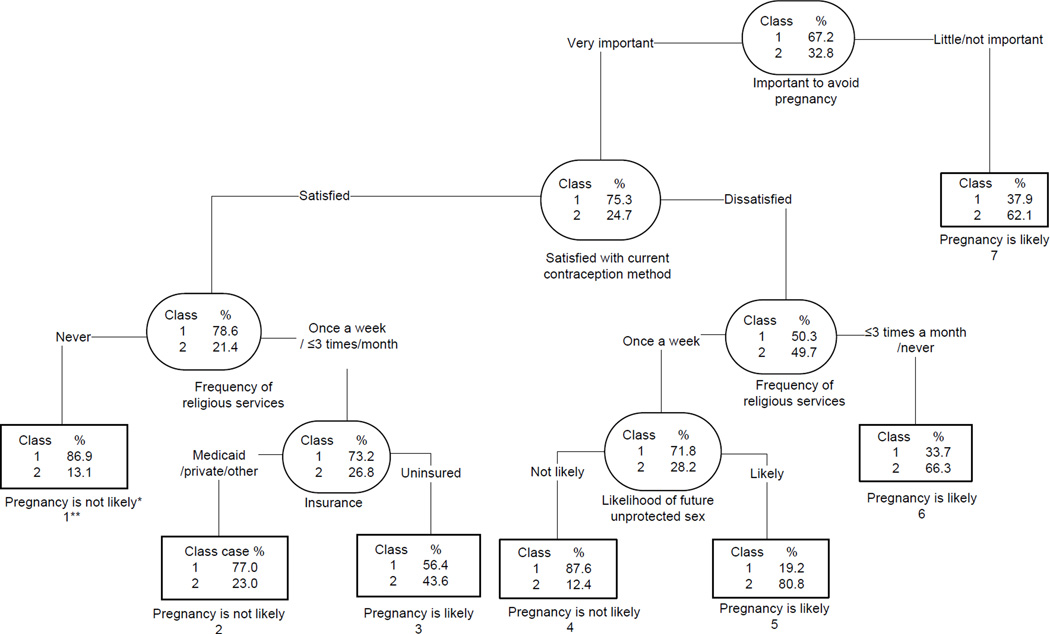
We conducted a secondary analysis of 660 young adults, aged 18 to 29 years in the United States, from the cross-sectional National Survey of Reproductive and Contraceptive Knowledge. Logistic regression and classification tree analyses were conducted to generate profiles of young adults most likely to report anticipating a pregnancy in the next year.
Nearly one-third (32%) of young adults indicated that they believed they had at least some likelihood of becoming pregnant in the next year. Young adults who believed that avoiding pregnancy was not very important were most likely to report pregnancy likelihood (odds ratio [OR], 5.21; 95% confidence interval [CI], 2.80-9.69), as were young adults who considered avoiding a pregnancy to be important but who were not satisfied with their current contraceptive method (OR, 3.93; 95% CI, 1.67-9.24) and who attended religious services frequently (OR, 3.0; 95% CI, 1.52-5.94), were uninsured (OR, 2.63; 95% CI, 1.31-5.26), and were likely to have unprotected sex in the next 3 months (OR, 1.77; 95% CI, 1.04-3.01).
These results may help guide future research and the development of pregnancy-prevention interventions targeting sexually experienced young adults.
尽管美国在减少青少年怀孕方面已取得进展,但18至29岁的年轻成年人意外怀孕率仍然很高。在本研究中,我们评估了有性经验、未打算怀孕且此前使用过避孕药具的年轻成年人中,与怀孕感知可能性(未来一年内自己怀孕/使伴侣怀孕的可能性)相关的因素。
我们对来自美国全国生殖与避孕知识横断面调查的660名18至29岁的年轻成年人进行了二次分析。进行了逻辑回归和分类树分析,以确定最有可能报告预计明年怀孕的年轻成年人特征。
近三分之一(32%)的年轻成年人表示,他们认为自己在明年至少有一定的怀孕可能性。认为避免怀孕不太重要的年轻成年人最有可能报告怀孕可能性(优势比[OR],5.21;95%置信区间[CI],2.80 - 9.69),认为避免怀孕很重要但对当前避孕方法不满意的年轻成年人(OR,3.93;95% CI,1.67 - 9.24)、经常参加宗教活动的年轻成年人(OR,3.0;95% CI,1.52 - 5.94)、未参保的年轻成年人(OR,2.63;95% CI,1.31 - 5.26)以及未来三个月可能进行无保护性行为的年轻成年人(OR,1.77;95% CI,1.04 - 3.01)也是如此。
这些结果可能有助于指导未来针对有性经验的年轻成年人的怀孕预防干预研究和开发。