Casas Caty, Isus Laura, Herrando-Grabulosa Mireia, Mancuso Francesco M, Borrás Eva, Sabidó Eduardo, Forés Joaquim, Aloy Patrick
Group of Neuroplasticity and Regeneration, Institut de Neurociències and Department of Cell Biology, Physiology and Immunology, Universitat Autònoma de Barcelona, and Centro de Investigación Biomédica en Red sobre Enfermedades Neurodegenerativas (CIBERNED), 08193 Bellaterra, Barcelona, Spain.
Joint IRB-BSC-CRG Program in Computational Biology. Institute for Research in Biomedicine (IRB Barcelona), 08028 Barcelona, Catalonia, Spain.
Sci Rep. 2015 Mar 18;5:9185. doi: 10.1038/srep09185.
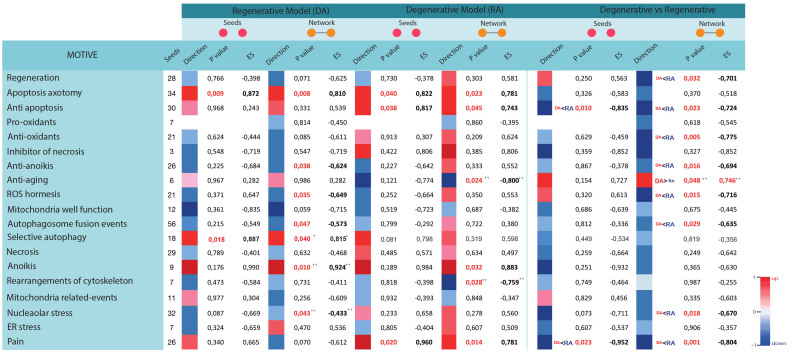
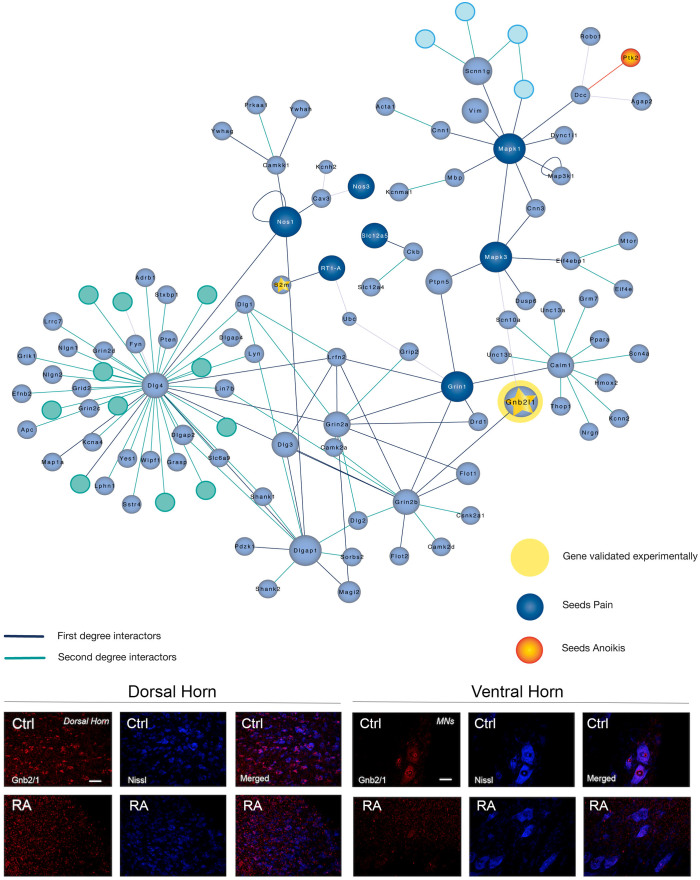
Neurodegenerative processes are preceded by neuronal dysfunction and synaptic disconnection. Disconnection between spinal motoneuron (MN) soma and synaptic target leads either to a retrograde degenerative process or to a regenerative reaction, depending injury proximity among other factors. Distinguished key events associated with one or other processes may give some clues towards new therapeutical approaches based on boosting endogenous neuroprotective mechanisms. Root mechanical traction leads to retrograde MN degeneration, but share common initial molecular mechanisms with a regenerative process triggered by distal axotomy and suture. By 7 days post-injury, key molecular events starts to diverge and sign apart each destiny. We used comparative unbiased proteomics to define these signatures, coupled to a novel network-based analysis to get biological meaning. The procedure implicated the previous generation of combined topological information from manual curated 19 associated biological processes to be contrasted with the proteomic list using gene enrichment analysis tools. The novel and unexpected results suggested that motoneurodegeneration is better explained mainly by the concomitant triggering of anoikis, anti-apoptotic and neuropathic-pain related programs. In contrast, the endogenous neuroprotective mechanisms engaged after distal axotomy included specifically rather anti-anoikis and selective autophagy. Validated protein-nodes and processes are highlighted across discussion.
神经退行性变过程之前会出现神经元功能障碍和突触连接中断。脊髓运动神经元(MN)胞体与突触靶点之间的连接中断,根据损伤距离等因素,要么导致逆行性退行性变过程,要么导致再生反应。与一种或另一种过程相关的显著关键事件可能为基于增强内源性神经保护机制的新治疗方法提供一些线索。神经根机械牵引会导致MN逆行性变性,但与由远端轴突切断和缝合引发的再生过程具有共同的初始分子机制。在损伤后7天,关键分子事件开始分化,并标志着各自的命运。我们使用比较无偏蛋白质组学来定义这些特征,并结合基于网络的新型分析以获得生物学意义。该过程涉及从手动策划的19个相关生物学过程中生成组合拓扑信息,以便使用基因富集分析工具与蛋白质组列表进行对比。这些新颖且意想不到的结果表明,运动神经元变性主要通过细胞失巢凋亡、抗凋亡和神经性疼痛相关程序的同时触发能得到更好的解释。相比之下,远端轴突切断后激活的内源性神经保护机制具体包括抗细胞失巢凋亡和选择性自噬。在整个讨论过程中突出显示了经过验证的蛋白质节点和过程。