Fallahi Poupak, Mazzi Valeria, Vita Roberto, Ferrari Silvia Martina, Materazzi Gabriele, Galleri David, Benvenga Salvatore, Miccoli Paolo, Antonelli Alessandro
Department of Clinical and Experimental Medicine, University of Pisa, Via Savi, 10, 56126 Pisa, Italy.
Department of Clinical & Experimental Medicine, Section of Endocrinology, University of Messina, Piazza Pugliatti, 1, 98122 Messina, Italy.
Int J Mol Sci. 2015 Mar 17;16(3):6153-82. doi: 10.3390/ijms16036153.
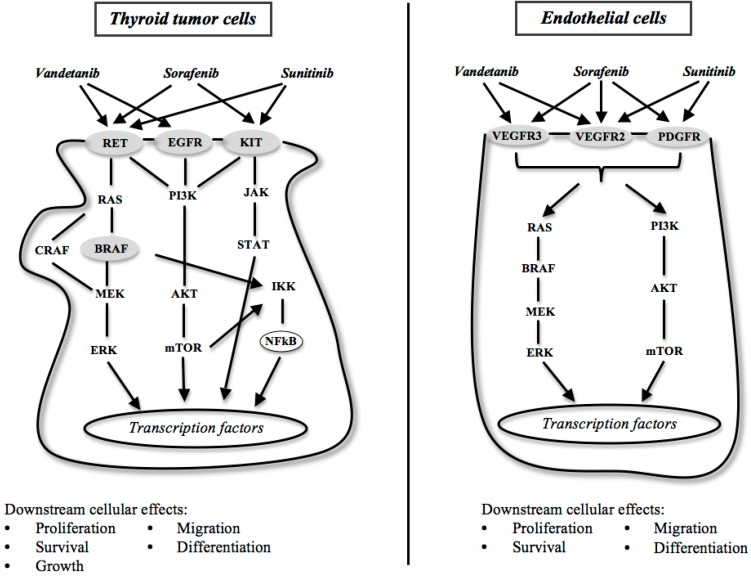
The number of thyroid cancers is increasing. Standard treatment usually includes primary surgery, thyroid-stimulating hormone suppressive therapy, and ablation of the thyroid remnant with radioactive iodine (RAI). Despite the generally good prognosis of thyroid carcinoma, about 5% of patients will develop metastatic disease, which fails to respond to RAI, exhibiting a more aggressive behavior. The lack of specific, effective and well-tolerated drugs, the scarcity of data about the association of multi-targeting drugs, and the limited role of radioiodine for dedifferentiated thyroid cancer, call for further efforts in the field of new drugs development. Rearranged during transfection (RET)/papillary thyroid carcinoma gene rearrangements, BRAF (B-RAF proto-oncogene, serine/threonine kinase) gene mutations, RAS (rat sarcoma) mutations, and vascular endothelial growth factor receptor 2 angiogenesis pathways are some of the known pathways playing a crucial role in the development of thyroid cancer. Targeted novel compounds have been demonstrated to induce clinical responses and stabilization of disease. Sorafenib has been approved for differentiated thyroid cancer refractory to RAI.
甲状腺癌的数量正在增加。标准治疗通常包括初次手术、促甲状腺激素抑制治疗以及用放射性碘(RAI)消融甲状腺残余组织。尽管甲状腺癌的总体预后良好,但约5%的患者会发生转移性疾病,对RAI无反应,表现出更具侵袭性的行为。缺乏特异性、有效且耐受性良好的药物,关于多靶点药物联合的数据稀缺,以及放射性碘对去分化型甲状腺癌的作用有限,都需要在新药研发领域进一步努力。转染重排(RET)/甲状腺乳头状癌基因重排、BRAF(B-RAF原癌基因,丝氨酸/苏氨酸激酶)基因突变、RAS(大鼠肉瘤)突变以及血管内皮生长因子受体2血管生成途径是已知的在甲状腺癌发展中起关键作用的一些途径。靶向新型化合物已被证明可诱导临床反应并使疾病稳定。索拉非尼已被批准用于对RAI难治的分化型甲状腺癌。