Nakane Shunya, Higuchi Osamu, Koga Michiaki, Kanda Takashi, Murata Kenya, Suzuki Takashi, Kurono Hiroko, Kunimoto Masanari, Kaida Ken-ichi, Mukaino Akihiro, Sakai Waka, Maeda Yasuhiro, Matsuo Hidenori
Department of Clinical Research, Nagasaki Kawatana Medical Center, Nagasaki, Japan; Department of Neurology, Nagasaki Kawatana Medical Center, Nagasaki, Japan.
Department of Clinical Research, Nagasaki Kawatana Medical Center, Nagasaki, Japan.
PLoS One. 2015 Mar 19;10(3):e0118312. doi: 10.1371/journal.pone.0118312. eCollection 2015.
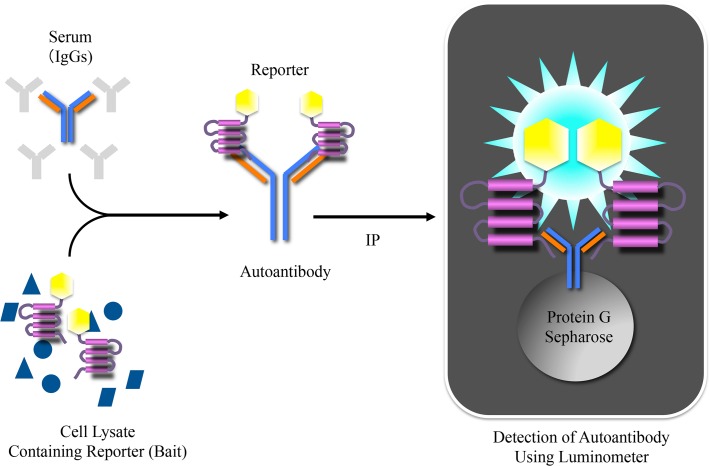
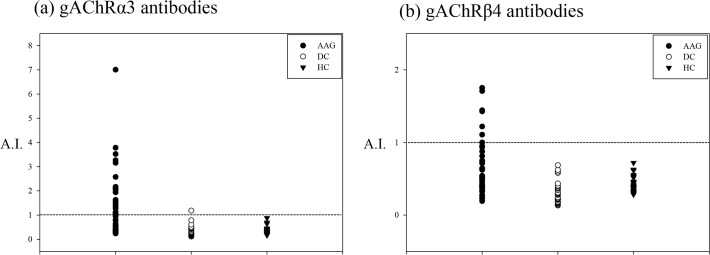
Autoimmune autonomic ganglionopathy (AAG) is a rare acquired channelopathy that is characterized by pandysautonomia, in which autoantibodies to ganglionic nicotinic acetylcholine receptors (gAChR) may play a central role. Radioimmunoprecipitation (RIP) assays have been used for the sensitive detection of autoantibodies to gAChR in the serum of patients with AAG. Here, we developed luciferase immunoprecipitation systems (LIPS) to diagnose AAG based on IgGs to both the α3 and β4 gAChR subunits in patient serum. We reviewed the serological and clinical data of 50 Japanese patients who were diagnosed with AAG. With the LIPS testing, we detected anti-α3 and -β4 gAChR antibodies in 48% (24/50) of the patients. A gradual mode of onset was more common in the seropositive group than in the seronegative group. Patients with AAG frequently have orthostatic hypotension and upper and lower gastrointestinal tract symptoms, with or without anti-gAChR. The occurrence of autonomic symptoms was not significantly different between the seropositive and seronegative group, with the exception of achalasia in three patients from the seropositive group. In addition, we found a significant overrepresentation of autoimmune diseases in the seropositive group and endocrinological abnormalities as an occasional complication of AAG. Our results demonstrated that the LIPS assay was a useful novel tool for detecting autoantibodies against gAChR in patients with AAG.
自身免疫性自主神经节病(AAG)是一种罕见的获得性通道病,其特征为广泛性自主神经功能障碍,其中针对神经节烟碱型乙酰胆碱受体(gAChR)的自身抗体可能起核心作用。放射免疫沉淀(RIP)测定法已用于灵敏检测AAG患者血清中针对gAChR的自身抗体。在此,我们开发了基于患者血清中α3和β4 gAChR亚基的IgG来诊断AAG的荧光素酶免疫沉淀系统(LIPS)。我们回顾了50例被诊断为AAG的日本患者的血清学和临床数据。通过LIPS检测,我们在48%(24/50)的患者中检测到了抗α3和抗β4 gAChR抗体。血清阳性组的发病方式逐渐起病比血清阴性组更常见。AAG患者常出现直立性低血压以及上、下胃肠道症状,无论有无抗gAChR抗体。血清阳性组和血清阴性组自主神经症状的发生率无显著差异,但血清阳性组有3例患者出现贲门失弛缓症。此外,我们发现血清阳性组自身免疫性疾病的发生率显著过高,且内分泌异常是AAG偶尔出现的并发症。我们的结果表明,LIPS测定法是检测AAG患者中针对gAChR自身抗体的一种有用的新工具。