Nagata Ryusei, Matsuura Eiji, Nozuma Satoshi, Dozono Mika, Noguchi Yutaka, Ando Masahiro, Hiramatsu Yu, Kodama Daisuke, Tanaka Masakazu, Kubota Ryuji, Yamakuchi Munekazu, Higuchi Yujiro, Sakiyama Yusuke, Arata Hitoshi, Higashi Keiko, Hashiguchi Teruto, Nakane Shunya, Takashima Hiroshi
Department of Neurology and Geriatrics, Kagoshima University Graduate School of Medical and Dental Sciences, Kagoshima, Japan.
Division of Neuroimmunology, Joint Research Center for Human Retrovirus Infection, Kagoshima University, Kagoshima, Japan.
Front Neurol. 2023 Feb 13;14:1137958. doi: 10.3389/fneur.2023.1137958. eCollection 2023.
Autoimmune autonomic ganglionopathy (AAG) is a rare disorder characterized by autonomic failure associated with the presence of anti-ganglionic acetylcholine receptor (gAChR) antibodies; however, several studies have reported that individuals with anti-gAChR antibodies present with central nervous system (CNS) symptoms such as impaired consciousness and seizures. In the present study, we investigated whether the presence of serum anti-gAChR antibodies correlated with autonomic symptoms in patients with functional neurological symptom disorder/conversion disorder (FNSD/CD).
Clinical data were collected for 59 patients presenting with neurologically unexplained motor and sensory symptoms at the Department of Neurology and Geriatrics between January 2013 and October 2017 and who were ultimately diagnosed with FNSD/CD according to the Diagnostic and Statistical Manual of Mental Disorders, 5th Edition. Correlations between serum anti-gAChR antibodies and clinical symptoms and laboratory data were analyzed. Data analysis was conducted in 2021.
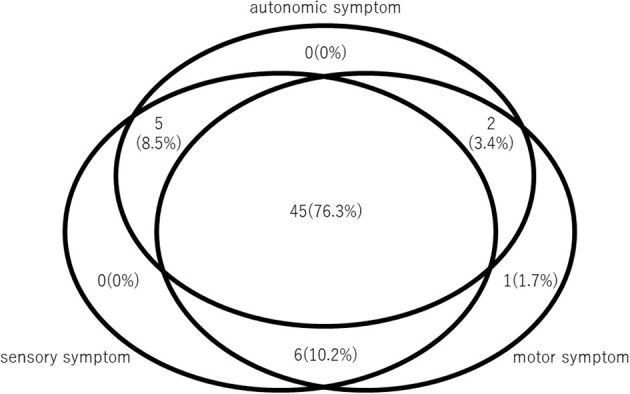
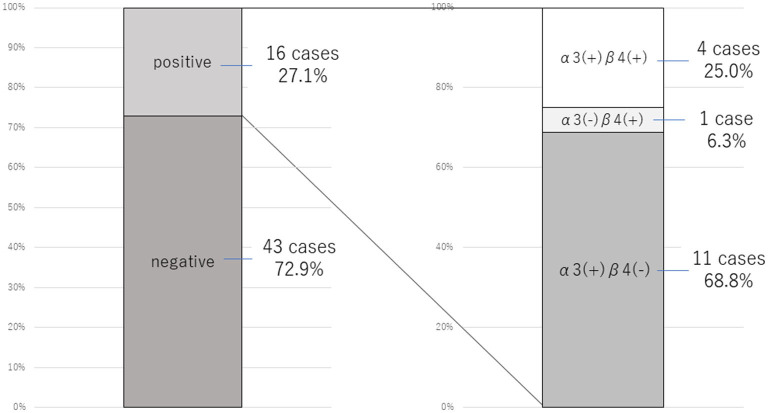
Of the 59 patients with FNSD/CD, 52 (88.1%) exhibited autonomic disturbances and 16 (27.1%) were positive for serum anti-gAChR antibodies. Cardiovascular autonomic dysfunction, including orthostatic hypotension, was significantly more prevalent (75.0 vs. 34.9%, = 0.008), whereas involuntary movements were significantly less prevalent (31.3 vs. 69.8%, = 0.007), among anti-gAChR antibody-positive compared with -negative patients. Anti-gAChR antibody serostatus did not correlate significantly with the frequency of other autonomic, sensory, or motor symptoms analyzed.
An autoimmune mechanism mediated by anti-gAChR antibodies may be involved in disease etiology in a subgroup of FNSD/CD patients.
自身免疫性自主神经节病(AAG)是一种罕见疾病,其特征为自主神经功能衰竭并伴有抗神经节乙酰胆碱受体(gAChR)抗体;然而,多项研究报告称,具有抗gAChR抗体的个体存在中枢神经系统(CNS)症状,如意识障碍和癫痫发作。在本研究中,我们调查了功能性神经症状障碍/转换障碍(FNSD/CD)患者血清抗gAChR抗体的存在是否与自主神经症状相关。
收集了2013年1月至2017年10月在神经内科和老年病科就诊的59例出现无法用神经学解释的运动和感觉症状、最终根据《精神疾病诊断与统计手册》第5版诊断为FNSD/CD的患者的临床数据。分析血清抗gAChR抗体与临床症状及实验室数据之间的相关性。数据分析于2021年进行。
在59例FNSD/CD患者中,52例(88.1%)出现自主神经功能紊乱,16例(27.1%)血清抗gAChR抗体呈阳性。与抗gAChR抗体阴性患者相比,抗gAChR抗体阳性患者中包括体位性低血压在内的心血管自主神经功能障碍明显更为普遍(75.0%对34.9%,P = 0.008),而非自主运动则明显较少见(31.3%对69.8%,P = 0.007)。抗gAChR抗体血清状态与所分析的其他自主神经、感觉或运动症状的频率无显著相关性。
抗gAChR抗体介导的自身免疫机制可能参与了部分FNSD/CD患者的疾病病因。