Ekström Sandra, Kull Inger, Nilsson Sara, Bergström Anna
Institute of Environmental Medicine, Karolinska Institutet, Stockholm, Sweden.
J Med Internet Res. 2015 Mar 18;17(3):e73. doi: 10.2196/jmir.3947.
Web-collected height and weight are increasingly used in epidemiological studies; however, the validity has rarely been evaluated.
The aim of the study was to validate self-reported height, weight, and corresponding body mass index (BMI) among Swedish adolescents aged approximately 16 years. A secondary aim was to investigate possible prediction factors for validity of self-reported BMI.
The study included 1698 adolescents from the population-based cohort BAMSE. Height and weight were collected through a Web-based questionnaire and subsequently measured using standard procedures. Differences between reported and measured height, weight, and corresponding BMI were compared by t tests and agreement was evaluated by Pearson correlation and Bland-Altman plots. Multivariable linear regression analysis was used to investigate whether lifestyle and demographic factors predicted validity of self-reported BMI.
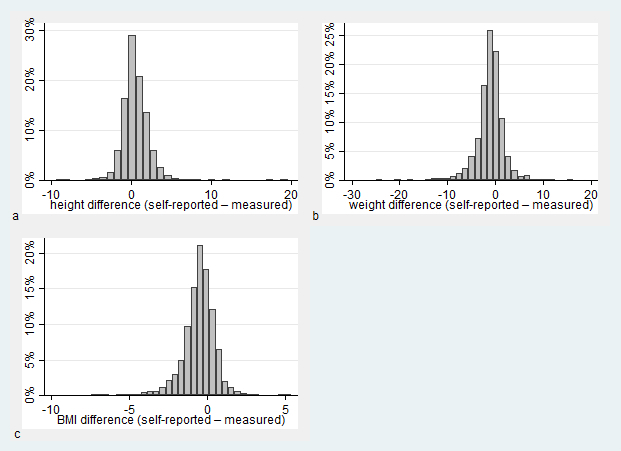
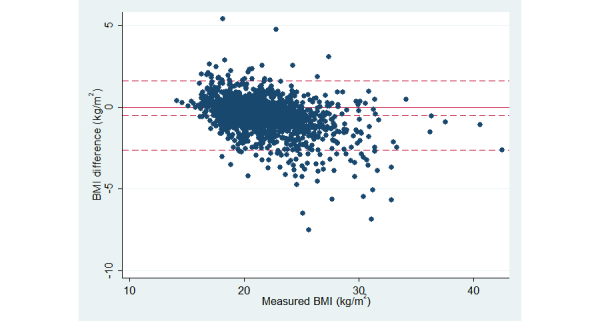
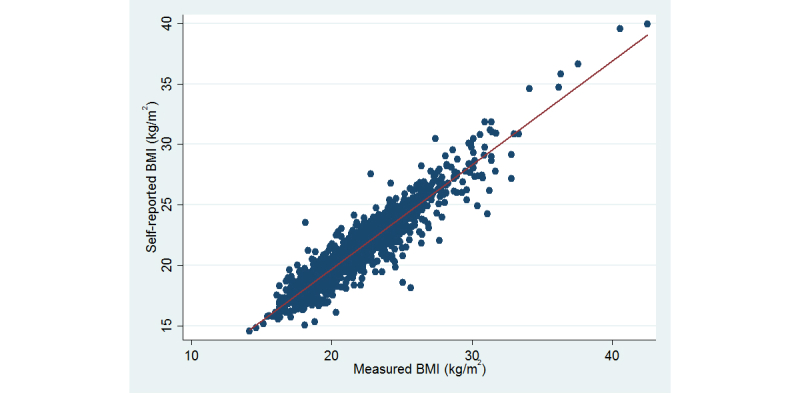
On average, weight was underestimated by 1.1 kg and height was overestimated by 0.5 cm, leading to an underestimation of BMI by 0.5 kg/m2. Correlation coefficients were .98 for height, .97 for weight, and .94 for BMI, and highly significant. Females underestimated weight to a higher extent than males and overweight and obese participants underestimated weight to a higher extent than normal-weight participants, which resulted in higher underestimation of BMI. Underweight participants, on the contrary, overestimated weight and correspondingly BMI. Overall, a high proportion of participants were classified into the correct BMI category; however, among overweight and obese participants, only 60.2% (139/231) and 46% (20/44) were correctly classified, respectively. In the multivariable prediction model, only gender and BMI status significantly predicted discrepancy between reported and measured BMI.
Web-collected BMI may be used as a valid, quick, and cost-effective alternative to measured BMI among Swedish adolescents. The accuracy of self-reported BMI declines with increasing BMI and self-reported BMI should not be used to estimate the prevalence of overweight or obesity.
网络收集的身高和体重越来越多地用于流行病学研究;然而,其有效性很少得到评估。
本研究旨在验证瑞典约16岁青少年自我报告的身高、体重及相应的体重指数(BMI)。次要目的是调查自我报告BMI有效性的可能预测因素。
本研究纳入了基于人群的BAMSE队列中的1698名青少年。通过网络问卷收集身高和体重,随后采用标准程序进行测量。通过t检验比较报告的身高、体重及相应BMI与测量值之间的差异,并通过Pearson相关分析和Bland-Altman图评估一致性。采用多变量线性回归分析来研究生活方式和人口统计学因素是否能预测自我报告BMI的有效性。
平均而言,体重被低估了1.1千克,身高被高估了0.5厘米,导致BMI被低估了0.5千克/平方米。身高的相关系数为0.98,体重为0.97,BMI为0.94,均具有高度显著性。女性低估体重的程度高于男性,超重和肥胖参与者低估体重的程度高于正常体重参与者,这导致BMI被更高程度地低估。相反,体重过轻的参与者高估了体重及相应的BMI。总体而言,很大一部分参与者被归类到正确的BMI类别;然而,在超重和肥胖参与者中,分别只有60.2%(139/231)和46%(20/44)被正确分类。在多变量预测模型中,只有性别和BMI状态能显著预测报告的BMI与测量的BMI之间的差异。
在瑞典青少年中,网络收集的BMI可作为测量BMI的一种有效、快速且经济高效的替代方法。自我报告BMI的准确性随着BMI的增加而下降,自我报告的BMI不应被用于估计超重或肥胖的患病率。