He Xiao-Zheng, Wang Qi-Fu, Han Shuai, Wang Hui-Qing, Ye Yong-Yi, Zhu Zhi-Yuan, Zhang Shi-Zhong
Department of Neurosurgery, Zhujiang Hospital, Southern Medical University, Guangzhou, People's Republic of China ; The National Key Clinic Specialty, The Neurosurgery Institute of Guangdong Province, Guangdong Provincial Key Laboratory on Brain Function Repair and Regeneration, Southern Medical University, Guangzhou, People's Republic of China.
Department of General Surgery, Zhujiang Hospital, Southern Medical University, Guangzhou, People's Republic of China.
Drug Des Devel Ther. 2015 Mar 10;9:1449-58. doi: 10.2147/DDDT.S76592. eCollection 2015.
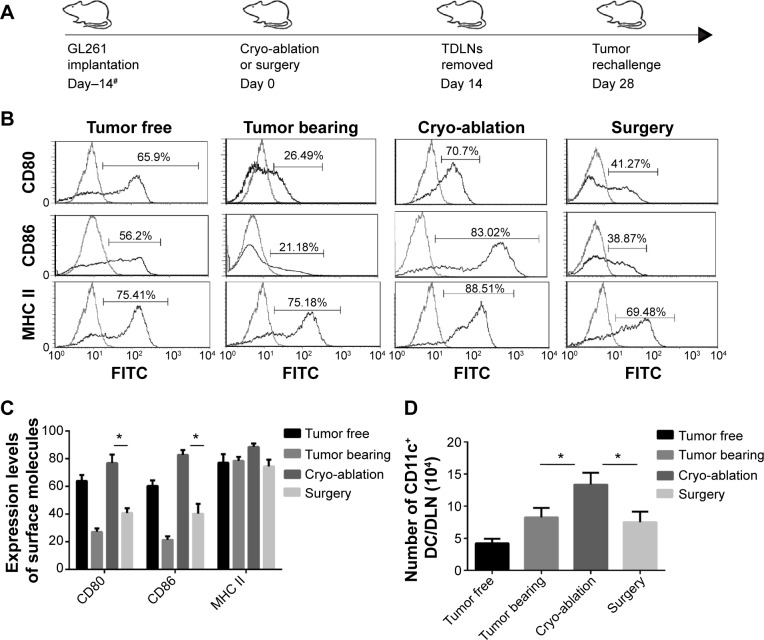
In addition to minimally invasive destruction of tumors, cryo-ablation of tumors to some extent modulated anti-tumor immunity. Cryo-ablated tumors in glioma mice models induced anti-tumor cellular immunologic response which increases the percentage of CD3(+) and CD4(+)T cells in blood as well as natural killer cells. As a crucial role in triggering anti-tumor immunity, dendritic cells (DCs) were educated by tumors to adopt a tolerance phenotype which helps the tumor escape from immune monitoring. This study aims to study whether cryo-ablation could influence the tolerogenic DCs, and influence anti-tumor immunity in tumor-draining lymph nodes (TDLNs).
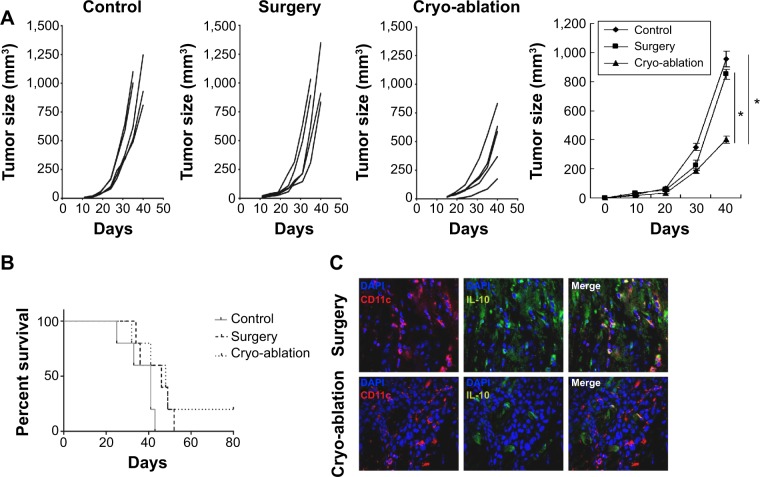
Using the GL261 subcutaneous glioma mouse model, we created a tumor bearing group, cryo-ablation group, and surgery group. We analyzed alteration in phenotype and function of tolerogenic DCs, and evaluated the factors of anti-tumor immunity inhibition.
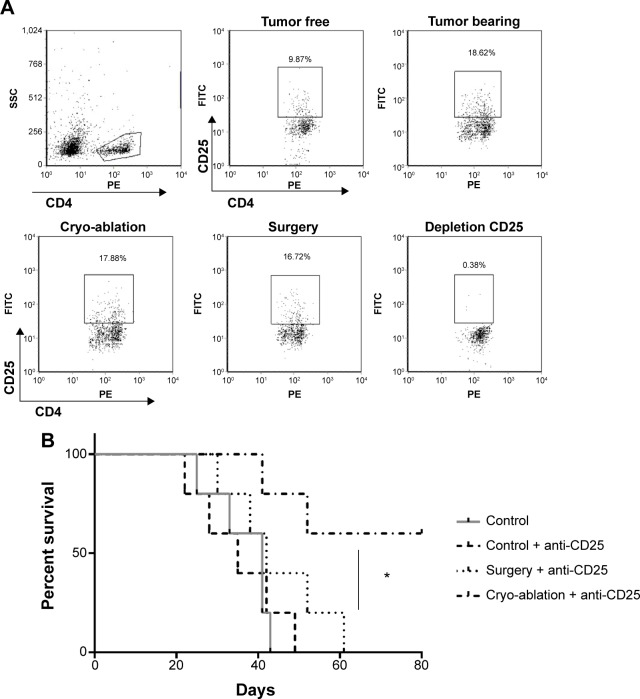
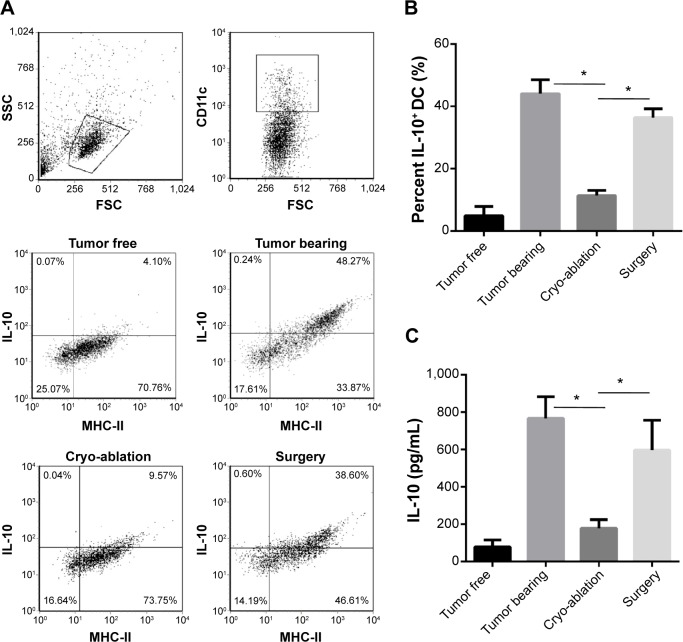
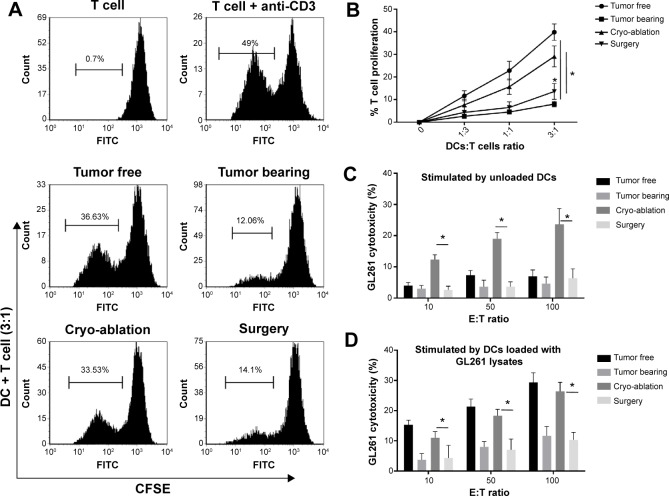
DCs in TDLNs in GL261 subcutaneous glioma mouse model expressed tolerogenic phenotype. In contrast to surgery, cryo-ablation improved the quantity and quality of these tolerogenic DCs. Moreover, the DCs decreased the expression of intracellular interleukin-10 (IL-10) and extra-cellular IL-10. In vitro, DCs from the cryo-ablation group recovered their specific function and induced potent anti-tumor immunity through triggering T cells. In vivo, cryo-ablation showed weak anti-tumor immunity, only inhibiting the growth of rechallenged tumors. But many IL-10-low DCs, rather than IL-10-high DCs, infiltrated the tumors. More importantly, Tregs inhibited the performance of these DCs; and depletion of Tregs greatly improved anti-tumor immunity in vivo.
Cryo-ablation could recover function of tumor induced tolerogenic DCs in vitro; and depletion of Tregs could improve this anti-tumor effect in vivo. The Tregs/CD4(+)T and Tregs/CD25(+)T cells in TDLNs inhibit DCs' activity and function.
除了对肿瘤进行微创破坏外,肿瘤冷冻消融在一定程度上还能调节抗肿瘤免疫。胶质瘤小鼠模型中经冷冻消融的肿瘤可诱导抗肿瘤细胞免疫反应,增加血液中CD3(+)和CD4(+)T细胞以及自然杀伤细胞的百分比。作为触发抗肿瘤免疫的关键角色,树突状细胞(DCs)被肿瘤诱导形成耐受表型,这有助于肿瘤逃避免疫监视。本研究旨在探讨冷冻消融是否会影响致耐受性DCs,并影响肿瘤引流淋巴结(TDLNs)中的抗肿瘤免疫。
使用GL261皮下胶质瘤小鼠模型,我们创建了荷瘤组、冷冻消融组和手术组。我们分析了致耐受性DCs的表型和功能变化,并评估了抗肿瘤免疫抑制因素。
GL261皮下胶质瘤小鼠模型的TDLNs中的DCs表达致耐受性表型。与手术相比,冷冻消融改善了这些致耐受性DCs的数量和质量。此外,DCs降低了细胞内白细胞介素-10(IL-10)和细胞外IL-10的表达。在体外,冷冻消融组的DCs恢复了其特定功能,并通过触发T细胞诱导了强大的抗肿瘤免疫。在体内,冷冻消融显示出较弱的抗肿瘤免疫,仅抑制再次接种肿瘤的生长。但是,许多IL-10低的DCs而非IL-10高的DCs浸润肿瘤。更重要的是,调节性T细胞(Tregs)抑制了这些DCs的功能;Tregs的清除在体内大大提高了抗肿瘤免疫。
冷冻消融可在体外恢复肿瘤诱导的致耐受性DCs的功能;Tregs的清除可在体内改善这种抗肿瘤作用。TDLNs中的Tregs/CD4(+)T和Tregs/CD25(+)T细胞抑制DCs的活性和功能。