The Department of Interventional Radiology, First Affiliated Hospital of Fujian Medical University, Fuzhou, Fujian, China.
Fujian Provincial Key Laboratory of Precision Medicine for Cancer, Fuzhou, Fujian, China.
Front Immunol. 2022 Sep 23;13:990224. doi: 10.3389/fimmu.2022.990224. eCollection 2022.
To explore the effectiveness of cryoablation combined with arterial perfusion with programmed cell death protein 1 inhibitors in overcoming immune resistance in advanced solid cancers.
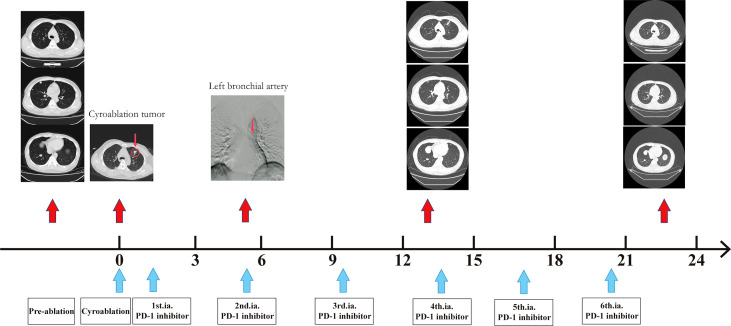
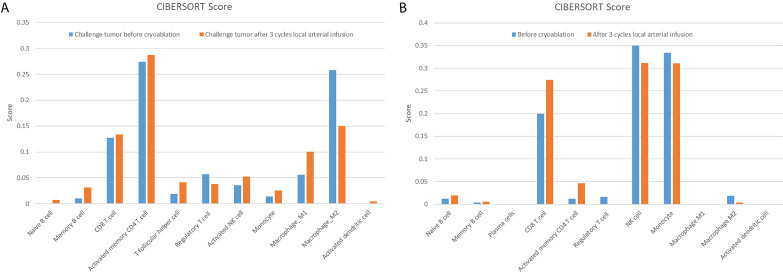
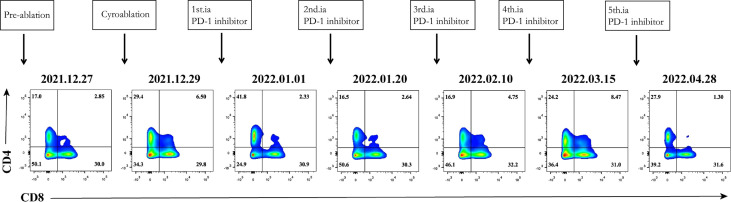
In this pilot retrospective study, nine patients with solid cancers were treated with tumour cryoablation and arterial perfusion with programmed cell death protein 1 inhibitors, which had previously proven ineffective. The CIBERSORT software was used to estimate the levels of tumour-infiltrating immune cells in the challenged tumour. Changes in the levels of circulating T cells were assessed using flow cytometry. The primary endpoints were disease control and objective response rates, and the secondary endpoint was safety.
The nine patients with advanced solid tumours received cryoablation combined with arterial perfusion with programmed cell death protein 1 inhibitors between June and December 2021. The median follow-up time was 5.8 months. We recorded an objective response rate in two patients (22.22%). The best overall responses were partial responses in two patients (22.22%) and one case (11.11%) of stable disease, while six patients (66.67%) presented progressive disease. However, the median overall survival time was not reached. The median progression-free survival was 2.4 months. Treatment-related severe adverse events included one case of abdominal infection and one case of upper gastrointestinal bleeding, which were cured after the intervention. The CIBERSORT software confirmed the importance of cryoablation in regulating tumour-infiltrating immune cells. Thus, macrophage polarisation from the M2 to the M1 phenotype in the challenged tumour and a gradual increase in the levels of circulating CD4 T cells were observed after administration of the combination therapy.
Cryoablation combined with arterial perfusion with programmed cell death protein 1 inhibitors has the potential efficacy and safety to overcome immune resistance in patients with advanced solid cancers. The combination therapy leads to macrophage polarisation from the M2 to the M1 phenotype in the challenged tumour to enhance antitumour immunity.
探索冷冻消融联合程序性细胞死亡蛋白 1 抑制剂动脉灌注克服晚期实体瘤免疫抵抗的疗效。
本研究为单臂、回顾性、探索性临床试验。纳入 9 例接受过经治的晚期实体瘤患者,这些患者接受了肿瘤冷冻消融联合程序性细胞死亡蛋白 1 抑制剂动脉灌注治疗,此前的治疗均无效。采用 CIBERSORT 软件估计挑战肿瘤中肿瘤浸润免疫细胞的水平。使用流式细胞术评估循环 T 细胞水平的变化。主要终点为疾病控制率和客观缓解率,次要终点为安全性。
2021 年 6 月至 12 月,9 例晚期实体瘤患者接受了冷冻消融联合程序性细胞死亡蛋白 1 抑制剂动脉灌注治疗。中位随访时间为 5.8 个月。我们在 2 例患者(22.22%)中记录到客观缓解率。2 例患者(22.22%)和 1 例患者(11.11%)的最佳总体反应为部分缓解,6 例患者(66.67%)出现疾病进展。然而,中位总生存期尚未达到。中位无进展生存期为 2.4 个月。与治疗相关的严重不良事件包括 1 例腹部感染和 1 例上消化道出血,经干预后治愈。CIBERSORT 软件证实了冷冻消融在调节肿瘤浸润免疫细胞方面的重要性。因此,在联合治疗后,观察到挑战肿瘤中 M2 向 M1 表型的巨噬细胞极化,以及循环 CD4 T 细胞水平逐渐增加。
冷冻消融联合程序性细胞死亡蛋白 1 抑制剂动脉灌注在克服晚期实体瘤患者的免疫抵抗方面具有潜在的疗效和安全性。联合治疗导致挑战肿瘤中 M2 向 M1 表型的巨噬细胞极化,增强抗肿瘤免疫。