Hargreaves James R, Davey Calum, Fearon Elizabeth, Hensen Bernadette, Krishnaratne Shari
Department of Social and Environmental Health Research and Centre for Evaluation, London School of Hygiene and Tropical Medicine, London, United Kingdom.
PLoS One. 2015 Mar 20;10(3):e0121775. doi: 10.1371/journal.pone.0121775. eCollection 2015.
In Eastern and Southern Africa, HIV prevalence was highest among higher socioeconomic groups during the 1990s. It has been suggested that this is changing, with HIV prevalence falling among higher-educated groups while stable among lower-educated groups. A multi-country analysis has not been undertaken.
We analysed data on socio-demographic factors and HIV infection from 14 nationally representative surveys of adults aged 15-24 (seven countries, two surveys each, 4-8 years apart). Sample sizes ranged from 2,408-12,082 (72,135 total). We used logistic regression to assess gender-stratified associations between highest educational level attended and HIV status in each survey, adjusting for age and urban/rural setting. We tested for interactions with urban/rural setting and age. Our primary hypothesis was that higher education became less of a risk factor for HIV over time. We tested for interaction between survey-year and the education-HIV association in each country and all countries pooled.
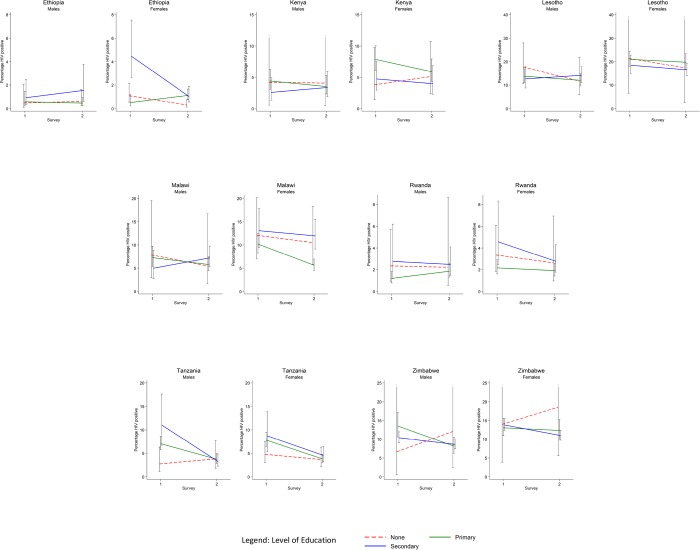
In Ethiopia and Malawi, HIV prevalence was higher in more educated women in both surveys. In Lesotho, Kenya and Zimbabwe, HIV prevalence was lower in higher educated women in both surveys. In Ethiopia, HIV prevalence fell among no and secondary educated women only (interaction p<0·01). Only among young men in Tanzania there was some evidence that the association between education and HIV changed over time (p=0·07). Pooled analysis found little evidence for an interaction between survey year and the education-HIV association among men (p=0·60) or women (p=0·37).
The pattern of prevalent HIV infection among young adults by level of education in different sub-Saharan African countries was heterogeneous. There was little statistical evidence that this pattern changed between 2003-5 and 2008-12. Explanations for the social epidemiology of HIV in Africa will need to account for time-trends and inter-country differences.
在东非和南非,20世纪90年代艾滋病毒感染率在社会经济地位较高的群体中最高。有人认为这种情况正在发生变化,受过高等教育群体中的艾滋病毒感染率在下降,而受教育程度较低群体中的感染率保持稳定。尚未进行多国分析。
我们分析了来自14项针对15至24岁成年人的全国代表性调查(七个国家,每个国家两项调查,相隔4至8年)中的社会人口学因素和艾滋病毒感染数据。样本量从2408至12082不等(总计72135)。我们使用逻辑回归评估每次调查中所接受的最高教育水平与艾滋病毒感染状况之间按性别分层的关联,并对年龄和城乡环境进行调整。我们检验了与城乡环境和年龄的相互作用。我们的主要假设是,随着时间的推移,高等教育成为艾滋病毒危险因素的程度降低。我们检验了每个国家以及所有国家汇总后的调查年份与教育 - 艾滋病毒关联之间的相互作用。
在埃塞俄比亚和马拉维,两次调查中受教育程度较高的女性艾滋病毒感染率均较高。在莱索托、肯尼亚和津巴布韦,两次调查中受教育程度较高的女性艾滋病毒感染率均较低。在埃塞俄比亚,仅未受过教育和受过中等教育的女性中艾滋病毒感染率下降(相互作用p<0.01)。仅在坦桑尼亚的年轻男性中,有一些证据表明教育与艾滋病毒之间的关联随时间发生了变化(p = 0.07)。汇总分析发现,几乎没有证据表明调查年份与男性(p = 0.60)或女性(p = 0.37)的教育 - 艾滋病毒关联之间存在相互作用。
撒哈拉以南非洲不同国家中,按教育水平划分的年轻成年人中艾滋病毒感染流行模式存在异质性。几乎没有统计证据表明这种模式在2003 - 2005年至2008 - 2012年期间发生了变化。对非洲艾滋病毒社会流行病学的解释需要考虑时间趋势和国家间差异。