Chen Jingyan, Tibroni Nadine, Sauter Daniel, Galaski Johanna, Miura Toshiyuki, Alter Galit, Mueller Birthe, Haller Claudia, Walker Bruce D, Kirchhoff Frank, Brumme Zabrina L, Ueno Takamasa, Fackler Oliver T
Department of Infectious Diseases, Integrative Virology, University Hospital Heidelberg, INF 324, Heidelberg, Germany; German Center for Infection Research, Heidelberg University, Heidelberg. Germany.
Institute of Molecular Virology, Ulm University Medical Center, Ulm, Germany.
PLoS One. 2015 Mar 20;10(3):e0120434. doi: 10.1371/journal.pone.0120434. eCollection 2015.
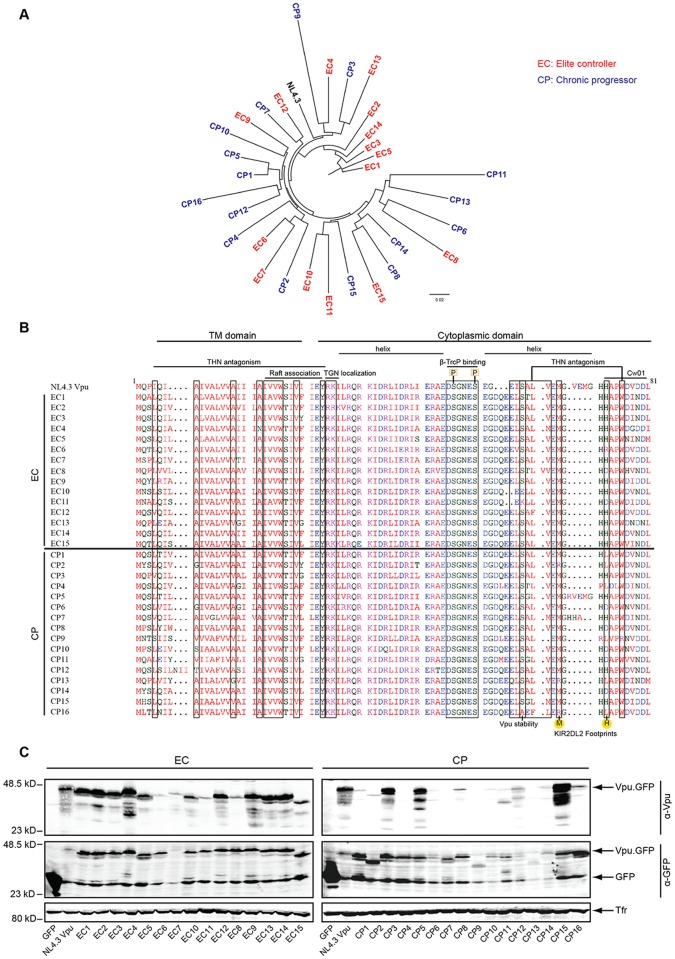
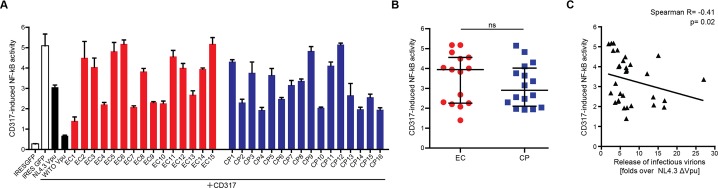
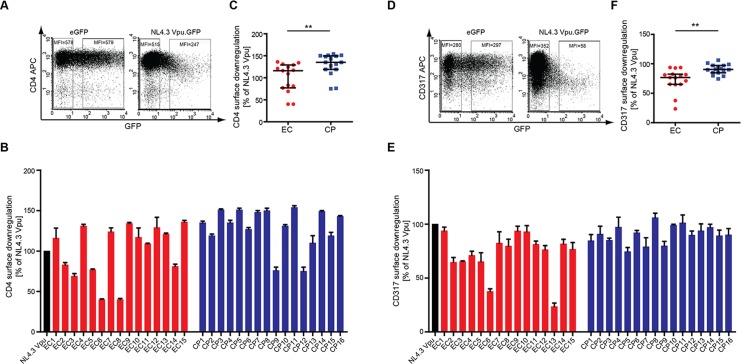
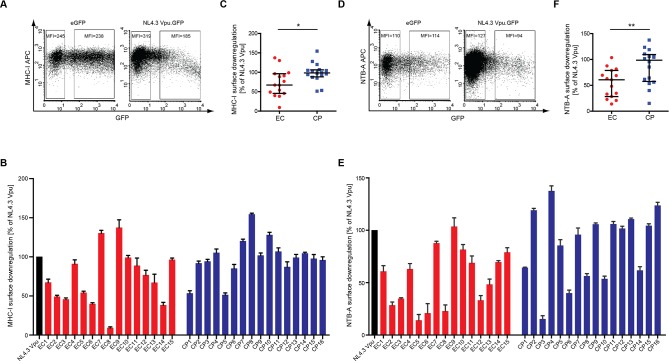
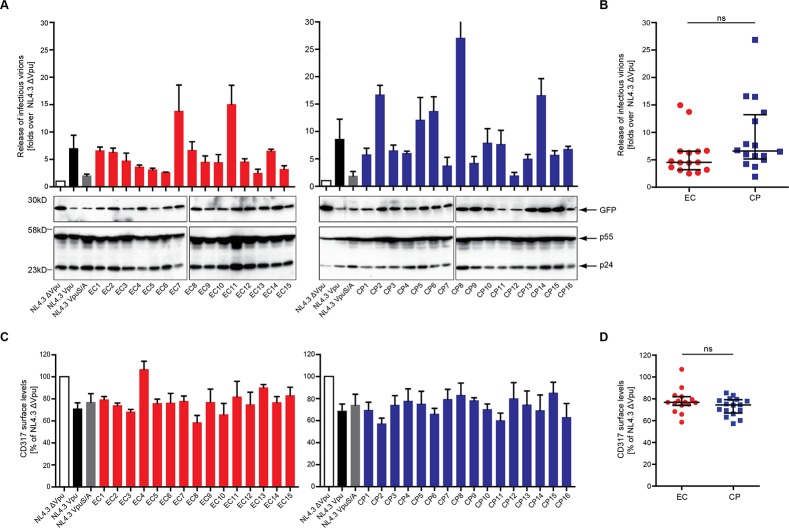
In the absence of antiretroviral therapy, infection with human immunodeficiency virus type 1 (HIV-1) can typically not be controlled by the infected host and results in the development of acquired immunodeficiency. In rare cases, however, patients spontaneously control HIV-1 replication. Mechanisms by which such elite controllers (ECs) achieve control of HIV-1 replication include particularly efficient immune responses as well as reduced fitness of the specific virus strains. To address whether polymorphisms in the accessory HIV-1 protein Vpu are associated with EC status we functionally analyzed a panel of plasma-derived vpu alleles from 15 EC and 16 chronic progressor (CP) patients. Antagonism of the HIV particle release restriction by the intrinsic immunity factor CD317/tetherin was well conserved among EC and CP Vpu alleles, underscoring the selective advantage of this Vpu function in HIV-1 infected individuals. In contrast, interference with CD317/tetherin induced NF-κB activation was little conserved in both groups. EC Vpus more frequently displayed reduced ability to downregulate cell surface levels of CD4 and MHC class I (MHC-I) molecules as well as of the NK cell ligand NTB-A. Polymorphisms potentially associated with high affinity interactions of the inhibitory killer immunoglobulin-like receptor (KIR) KIR2DL2 were significantly enriched among EC Vpus but did not account for these functional differences. Together these results suggest that in a subgroup of EC patients, some Vpu functions are modestly reduced, possibly as a result of host selection.
在没有抗逆转录病毒疗法的情况下,1型人类免疫缺陷病毒(HIV-1)感染通常无法被受感染宿主控制,并导致获得性免疫缺陷的发展。然而,在罕见情况下,患者可自发控制HIV-1复制。这类精英控制者(EC)实现对HIV-1复制控制的机制包括特别有效的免疫反应以及特定病毒株适应性的降低。为了探讨HIV-1辅助蛋白Vpu中的多态性是否与EC状态相关,我们对来自15名EC患者和16名慢性进展者(CP)患者的一组血浆来源的vpu等位基因进行了功能分析。EC和CP的Vpu等位基因在通过固有免疫因子CD317/束缚素对抗HIV颗粒释放限制方面表现出良好的保守性,这突出了这种Vpu功能在HIV-1感染个体中的选择优势。相比之下,两组在干扰CD317/束缚素诱导的NF-κB激活方面几乎没有保守性。EC的Vpu更频繁地表现出下调CD4和MHC I类(MHC-I)分子以及NK细胞配体NTB-A细胞表面水平的能力降低。与抑制性杀伤免疫球蛋白样受体(KIR)KIR2DL2的高亲和力相互作用可能相关的多态性在EC的Vpu中显著富集,但并不能解释这些功能差异。这些结果共同表明,在一部分EC患者中,某些Vpu功能适度降低,可能是宿主选择的结果。