Khandaker Golam M, Stochl Jan, Zammit Stanley, Lewis Glyn, Jones Peter B
Department of Psychiatry, University of Cambridge, Cambridge, UK; National Institute for Health Research Biomedical Research Centre, Cambridge, UK; Cambridgeshire and Peterborough NHS Foundation Trust, Cambridge, UK.
Department of Psychiatry, University of Cambridge, Cambridge, UK; National Institute for Health Research Biomedical Research Centre, Cambridge, UK; Cambridgeshire and Peterborough NHS Foundation Trust, Cambridge, UK; Department of Health Sciences, University of York, UK.
Ann Epidemiol. 2015 Apr;25(4):236-42. doi: 10.1016/j.annepidem.2014.11.013. Epub 2014 Nov 20.
To determine neurocognitive, educational, and psychological functioning during childhood and early adolescence among survivors of early life meningitis who are apparently healthy.
In the general population-based Avon Longitudinal Study of Parents and Children birth cohort, meningitis exposure was determined at age of 18 months. The outcomes of intelligence quotient, short-term memory, working memory, reading and spelling abilities, psychological and behavioral problems, depressive and anxiety symptoms, and psychotic experiences at ages 9 to 13 years were compared between those exposed and unexposed to meningitis. Individuals with special educational needs were excluded.
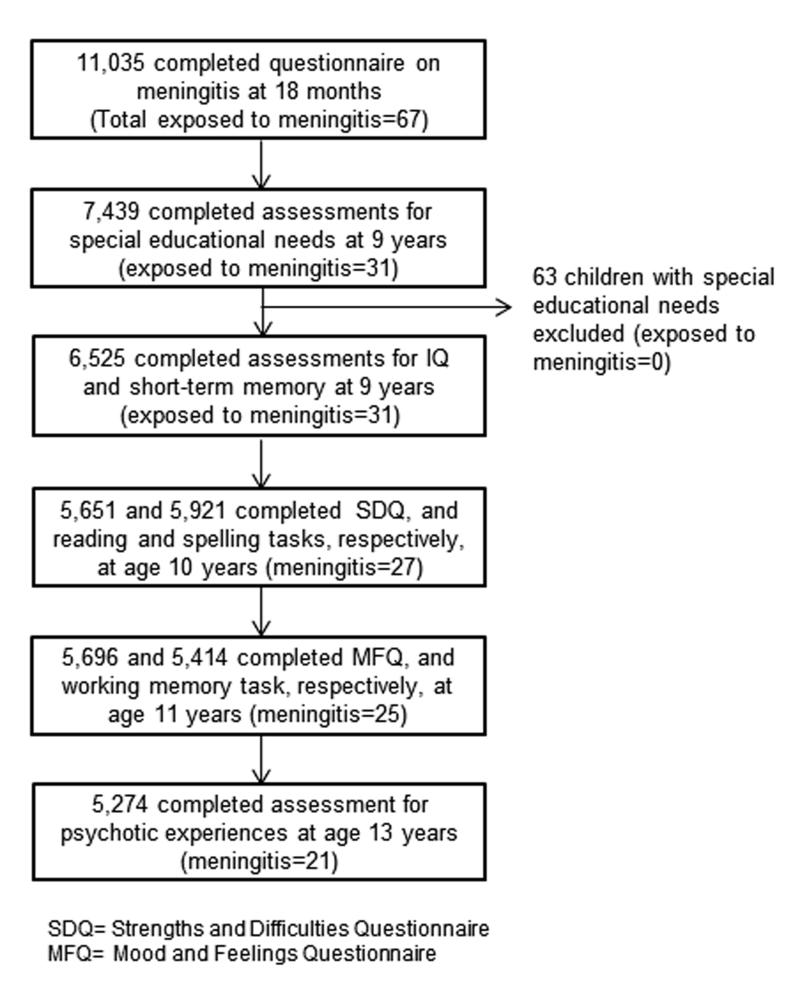
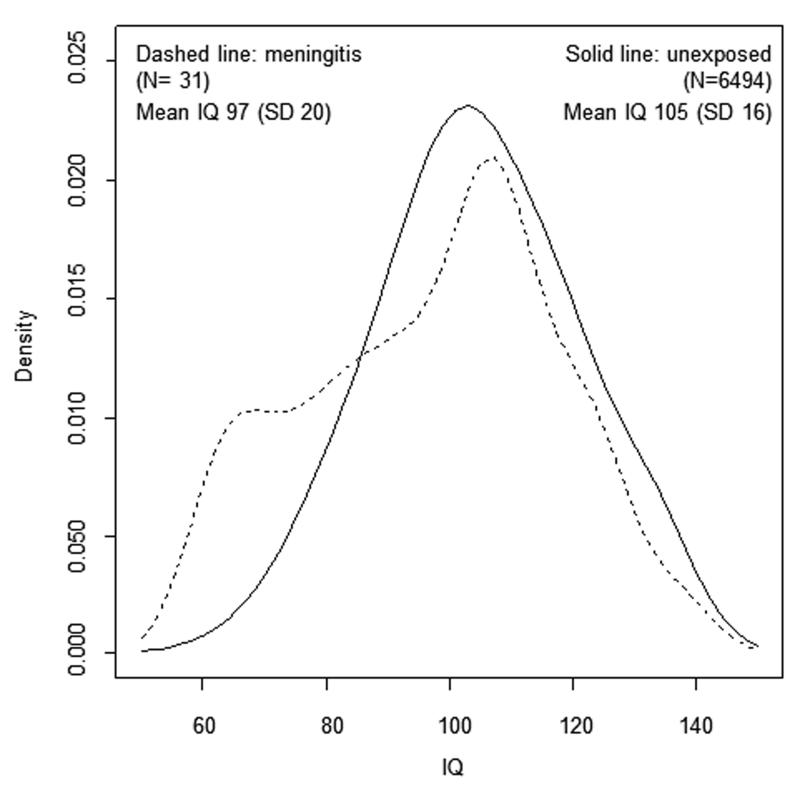
By age of 18 months, 67 of 11,035 children were reported to have suffered from meningitis (0.61%). These children, compared with the unexposed, performed worse on all neurocognitive and educational measures; mean difference in total intelligence quotient 7.36 (95% confidence interval, 1.60-13.11). Meningitis was associated with higher depressive and anxiety symptoms (P = .02), psychological and behavioral problems (P = .09), and increased risk of psychotic experiences; risk ratio 2.22 (95% confidence interval, 1.12-4.38).
Exposure to meningitis in the early life is associated with neurocognitive, educational, and psychological difficulties during childhood and early adolescence among survivors who are apparently healthy. Therefore, focusing only on serious neurologic disabilities may underestimate the true impact of early life meningitis.
确定看似健康的早年患脑膜炎幸存者在童年期和青春期早期的神经认知、教育及心理功能状况。
在基于一般人群的雅芳亲子纵向研究出生队列中,在18个月大时确定是否接触过脑膜炎。比较9至13岁时接触过和未接触过脑膜炎的儿童在智商、短期记忆、工作记忆、阅读和拼写能力、心理和行为问题、抑郁和焦虑症状以及精神病体验方面的结果。排除有特殊教育需求的个体。
到18个月大时,11035名儿童中有67名报告曾患脑膜炎(0.61%)。与未接触者相比,这些儿童在所有神经认知和教育指标上表现更差;总智商的平均差异为7.36(95%置信区间,1.60 - 13.11)。脑膜炎与更高的抑郁和焦虑症状(P = 0.02)、心理和行为问题(P = 0.09)以及精神病体验风险增加有关;风险比为2.22(95%置信区间,1.12 - 4.38)。
早年接触脑膜炎与看似健康的幸存者在童年期和青春期早期的神经认知、教育和心理困难有关。因此,仅关注严重的神经残疾可能会低估早年脑膜炎的真正影响。