Zdżalik Daria, Domańska Anna, Prorok Paulina, Kosicki Konrad, van den Born Erwin, Falnes Pål Ø, Rizzo Carmelo J, Guengerich F Peter, Tudek Barbara
Institute of Genetics and Biotechnology, Faculty of Biology, University of Warsaw, Warsaw, Poland.
Institute of Genetics and Biotechnology, Faculty of Biology, University of Warsaw, Warsaw, Poland; Institute of Biochemistry and Biophysics, Polish Academy of Sciences, Warsaw, Poland.
DNA Repair (Amst). 2015 Jun;30:1-10. doi: 10.1016/j.dnarep.2015.02.021. Epub 2015 Mar 5.
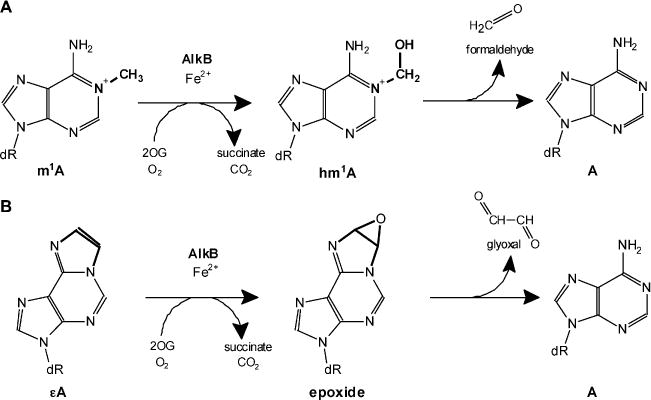
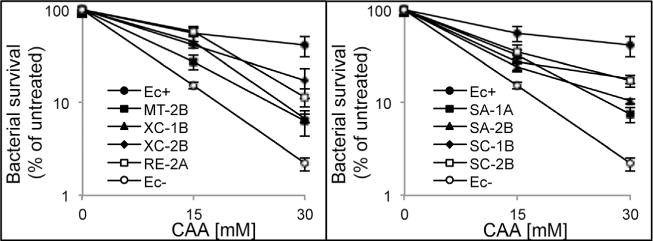
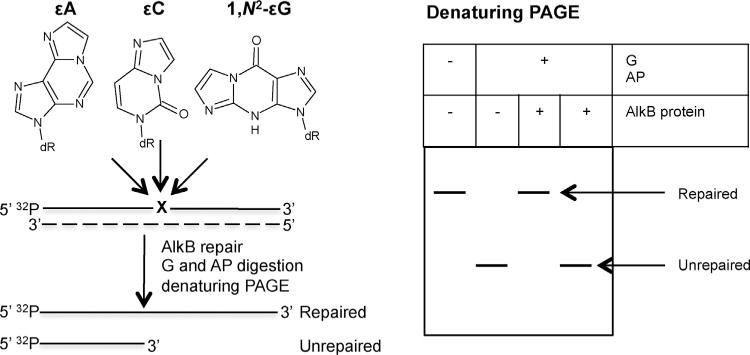
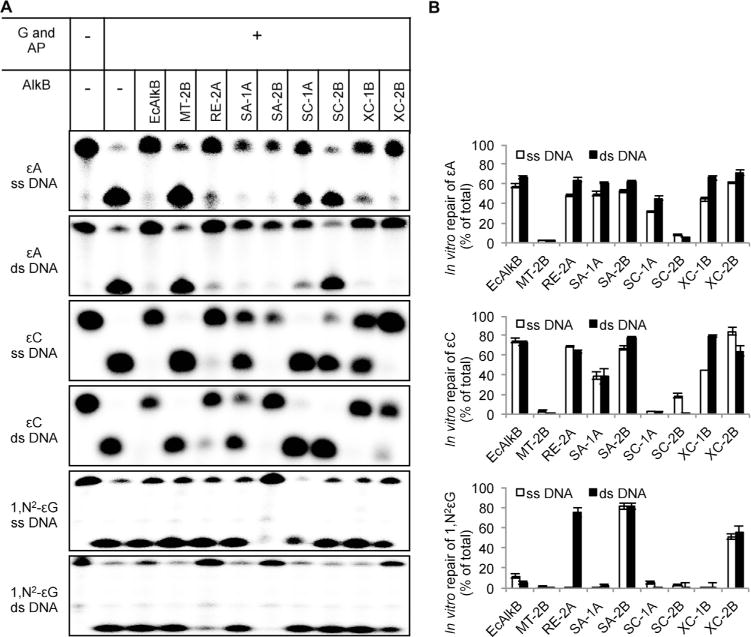
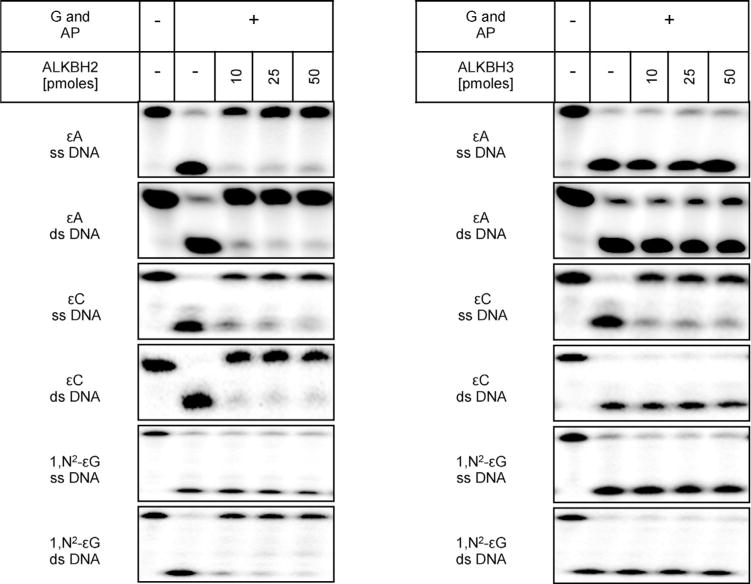
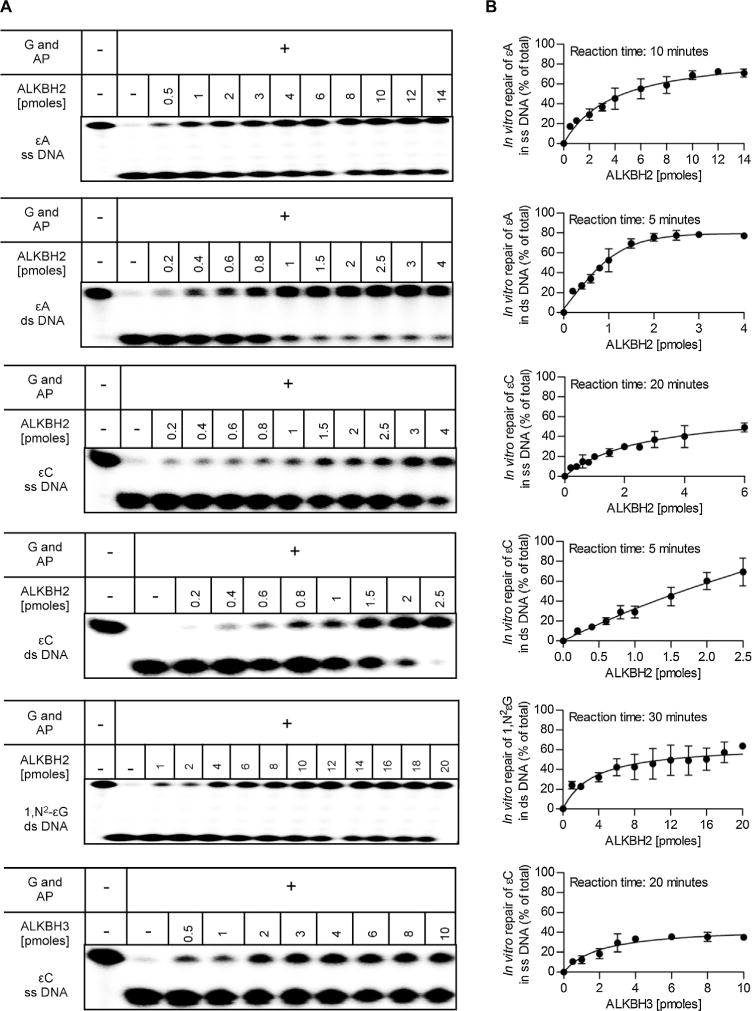
AlkB proteins are evolutionary conserved Fe(II)/2-oxoglutarate-dependent dioxygenases, which remove alkyl and highly promutagenic etheno(ɛ)-DNA adducts, but their substrate specificity has not been fully determined. We developed a novel assay for the repair of ɛ-adducts by AlkB enzymes using oligodeoxynucleotides with a single lesion and specific DNA glycosylases and AP-endonuclease for identification of the repair products. We compared the repair of three ɛ-adducts, 1,N(6)-ethenoadenine (ɛA), 3,N(4)-ethenocytosine (ɛC) and 1,N(2)-ethenoguanine (1,N(2)-ɛG) by nine bacterial and two human AlkBs, representing four different structural groups defined on the basis of conserved amino acids in the nucleotide recognition lid, engaged in the enzyme binding to the substrate. Two bacterial AlkB proteins, MT-2B (from Mycobacterium tuberculosis) and SC-2B (Streptomyces coelicolor) did not repair these lesions in either double-stranded (ds) or single-stranded (ss) DNA. Three proteins, RE-2A (Rhizobium etli), SA-2B (Streptomyces avermitilis), and XC-2B (Xanthomonas campestris) efficiently removed all three lesions from the DNA substrates. Interestingly, XC-2B and RE-2A are the first AlkB proteins shown to be specialized for ɛ-adducts, since they do not repair methylated bases. Three other proteins, EcAlkB (Escherichia coli), SA-1A, and XC-1B removed ɛA and ɛC from ds and ssDNA but were inactive toward 1,N(2)-ɛG. SC-1A repaired only ɛA with the preference for dsDNA. The human enzyme ALKBH2 repaired all three ɛ-adducts in dsDNA, while only ɛA and ɛC in ssDNA and repair was less efficient in ssDNA. ALKBH3 repaired only ɛC in ssDNA. Altogether, we have shown for the first time that some AlkB proteins, namely ALKBH2, RE-2A, SA-2B and XC-2B can repair 1,N(2)-ɛG and that ALKBH3 removes only ɛC from ssDNA. Our results also suggest that the nucleotide recognition lid is not the sole determinant of the substrate specificity of AlkB proteins.
AlkB蛋白是进化上保守的依赖于Fe(II)/2-氧代戊二酸的双加氧酶,可去除烷基和高度致突变的乙烯基(ɛ)-DNA加合物,但其底物特异性尚未完全确定。我们开发了一种新的检测方法,用于检测AlkB酶对ɛ-加合物的修复作用,该方法使用带有单个损伤的寡脱氧核苷酸以及特异性DNA糖基化酶和AP核酸内切酶来鉴定修复产物。我们比较了9种细菌和2种人类AlkB蛋白对三种ɛ-加合物(1,N(6)-乙烯基腺嘌呤(ɛA)、3,N(4)-乙烯基胞嘧啶(ɛC)和1,N(2)-乙烯基鸟嘌呤(1,N(2)-ɛG))的修复情况,这些AlkB蛋白代表了基于核苷酸识别结构域中保守氨基酸定义的四个不同结构组,参与酶与底物的结合。两种细菌AlkB蛋白,MT-2B(来自结核分枝杆菌)和SC-2B(天蓝色链霉菌)在双链(ds)或单链(ss)DNA中均不能修复这些损伤。三种蛋白,RE-2A(根瘤菌)、SA-2B(阿维链霉菌)和XC-2B(野油菜黄单胞菌)能有效去除DNA底物上的所有三种损伤。有趣的是,XC-2B和RE-2A是首批被证明专门针对ɛ-加合物的AlkB蛋白,因为它们不能修复甲基化碱基。另外三种蛋白,EcAlkB(大肠杆菌)、SA-1A和XC-1B能从dsDNA和ssDNA中去除ɛA和ɛC,但对1,N(2)-ɛG无活性。SC-1A仅修复ɛA,且更倾向于dsDNA。人类酶ALKBH2能修复dsDNA中的所有三种ɛ-加合物,而在ssDNA中仅能修复ɛA和ɛC,且在ssDNA中的修复效率较低。ALKBH3仅能修复ssDNA中的ɛC。总之,我们首次表明,一些AlkB蛋白,即ALKBH2、RE-2A、SA-2B和XC-2B可以修复1,N(2)-ɛG,而ALKBH3仅能从ssDNA中去除ɛC。我们的结果还表明,核苷酸识别结构域不是AlkB蛋白底物特异性的唯一决定因素。