Salvadori Enrico, Fung Mei Wai, Hoffmann Markus, Anderson Harry L, Kay Christopher W M
London Centre for Nanotechnology, University College London, 17-19 Gordon Street, London, WC1H 0AH UK ; Institute of Structural and Molecular Biology, University College London, Gower Street, London, WC1E 6BT UK.
Institute of Structural and Molecular Biology, University College London, Gower Street, London, WC1E 6BT UK.
Appl Magn Reson. 2015;46(4):359-368. doi: 10.1007/s00723-014-0621-8. Epub 2014 Dec 6.
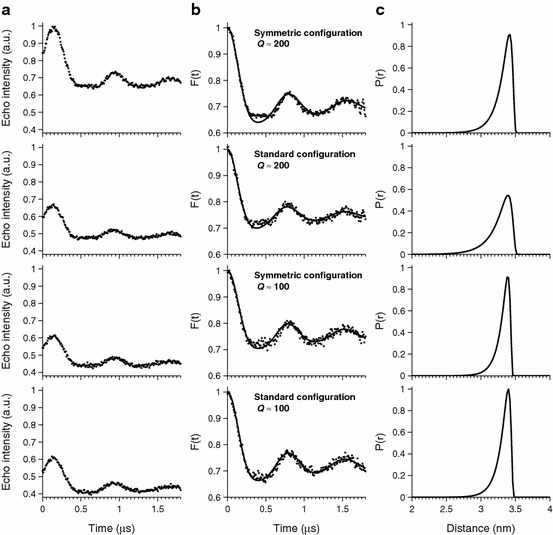
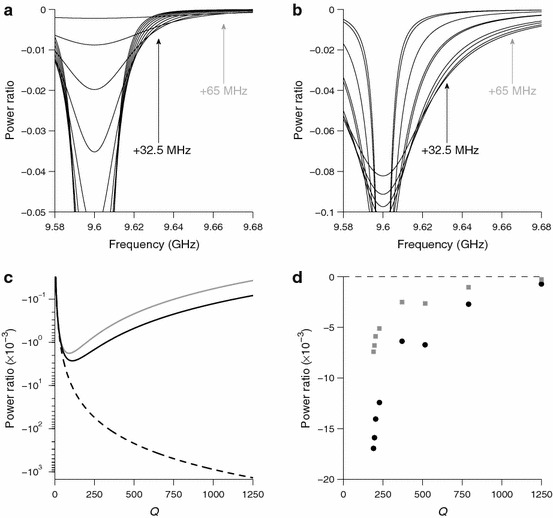
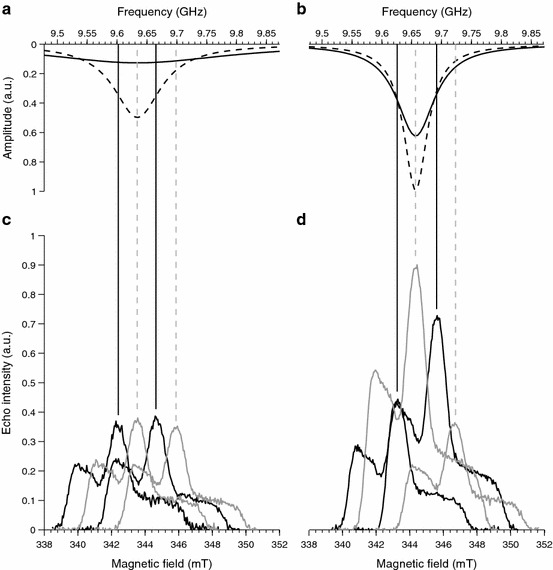
Pulsed electron paramagnetic resonance (EPR) spectroscopy using microwaves at two frequencies can be employed to measure distances between pairs of paramagnets separated by up to 10 nm. The method, combined with site-directed mutagenesis, has become increasingly popular in structural biology for both its selectivity and capability of providing information not accessible through more standard methods such as nuclear magnetic resonance and X-ray crystallography. Despite these advantages, EPR distance measurements suffer from poor sensitivity. One contributing factor is technical: since 65 MHz typically separates the pump and detection frequencies, they cannot both be located at the center of the pseudo-Lorentzian microwave resonance of a single-mode resonator. To maximize the inversion efficiency, the pump pulse is usually placed at the center of the resonance, while the observer frequency is placed in the wing, with consequent reduction in sensitivity. Here, we consider an alternative configuration: by spacing pump and observer frequencies symmetrically with respect to the microwave resonance and by increasing the quality factor, valuable improvement in the signal-to-noise ratio can be obtained.
使用两个频率的微波的脉冲电子顺磁共振(EPR)光谱可用于测量相距达10纳米的顺磁体对之间的距离。该方法与定点诱变相结合,因其选择性以及能够提供通过核磁共振和X射线晶体学等更标准方法无法获得的信息,在结构生物学中越来越受欢迎。尽管有这些优点,但EPR距离测量的灵敏度较差。一个促成因素是技术方面的:由于泵浦频率和检测频率通常相差65兆赫兹,它们不能同时位于单模谐振器的伪洛伦兹微波共振中心。为了使反转效率最大化,泵浦脉冲通常置于共振中心,而观测频率置于边带,从而导致灵敏度降低。在此,我们考虑一种替代配置:通过使泵浦频率和观测频率相对于微波共振对称分布,并提高品质因数,可以显著提高信噪比。