Erickson Kirk I, Leckie Regina L, Weinstein Andrea M, Radchenkova Polina, Sutton Bradley P, Prakash Ruchika Shaurya, Voss Michelle W, Chaddock-Heyman Laura, McAuley Edward, Kramer Arthur F
Department of Psychology, University of Pittsburgh Pittsburgh, Pennsylvania ; Center for the Neural Basis of Cognition, University of Pittsburgh Pittsburgh, Pennsylvania ; Center for Neuroscience, University of Pittsburgh Pittsburgh, Pennsylvania.
Department of Psychology, University of Pittsburgh Pittsburgh, Pennsylvania ; Center for the Neural Basis of Cognition, University of Pittsburgh Pittsburgh, Pennsylvania.
Brain Behav. 2015 Mar;5(3):e00311. doi: 10.1002/brb3.311. Epub 2015 Jan 29.
Greater educational attainment is associated with better neurocognitive health in older adults and is thought to reflect a measure of cognitive reserve. In vivo neuroimaging tools have begun to identify the brain systems and networks potentially responsible for reserve.
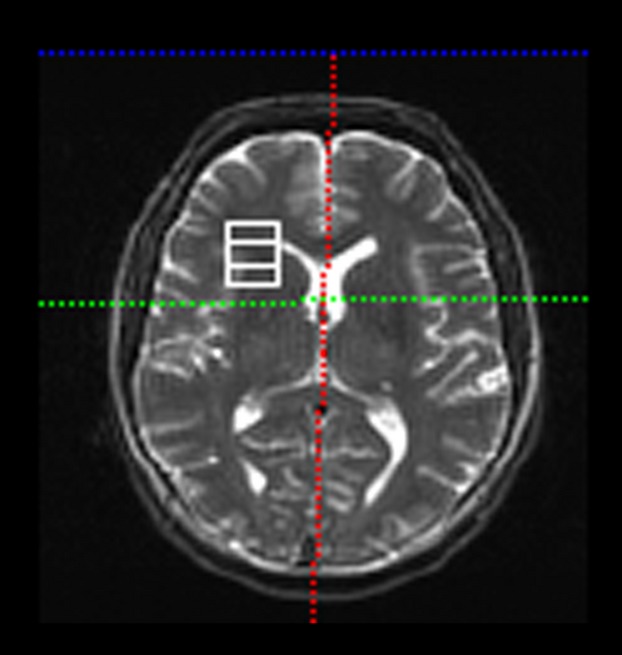
We examined the relationship between education, a commonly used proxy for cognitive reserve, and N-acetylaspartate (NAA) in neurologically healthy older adults (N=135; mean age=66 years). Using single voxel MR spectroscopy, we predicted that higher levels of education would moderate an age-related decline in NAA in the frontal cortex.
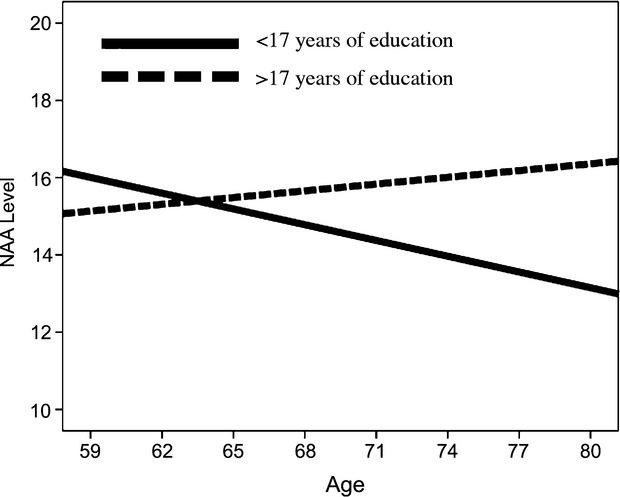
After controlling for the variance associated with cardiorespiratory fitness, sex, annual income, and creatine levels, there were no significant main effects of education (B=0.016, P=0.787) or age (B=-0.058, P=0.204) on NAA levels. However, consistent with our predictions, there was a significant education X age interaction such that more years of education offset an age-related decline in NAA (B=0.025, P=0.031). When examining working memory via the backwards digit span task, longer span length was associated with greater education (P<0.01) and showed a trend with greater NAA concentrations (P<0.06); however, there was no age X education interaction on digit span performance nor a significant moderated mediation effect between age, education, and NAA on digit span performance.
Taken together, these results suggest that higher levels of education may attenuate an age-related reduction in neuronal viability in the frontal cortex.
较高的教育程度与老年人更好的神经认知健康相关,并且被认为反映了一种认知储备的度量。体内神经成像工具已开始识别可能负责储备的脑系统和网络。
我们研究了教育(认知储备的常用替代指标)与神经功能正常的老年人(N = 135;平均年龄 = 66岁)中N - 乙酰天门冬氨酸(NAA)之间的关系。使用单体素磁共振波谱,我们预测更高的教育水平将缓解额叶皮质中与年龄相关的NAA下降。
在控制了与心肺适能、性别、年收入和肌酸水平相关的方差后,教育程度(B = 0.016,P = 0.787)或年龄(B = -0.058,P = 0.204)对NAA水平均无显著的主效应。然而,与我们的预测一致,存在显著的教育程度×年龄交互作用,即更多年的教育抵消了与年龄相关的NAA下降(B = 0.025,P = 0.031)。当通过倒背数字广度任务检查工作记忆时,更长的广度长度与更高的教育程度相关(P < 0.01),并且与更高的NAA浓度呈趋势相关(P < 0.06);然而,在数字广度表现上不存在年龄×教育程度交互作用,年龄、教育程度和NAA之间对数字广度表现也不存在显著的调节中介效应。
综合来看,这些结果表明更高的教育水平可能会减弱额叶皮质中与年龄相关的神经元活力下降。