Kamal Younis, Khan Hayat Ahmad, Farooq Munir, Gani Naseemul, Lone Ansar Ul Haq, Shah Adil Bashir, Latto Irfan Ahmad, Khan Mohammad Ashraf
Post Graduate Department of Orthopedics, Bone and Joint Hospital, GMC Srinagar, Jammu and Kashmir, India.
Arch Trauma Res. 2015 Mar 20;4(1):e20056. doi: 10.5812/atr.20056. eCollection 2015 Mar.
Management of distal radius fractures (DRFs) is still controversial and may be influenced by the initial fracture classification. Even though numerous classification systems have been proposed in this regard, the evaluation and management of this fracture has remained problematic.
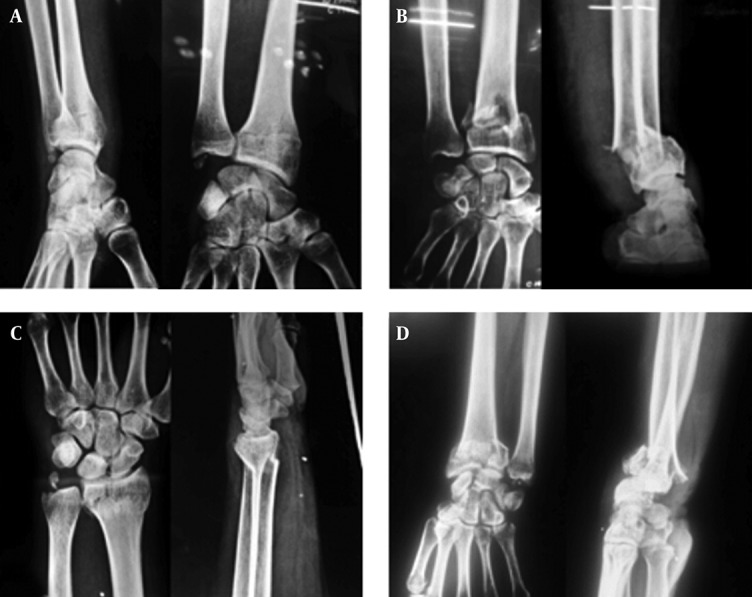
The purpose of this study was to evaluate the functional outcome of DRF managed on the basis of a new classification. This classification named as Barzullah Working Classification represents a modification of Melone classification, which is based on fracture stability.
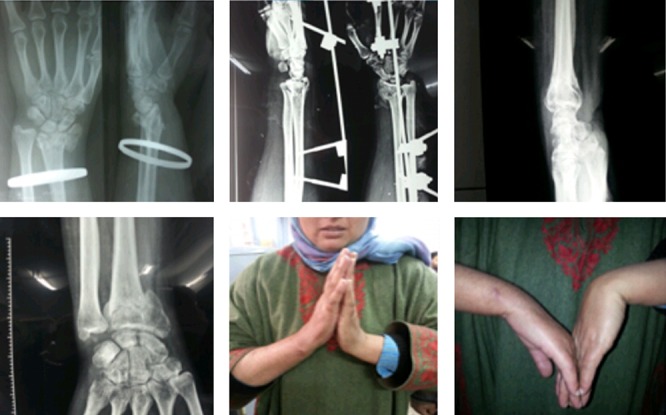
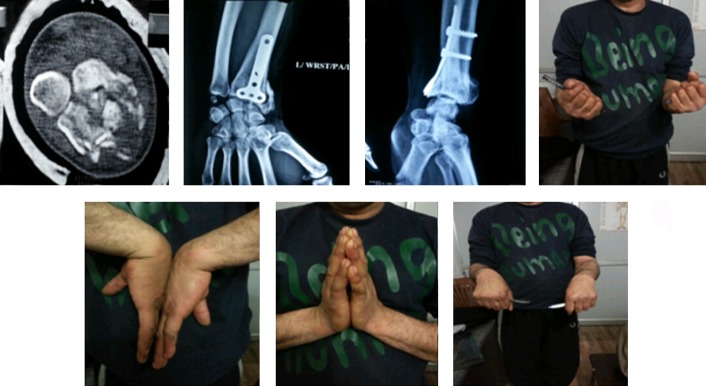
A total of 310 DRFs of patients skeletally matured referred to a tertiary care hospital at a period of 18 months were classified as per the new classification system into four types; metaphyseal stable, metaphyseal unstable, radiocarpal stable, and radiocarpal unstable fractures. They were managed and followed over a mean period of 15.10 ± 5.4 months, and the results were recorded at the final follow-up.
The mean age of the patients was 51.22 ± 20.58 years. Most of the patients were females (n=189, 64.19%). The minimal follow up was 6 months with a mean of 15.10 ± 5.4 months. Mean mayo wrist scores were 95 ± 4, 80 ± 7.4, 75 ± 7.4, and 70 ± 6.9, for stable metaphyseal fractures, unstable metaphyseal radial, stable radiocarpal fractures and unstable radiocarpal fractures, respectively. The overall mean mayo wrist functional score was 80.58 ± 12.3 (good results) at final follow up.
Various modalities of treatment used differentially in different types of DRFs based on the Barzullah Working Classification give good results in spite of conflicting literature.
桡骨远端骨折(DRF)的治疗仍存在争议,且可能受初始骨折分类的影响。尽管在这方面已提出众多分类系统,但该骨折的评估和治疗仍存在问题。
本研究旨在评估基于一种新分类法治疗DRF的功能结局。这种分类法名为Barzullah工作分类法,是对基于骨折稳定性的Melone分类法的一种改良。
在18个月期间转诊至一家三级护理医院的310例骨骼成熟患者的DRF,根据新分类系统分为四种类型:干骺端稳定型、干骺端不稳定型、桡腕关节稳定型和桡腕关节不稳定型骨折。对其进行治疗并平均随访15.10±5.4个月,在最终随访时记录结果。
患者的平均年龄为51.22±20.58岁。大多数患者为女性(n = 189,64.19%)。最短随访时间为6个月,平均随访时间为15.10±5.4个月。干骺端稳定型骨折、干骺端不稳定型桡骨骨折、桡腕关节稳定型骨折和桡腕关节不稳定型骨折的平均梅奥腕关节评分分别为95±4、80±7.4、75±7.4和70±6.9。在最终随访时,总体平均梅奥腕关节功能评分为80.58±12.3(结果良好)。
尽管文献存在争议,但基于Barzullah工作分类法在不同类型的DRF中采用不同的治疗方式仍可取得良好效果。