Jarosz-Biej Magdalena, Smolarczyk Ryszard, Cichoń Tomasz, Kułach Natalia, Czapla Justyna, Matuszczak Sybilla, Szala Stanisław
Center for Translational Research and Molecular Biology of Cancer, Maria Skłodowska-Curie Memorial Cancer Center and Institute of Oncology, Gliwice Branch, Wybrzeże Armii Krajowej 15, 44-101, Gliwice, Poland.
Department of Animal Physiology and Ecotoxycology, University of Silesia, Katowice, Poland.
Arch Immunol Ther Exp (Warsz). 2015 Dec;63(6):451-64. doi: 10.1007/s00005-015-0337-y. Epub 2015 Mar 24.
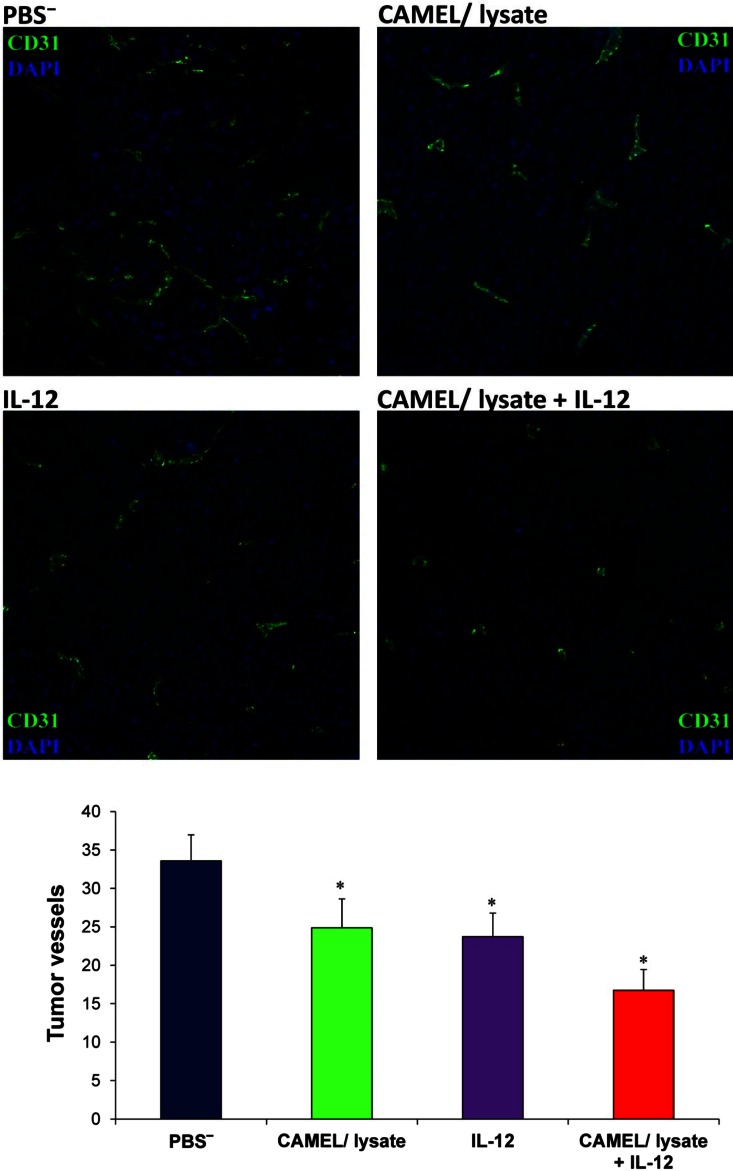
Tumor progression depends on tumor milieu, which influences neovasculature formation and immunosuppression. Combining immunotherapy with antiangiogenic/antivascular therapy might be an effective therapeutic approach. The aim of our study was to elaborate an anticancer therapeutic strategy based on the induction of immune response which leads to polarization of tumor milieu. To achieve this, we developed a tumor cell-based vaccine. CAMEL peptide was used as a B16-F10 cell death-inducing agent. The lysates were used as a vaccine to immunize mice bearing B16-F10 melanoma tumors. To further improve the therapeutic effect of the vaccine, we combined it with interleukin (IL)-12 gene therapy. IL-12, a cytokine with antiangiogenic properties, activates nonspecific and specific immune responses. We observed that combined therapy is significantly more effective (as compared with monotherapies) in inhibiting tumor growth. Furthermore, the tested combination polarizes the tumor microenvironment, which results in a switch from a proangiogenic/immunosuppressive to an antiangiogenic/immunostimulatory one. The switch manifests itself as a decreased number of tumor blood vessels, increased levels of tumor-infiltrating CD4(+), CD8(+) and NK cells, as well as lower level of suppressor lymphocytes (Treg). Our results suggest that polarizing tumor milieu by such combined therapy does inhibit tumor growth and seems to be a promising therapeutic strategy.
肿瘤进展取决于肿瘤微环境,肿瘤微环境会影响新生血管形成和免疫抑制。将免疫疗法与抗血管生成/抗血管疗法相结合可能是一种有效的治疗方法。我们研究的目的是制定一种基于诱导免疫反应的抗癌治疗策略,这种免疫反应会导致肿瘤微环境的极化。为实现这一目标,我们开发了一种基于肿瘤细胞的疫苗。骆驼肽(CAMEL)被用作诱导B16-F10细胞死亡的试剂。这些裂解物被用作疫苗来免疫荷B16-F10黑色素瘤肿瘤的小鼠。为进一步提高疫苗的治疗效果,我们将其与白细胞介素(IL)-12基因疗法相结合。IL-12是一种具有抗血管生成特性的细胞因子,可激活非特异性和特异性免疫反应。我们观察到联合治疗在抑制肿瘤生长方面(与单一疗法相比)明显更有效。此外,所测试的联合疗法使肿瘤微环境极化,这导致从促血管生成/免疫抑制状态转变为抗血管生成/免疫刺激状态。这种转变表现为肿瘤血管数量减少、肿瘤浸润的CD4(+)、CD8(+)和NK细胞水平增加,以及抑制性淋巴细胞(调节性T细胞)水平降低。我们的结果表明,通过这种联合疗法使肿瘤微环境极化确实能抑制肿瘤生长,似乎是一种有前景的治疗策略。