Winton-Brown T, Kumari V, Windler F, Moscoso A, Stone J, Kapur S, McGuire P
Department of Psychosis Studies, Institute of Psychiatry, Kings College London, United Kingdom.
Department of Psychology, Institute of Psychiatry, Kings College London, United Kingdom.
Schizophr Res. 2015 May;164(1-3):21-7. doi: 10.1016/j.schres.2015.02.017. Epub 2015 Mar 21.
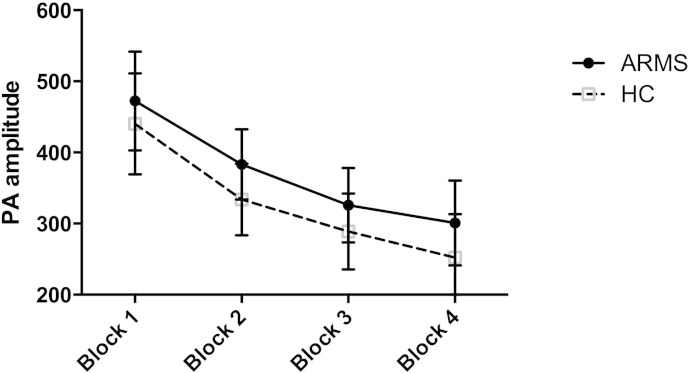
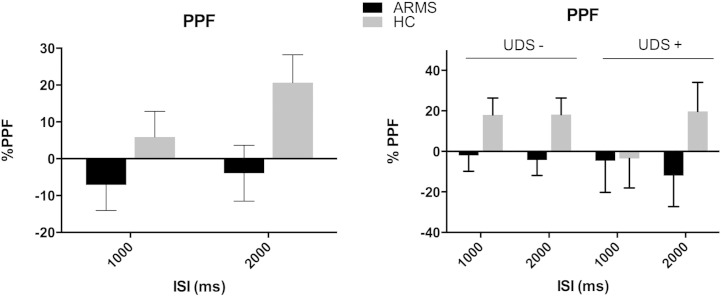
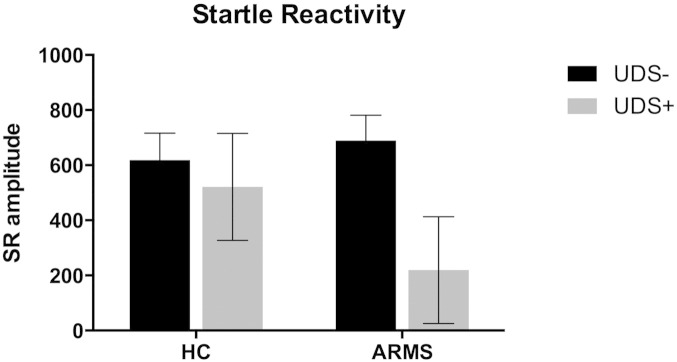
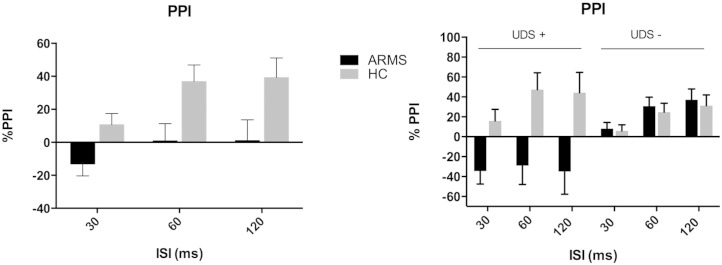
Sensorimotor gating, measured as the modification of eye blink startle reflexes to loud acoustic stimuli by quieter preceding stimuli, is altered in those with psychosis, their relatives and those at high clinical risk for psychosis. Alterations have also been shown in cannabis users, albeit to a lesser extent, and cannabis is a known risk factor for the onset of psychosis in clinically and genetically susceptible individuals. We examined the interaction between clinical risk for psychosis and cannabis use on sensorimotor gating, both Prepulse Inhibition (PPI) and Prepulse Facilitation (PPF). We tested PPI and PPF in participants with an At Risk Mental State (ARMS) for psychosis and a matched control group. Both groups included a proportion of subjects who had recently used cannabis, as confirmed by urinary drug screening (UDS) on the day of testing. We found that ARMS participants showed reduced PPF and PPI relative to controls, the latter driven by a group by cannabis use interaction, with recent use reducing PPI in ARMS participants but not in controls. When the analysis was limited to UDS-negative participants there was significantly reduced PPF in ARMS subjects relative to controls, but no differences in PPI. Within the ARMS group reduced sensorimotor gating, measured by both PPI and PPF, related to reduced overall level of function. Cannabis use in clinical high risk individuals may increase the risk of psychosis in part through worsening PPI, while PPF is altered in ARMS individuals irrespective of cannabis use. This develops our understanding of cognitive mechanisms leading to the experience of aberrant perceptual phenomena and the subsequent development of psychotic symptoms.
感觉运动门控是通过较安静的前置刺激对大声听觉刺激引起的眨眼惊吓反射的改变来衡量的,在患有精神病的患者、他们的亲属以及具有高精神病临床风险的人群中会发生改变。在大麻使用者中也发现了这种改变,尽管程度较轻,并且大麻是临床和遗传易感个体中精神病发作的已知风险因素。我们研究了精神病临床风险与大麻使用之间在感觉运动门控方面的相互作用,包括前脉冲抑制(PPI)和前脉冲促进(PPF)。我们在有精神病风险精神状态(ARMS)的参与者和匹配的对照组中测试了PPI和PPF。两组都包括一部分经测试当天尿液药物筛查(UDS)证实近期使用过大麻的受试者。我们发现,与对照组相比,ARMS参与者的PPF和PPI降低,后者是由组间与大麻使用的相互作用驱动的,近期使用大麻会降低ARMS参与者的PPI,但不会降低对照组的PPI。当分析仅限于UDS阴性参与者时,与对照组相比,ARMS受试者的PPF显著降低,但PPI没有差异。在ARMS组中,通过PPI和PPF测量的感觉运动门控降低与整体功能水平降低有关。临床高危个体使用大麻可能部分通过恶化PPI增加精神病风险,而无论是否使用大麻,ARMS个体的PPF都会改变。这加深了我们对导致异常感知现象体验和随后精神病症状发展的认知机制的理解。