Bresnahan Michaeline, Hornig Mady, Schultz Andrew F, Gunnes Nina, Hirtz Deborah, Lie Kari Kveim, Magnus Per, Reichborn-Kjennerud Ted, Roth Christine, Schjølberg Synnve, Stoltenberg Camilla, Surén Pål, Susser Ezra, Lipkin W Ian
Department of Epidemiology, Mailman School of Public Health, Columbia University, New York, New York2New York State Psychiatric Institute, New York.
Department of Epidemiology, Mailman School of Public Health, Columbia University, New York, New York3The Center for Infection and Immunity, Mailman School of Public Health, Columbia University, New York, New York.
JAMA Psychiatry. 2015 May;72(5):466-74. doi: 10.1001/jamapsychiatry.2014.3034.
Gastrointestinal (GI) comorbidities are frequently described in association with autism spectrum disorder (ASD). However, the prevalence of GI disturbances and the age at which such problems first appear are unclear, and their specificity for ASD compared with other neurodevelopmental disorders is uncertain.
To compare maternal report of GI symptoms during the first 3 years of life in children with ASD, developmental delay (DD), and typical development (TD).
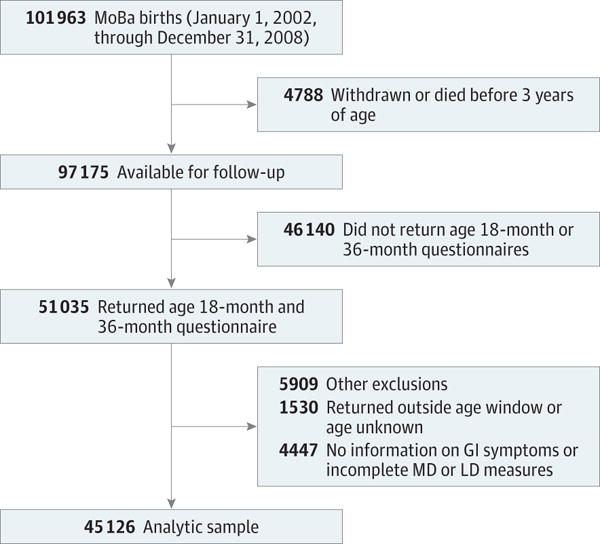
DESIGN, SETTING, AND PARTICIPANTS: This large prospective cohort study consists of participants in the Norwegian Mother and Child Cohort Study. During a 10-year period (January 1, 1999, through December 31, 2008), women throughout Norway were recruited at the first prenatal ultrasonographic visit (approximately 18 weeks' gestation). The study enrolled 95,278 mothers, 75,248 fathers, and 114,516 children. Our analyses are based on MoBa data released through October 1, 2013, and NPR diagnoses registered through December 31, 2012, and include children born from January 1, 2002, through December 31, 2008, with completed age 18- and 36-month questionnaires.
We defined 3 groups of children: children with ASD (n = 195), children with DD and delayed language and/or motor development (n = 4636), and children with TD (n = 40 ,95).
The GI symptoms were based on maternal report of constipation, diarrhea, and food allergy/intolerance.
Children with ASD were at significantly increased odds of maternally reported constipation (adjusted odds ratio [aOR], 2.7; 95% CI, 1.9-3.8; P < .001) and food allergy/intolerance (aOR, 1.7; 95% CI, 1.1-2.6; P = .01) in the 6- to 18-month-old age period and diarrhea (aOR, 2.3; 95% CI, 1.5-3.6; P < .001), constipation (aOR, 1.6; 95% CI, 1.2-2.3; P < .01), and food allergy/intolerance (aOR, 2.0; 95% CI, 1.3-3.1; P < .01) in the 18- to 36-month-old age period compared with children with TD. Similar results for these symptom categories were observed in comparisons with children with DD, but ORs were slightly lower. Mothers of children with ASD were significantly more likely to report 1 or more GI symptom in either the 6- to 18-month or the 18- to 36-month-old age period and more than twice as likely to report at least 1 GI symptom in both age periods compared with mothers of children with TD or DD.
In this large prospective cohort, maternally reported GI symptoms are more common and more often persistent during the first 3 years of life in children with ASD than in children with TD or DD.
胃肠道合并症常与自闭症谱系障碍(ASD)相关。然而,胃肠道功能紊乱的患病率以及这些问题首次出现的年龄尚不清楚,并且与其他神经发育障碍相比,其在ASD中的特异性也不确定。
比较自闭症谱系障碍(ASD)、发育迟缓(DD)和发育正常(TD)儿童在生命最初3年中母亲报告的胃肠道症状。
设计、背景和参与者:这项大型前瞻性队列研究由挪威母婴队列研究的参与者组成。在10年期间(1999年1月1日至2008年12月31日),挪威各地的妇女在首次产前超声检查(约妊娠18周)时被招募。该研究纳入了95278名母亲、75248名父亲和114516名儿童。我们的分析基于截至2013年10月1日发布的MoBa数据以及截至2012年12月31日登记的NPR诊断,包括2002年1月1日至2008年12月31日出生且完成了18个月和36个月问卷的儿童。
我们将儿童分为3组:自闭症谱系障碍儿童(n = 195)、发育迟缓和语言及/或运动发育迟缓儿童(n = 4636)以及发育正常儿童(n = 4095)。
胃肠道症状基于母亲报告的便秘、腹泻和食物过敏/不耐受情况。
与发育正常儿童相比,自闭症谱系障碍儿童在6至18个月龄时母亲报告的便秘(调整优势比[aOR],2.7;95%置信区间[CI],1.9 - 3.8;P <.001)和食物过敏/不耐受(aOR,1.7;95% CI,1.1 - 2.6;P =.01)的几率显著增加,在18至36个月龄时腹泻(aOR,2.3;95% CI,1.5 - 3.6;P <.001)、便秘(aOR,1.6;95% CI,1.2 - 2.3;P <.01)和食物过敏/不耐受(aOR,2.0;95% CI,1.3 - 3.1;P <.01)的几率也显著增加。与发育迟缓儿童相比,这些症状类别也有类似结果,但优势比略低。与发育正常或发育迟缓儿童的母亲相比,自闭症谱系障碍儿童的母亲在6至18个月龄或18至36个月龄时更有可能报告1种或更多胃肠道症状,并且在两个年龄阶段报告至少1种胃肠道症状的可能性是发育正常或发育迟缓儿童母亲的两倍多。
在这个大型前瞻性队列中,与发育正常或发育迟缓儿童相比,母亲报告的胃肠道症状在自闭症谱系障碍儿童生命的前3年中更常见且更常持续存在。