Restrepo Bibiana, Angkustsiri Kathleen, Taylor Sandra L, Rogers Sally J, Cabral Jacqueline, Heath Brianna, Hechtman Alexa, Solomon Marjorie, Ashwood Paul, Amaral David G, Nordahl Christine Wu
Division of Developmental and Behavioral Pediatrics, Department of Pediatrics, University of California at Davis School of Medicine, Sacramento, California, USA.
MIND (Medical Investigations of Neurodevelopmental Disorders) Institute, University of California at Davis, Sacramento, California, USA.
Autism Res. 2020 Oct;13(10):1778-1789. doi: 10.1002/aur.2354. Epub 2020 Aug 6.
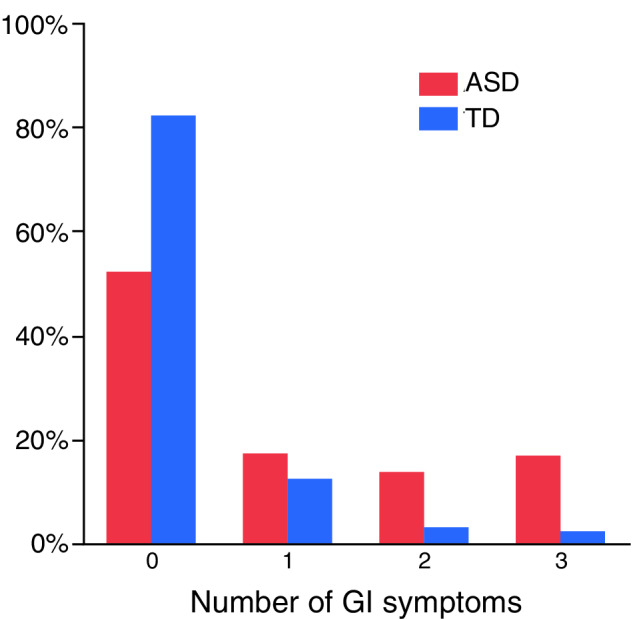
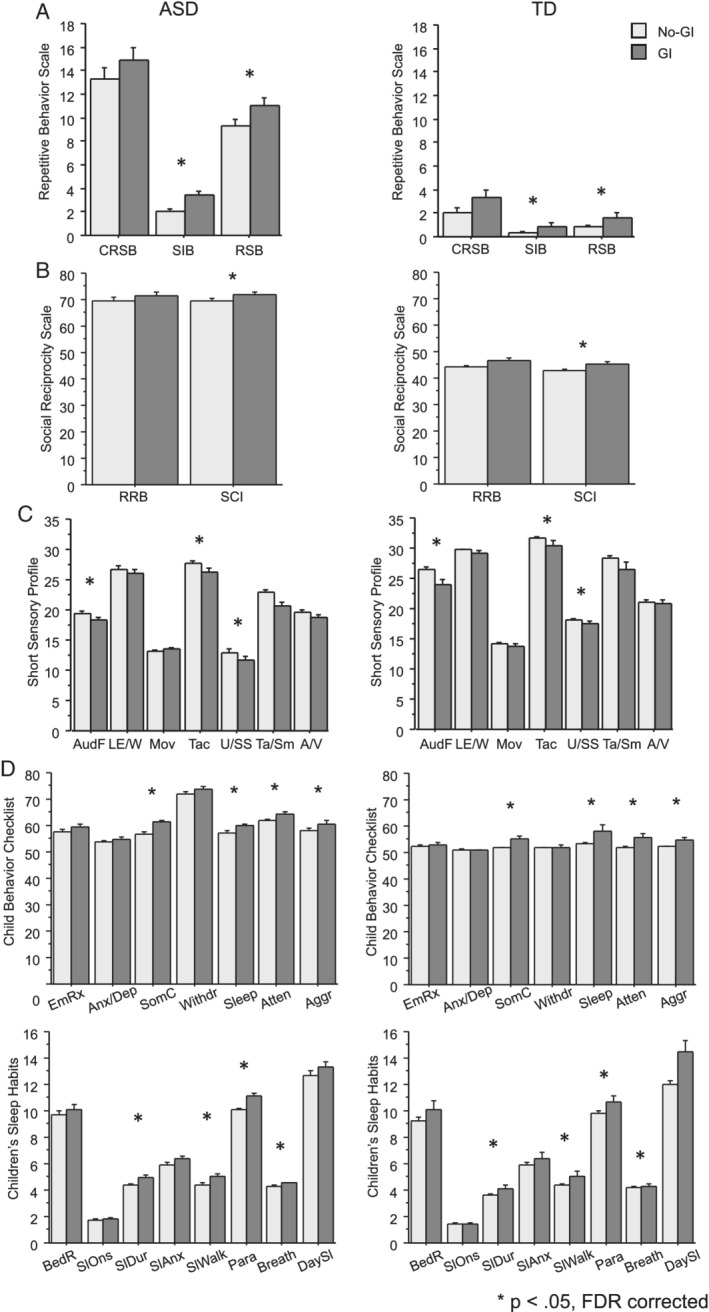
Gastrointestinal (GI) symptoms are frequently reported in children with autism spectrum disorder (ASD). We evaluated the frequency and severity of GI symptoms in preschool-aged children with ASD compared to participants with typical development (TD). Our goal was to ascertain whether GI symptoms are associated with differences in sex or developmental and behavioral measures. Participants were between 2 and 3.5 years of age and included 255 children with ASD (184 males/71 females) and 129 age-matched TD controls (75 males/54 females). A parent interview was used to assess GI symptoms (abdominal pain, gaseousness/bloating, diarrhea, constipation, pain on stooling, vomiting, difficulty swallowing, blood in stool or in vomit). Children with GI symptoms in each diagnostic group were compared to children without GI symptoms on measures of developmental, behavioral, and adaptive functioning. GI symptoms were reported more frequently in children with ASD compared to the TD group (47.8% vs. 17.8%, respectively). Children with ASD were also more likely to experience multiple GI symptoms (30.6% vs. 5.4%). GI symptoms were equally common in males and females across both diagnostic groups. There were no statistically significant differences in developmental or adaptive measures based on presence of GI symptoms in either ASD or TD children. Co-occurring GI symptoms were, however, associated with increased self-injurious behaviors, restricted stereotyped behaviors, aggressive behaviors, sleep problems and attention problems in both ASD and TD children. In children with ASD, a higher number of GI symptoms was associated with an increase in self-injurious behaviors, somatic complaints, reduced sleep duration, and increased parasomnias. LAY SUMMARY: ASD is characterized by challenges in social communication and repetitive behaviors. But, people with autism have many other difficulties including gastrointestinal problems. Children with ASD were three times more likely to experience GI symptoms than typically developing peers. Increased GI symptoms are associated with increased problem behaviors such as sleep problems, self-injury, and body aches. Since GI symptoms are often treatable, it is important to recognize them as soon as possible. Both clinicians and parents should become more aware of the high occurrence of GI problems in autistic people. Autism Res 2020, 13: 1778-1789. © 2020 International Society for Autism Research and Wiley Periodicals LLC.
自闭症谱系障碍(ASD)患儿经常出现胃肠道(GI)症状。我们评估了学龄前ASD患儿与发育正常(TD)儿童相比,GI症状的发生频率和严重程度。我们的目标是确定GI症状是否与性别差异或发育及行为指标相关。研究对象年龄在2至3.5岁之间,包括255名ASD儿童(184名男性/71名女性)和129名年龄匹配的TD对照儿童(75名男性/54名女性)。通过家长访谈来评估GI症状(腹痛、肠胃胀气、腹泻、便秘、排便时疼痛、呕吐、吞咽困难、便血或吐血)。在发育、行为和适应功能指标方面,将各诊断组中有GI症状的儿童与无GI症状的儿童进行比较。与TD组相比,ASD患儿报告GI症状的频率更高(分别为47.8%和17.8%)。ASD患儿也更有可能出现多种GI症状(30.6%对5.4%)。在两个诊断组中,GI症状在男性和女性中同样常见。在ASD或TD儿童中,基于是否存在GI症状,发育或适应指标方面没有统计学上的显著差异。然而,在ASD和TD儿童中,同时出现的GI症状与自我伤害行为、刻板行为、攻击行为、睡眠问题和注意力问题的增加有关。在ASD儿童中,更多的GI症状与自我伤害行为、躯体不适、睡眠时间缩短和异态睡眠增加有关。内容摘要:ASD的特征是社交沟通和重复行为方面存在挑战。但是,自闭症患者还有许多其他困难,包括胃肠道问题。ASD患儿出现GI症状的可能性是发育正常同龄人3倍。GI症状增加与睡眠问题、自我伤害和身体疼痛等问题行为增加有关。由于GI症状通常是可治疗的,因此尽快识别它们很重要。临床医生和家长都应该更加意识到自闭症患者中GI问题的高发生率。《自闭症研究》2020年,13:1778 - 1789。©2020国际自闭症研究协会和威利期刊有限责任公司