Sotelo Kristine Ann Gualberto, Hamid Nazimah, Oey Indrawati, Gutierrez-Maddox Noemi, Ma Qianli, Leong Sze Ying
School of Applied Sciences, Faculty of Health and Environmental Sciences, Auckland University of Technology, Auckland 1142, Private Bag 92006, New Zealand.
Department of Food Science, University of Otago, PO Box 56, Dunedin 9054, New Zealand.
Molecules. 2015 Mar 23;20(3):5223-38. doi: 10.3390/molecules20035223.
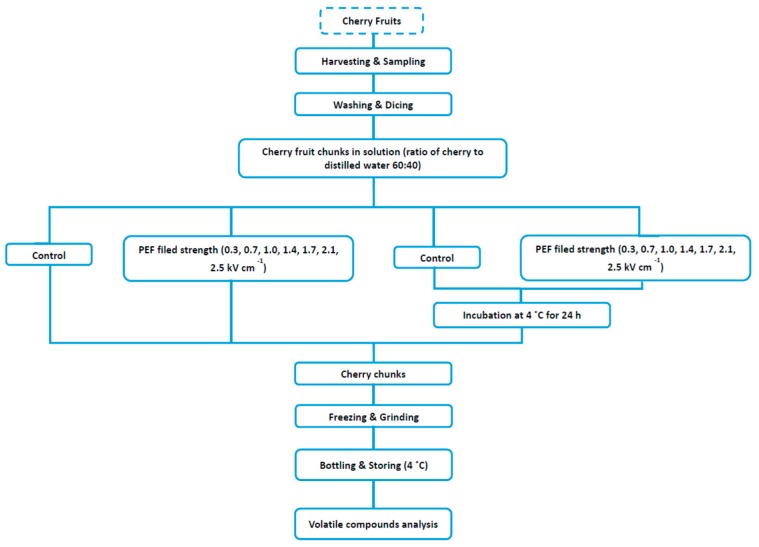
The aim of this research was to study the effect of pulsed electric fields (PEF) on the flavour profile of red-fleshed sweet cherries (Prunus avium variety Stella). The cherry samples were treated at a constant pulse frequency of 100 Hz, a constant pulse width of 20 μs, different electric field strengths between 0.3 and 2.5 kV/cm and specific energy ranging from 31 to 55 kJ/kg. Volatile compounds of samples were analysed using an automated headspace solid phase microextraction (HS-SPME) method coupled with gas chromatography-mass spectrometry (GC-MS). A total of 33 volatile compounds were identified with benzaldehyde, hexanal, (E)-2-hexenal, (Z)-2-hexen-1-ol, and benzyl alcohol being the predominant volatiles in different PEF-treated samples. Aldehydes namely butanal, octanal, 2-octenal, and nonanal, and (Z)-2-hexen-1-ol increased significantly 24 h after PEF treatment at electric field strengths of more than 1.0 kV/cm. Samples incubated for 24 h after PEF treatment (S3) generated higher concentrations of volatiles than samples immediately after PEF treatments (S2). Quantitative results revealed that more flavour volatiles were released and associated with S3 samples after 24 h storage and S2 samples immediately after PEF both with the highest electric field intensities. Interestingly, this study found that the PEF treatments at the applied electric field strength and energy did not result in releasing/producing undesirable flavour compounds.
本研究的目的是探究脉冲电场(PEF)对红肉甜樱桃(Prunus avium品种Stella)风味特征的影响。樱桃样品在100 Hz的恒定脉冲频率、20 μs的恒定脉冲宽度、0.3至2.5 kV/cm的不同电场强度以及31至55 kJ/kg的特定能量下进行处理。采用自动顶空固相微萃取(HS-SPME)法结合气相色谱-质谱联用(GC-MS)对样品中的挥发性化合物进行分析。共鉴定出33种挥发性化合物,其中苯甲醛、己醛、(E)-2-己烯醛、(Z)-2-己烯-1-醇和苯甲醇是不同PEF处理样品中的主要挥发性成分。在电场强度超过1.0 kV/cm的PEF处理24小时后,丁醛、辛醛、2-辛烯醛、壬醛等醛类以及(Z)-2-己烯-1-醇显著增加。PEF处理后孵育24小时的样品(S3)比PEF处理后立即得到的样品(S2)产生更高浓度的挥发性物质。定量结果显示,在储存24小时后的S3样品以及在最高电场强度下PEF处理后立即得到的S2样品中释放出更多的风味挥发性物质。有趣的是,本研究发现,在所施加的电场强度和能量下进行的PEF处理不会导致释放/产生不良风味化合物。