Matsubara Hirokazu, Okazaki Ken, Takayama Yukihisa, Osaki Kanji, Matsuo Yoshio, Honda Hiroshi, Iwamoto Yukihide
BMC Musculoskelet Disord. 2015 Feb 10;16(1):22. doi: 10.1186/s12891-015-0487-4.
In patients with degenerative meniscal tears, subclinical cartilage degeneration may be present even if gross morphological changes are not evident. The aim of this study was to detect occult cartilage degeneration using T1ρ MRI mapping in patients with meniscal tears without obvious radiographic osteoarthritis (OA).
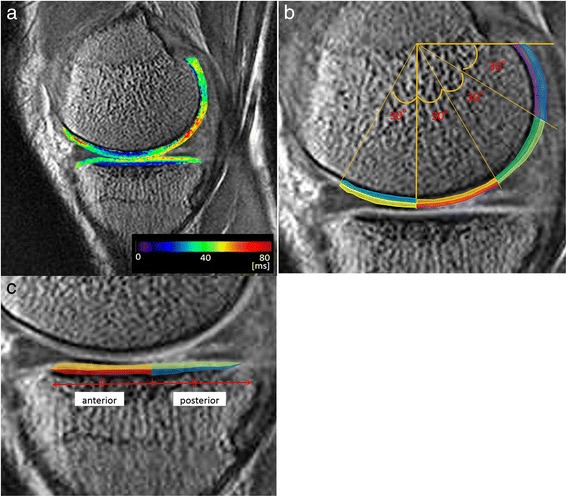
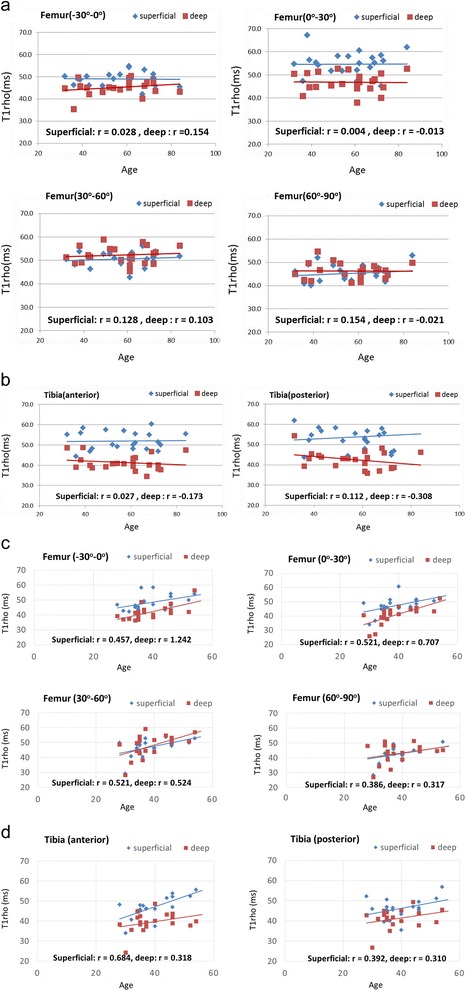
A total of 22 subjects with degenerative meniscal tears in the early stages of osteoarthritis [Kellgren-Lawrence (KL) grade of 0-2] and 19 healthy subjects as the control group were examined. The femoral condyle was divided into four 30° wedges (-30°-0° anteriorly, 0°-30°, 30°-60° and 60°-90° posteriorly), and each area of cartilage was further divided into superficial and deep layers of equal thickness. The tibial side was divided into anterior and posterior areas with superficial and deep layers in each. The mean T1ρ values (ms) in each area were calculated.
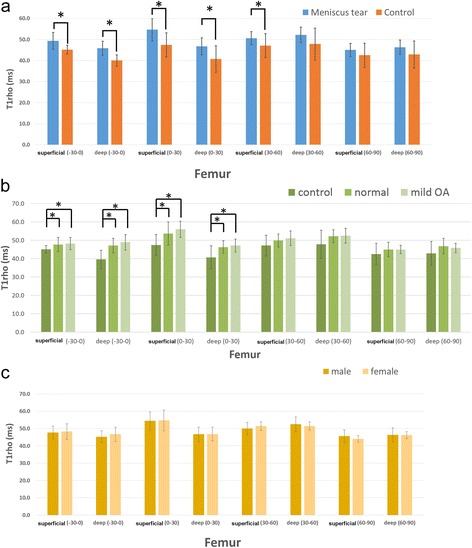
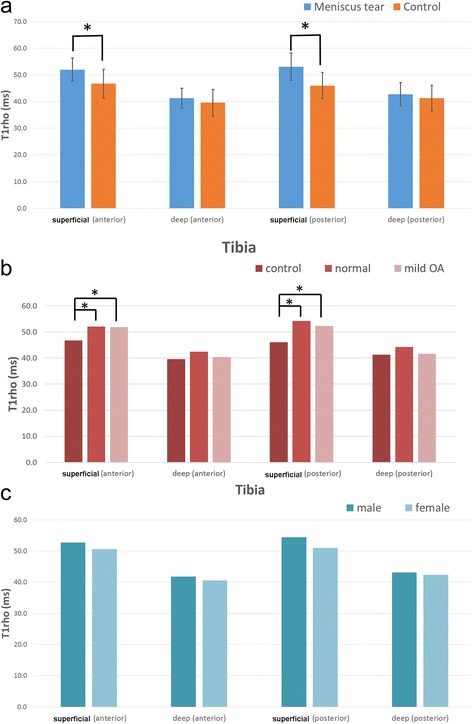
On the femoral side, T1ρ values of the superficial and deep regions (-30°-0°, 0°-30° and 30°-60°) in the meniscal tear group were significantly higher than those in the control group [superficial (-30°-0°): 49.0 ± 4.0 (meniscal tear group) vs 45.1 ± 2.1 (control group), deep (-30°-0°): 45.2 ± 3.3 vs 39.5 ± 5.0, superficial (0°-30°): 54.5 ± 5.3 vs 47.4 ± 5.7, deep (0°-30°): 46.8 ± 4.0 vs 40.7 ± 6.3, superficial (30°-60°): 50.5 ± 3.1 vs 47.1 ± 5.7]. On the tibial side, the meniscal tear group had significantly higher T1ρ values superficially in both anterior and posterior regions compared with the control group [superficial (anterior): 52.0 ± 4.3 vs 46.7 ± 5.4, superficial (posterior): 53.1 ± 5.1 vs 46.0 ± 4.9]. Moreover, these significant differences were observed when comparing patients in the meniscal tear group with KL grades of 0 or 1 and the control group.
Our study suggested that early biochemical changes in cartilage associated with degenerative meniscal tears occur first in the superficial zones in areas of contact during slight flexion. Characterising the early relationship between cartilage degeneration and degenerative meniscal tears using T1ρ MRI mapping may be of clinical benefit and provide further evidence linking meniscal injury to OA.
在退行性半月板撕裂患者中,即使没有明显的大体形态学改变,也可能存在亚临床软骨退变。本研究的目的是使用T1ρ磁共振成像(MRI)映射技术检测无明显影像学骨关节炎(OA)的半月板撕裂患者的隐匿性软骨退变。
共检查了22例处于骨关节炎早期(Kellgren-Lawrence(KL)分级为0-2级)的退行性半月板撕裂患者以及19名健康受试者作为对照组。股骨髁被分为四个30°楔形区域(前方-30°至0°,0°至30°,30°至60°以及后方60°至90°),每个软骨区域进一步分为厚度相等的浅层和深层。胫骨侧分为前后区域,每个区域又分为浅层和深层。计算每个区域的平均T1ρ值(毫秒)。
在股骨侧,半月板撕裂组的浅层和深层区域(-30°至0°,0°至30°和30°至60°)的T1ρ值显著高于对照组[浅层(-30°至0°):49.0±4.0(半月板撕裂组)对45.1±2.1(对照组),深层(-30°至0°):45.2±3.3对39.5±5.0,浅层(0°至30°):54.5±5.3对47.4±5.7,深层(0°至30°):46.8±4.0对40.7±6.3,浅层(30°至60°):50.5±3.1对47.1±5.7]。在胫骨侧,半月板撕裂组的前后区域浅层T1ρ值均显著高于对照组[浅层(前方):52.0±4.3对46.7±5.4,浅层(后方):53.1±5.1对46.0±4.9]。此外,在比较KL分级为0或1的半月板撕裂组患者与对照组时也观察到了这些显著差异。
我们的研究表明,与退行性半月板撕裂相关的软骨早期生化变化首先发生在轻微屈曲时接触区域的浅层。使用T1ρ MRI映射技术表征软骨退变与退行性半月板撕裂之间的早期关系可能具有临床益处,并为半月板损伤与OA之间的联系提供进一步证据。