Kuijper Bram, Hoyle Rebecca B
CoMPLEX, Centre for Mathematics and Physics in the Life Sciences and Experimental Biology, University College London, London, United Kingdom; Department of Genetics, Evolution and Environment, University, College London, London, United Kingdom; Environment and Sustainability Institute, University of Exeter, Penryn, Campus, Tremough, United Kingdom.
Evolution. 2015 Apr;69(4):950-68. doi: 10.1111/evo.12635. Epub 2015 Apr 10.
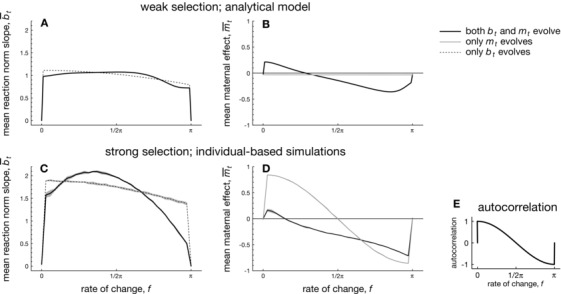
Existing insight suggests that maternal effects have a substantial impact on evolution, yet these predictions assume that maternal effects themselves are evolutionarily constant. Hence, it is poorly understood how natural selection shapes maternal effects in different ecological circumstances. To overcome this, the current study derives an evolutionary model of maternal effects in a quantitative genetics context. In constant environments, we show that maternal effects evolve to slight negative values that result in a reduction of the phenotypic variance (canalization). By contrast, in populations experiencing abrupt change, maternal effects transiently evolve to positive values for many generations, facilitating the transmission of beneficial maternal phenotypes to offspring. In periodically fluctuating environments, maternal effects evolve according to the autocorrelation between maternal and offspring environments, favoring positive maternal effects when change is slow, and negative maternal effects when change is rapid. Generally, the strongest maternal effects occur for traits that experience very strong selection and for which plasticity is severely constrained. By contrast, for traits experiencing weak selection, phenotypic plasticity enhances the evolutionary scope of maternal effects, although maternal effects attain much smaller values throughout. As weak selection is common, finding substantial maternal influences on offspring phenotypes may be more challenging than anticipated.
现有研究表明母体效应会对进化产生重大影响,但这些预测假设母体效应本身在进化上是恒定的。因此,人们对自然选择如何在不同生态环境中塑造母体效应知之甚少。为了克服这一问题,当前研究在数量遗传学背景下推导了一个母体效应的进化模型。在恒定环境中,我们发现母体效应会进化为轻微的负值,从而导致表型方差减小(发育稳态)。相比之下,在经历突然变化的种群中,母体效应会在许多代中短暂地进化为正值,从而促进有益母体表型向后代的传递。在周期性波动的环境中,母体效应根据母体和后代环境之间的自相关性而进化,当变化缓慢时有利于正的母体效应,而当变化迅速时有利于负的母体效应。一般来说,对于经历非常强烈选择且可塑性受到严重限制的性状,母体效应最强。相比之下,对于经历弱选择的性状,表型可塑性会增强母体效应的进化范围,尽管母体效应在整个过程中达到的值要小得多。由于弱选择很常见,因此发现母体对后代表型有重大影响可能比预期更具挑战性。