He Feng, Wei Chuanxian, Wu Honggang, Cheung David, Jiao Renjie, Ma Jun
Division of Biomedical Informatics, Cincinnati Children's Research Foundation, 3333 Burnet Avenue, Cincinnati, Ohio 45229, USA.
1] Division of Biomedical Informatics, Cincinnati Children's Research Foundation, 3333 Burnet Avenue, Cincinnati, Ohio 45229, USA [2] State Key Laboratory of Brain and Cognitive Science, Institute of Biophysics, Chinese Academy of Sciences, 15 Datun Road, Beijing 100101, China [3] University of Chinese Academy of Sciences, Beijing 100080, China.
Nat Commun. 2015 Mar 26;6:6679. doi: 10.1038/ncomms7679.
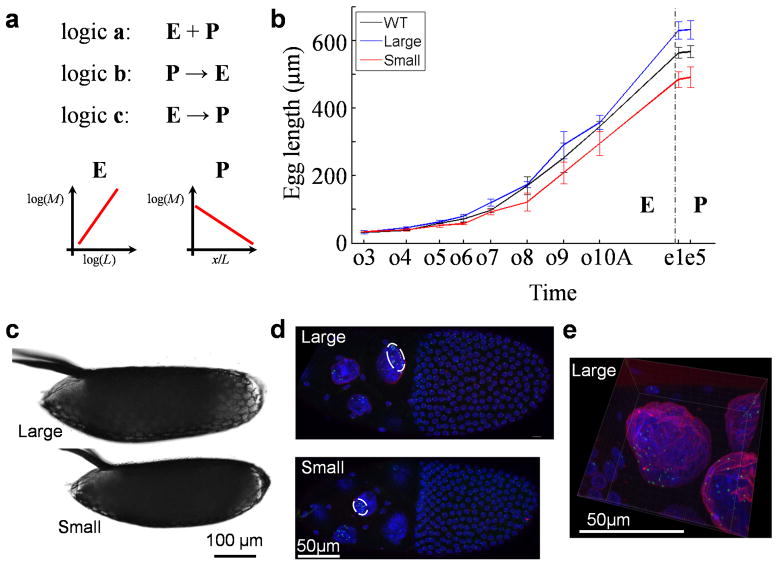
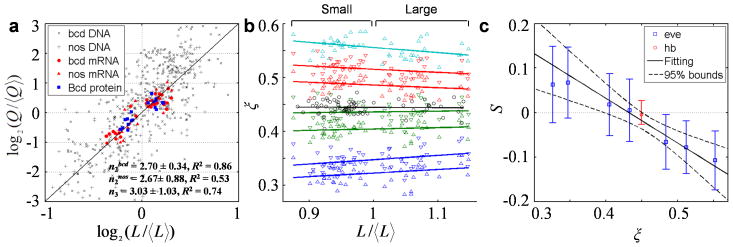
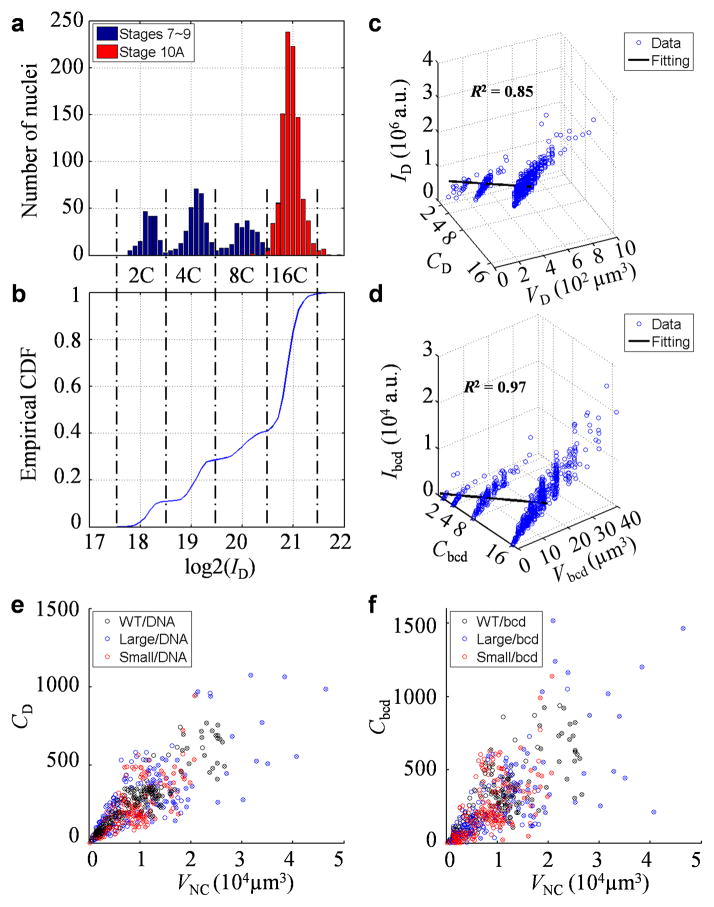
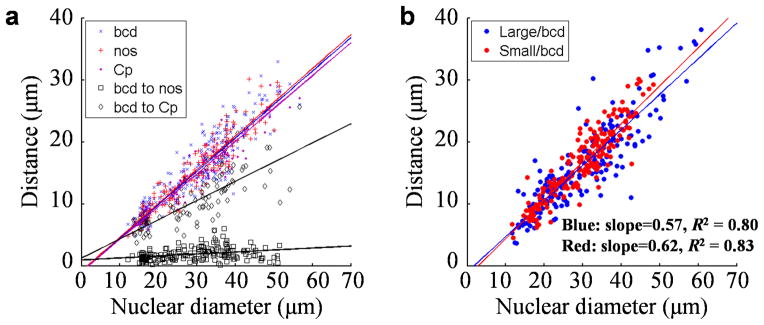
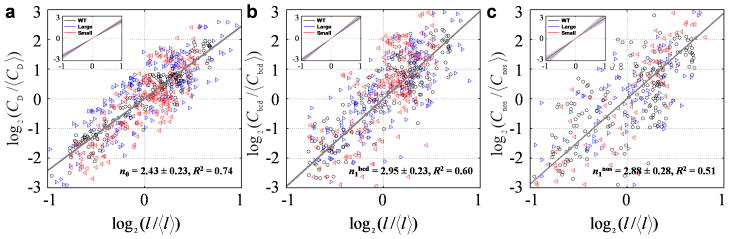
Tissue expansion and patterning are integral to development; however, it is unknown quantitatively how a mother accumulates molecular resources to invest in the future of instructing robust embryonic patterning. Here we develop a model, Tissue Expansion-Modulated Maternal Morphogen Scaling (TEM(3)S), to study scaled anterior-posterior patterning in Drosophila embryos. Using both ovaries and embryos, we measure a core quantity of the model, the scaling power of the Bicoid (Bcd) morphogen gradient's amplitude nA. We also evaluate directly model-derived predictions about Bcd gradient and patterning properties. Our results show that scaling of the Bcd gradient in the embryo originates from, and is constrained fundamentally by, a dynamic relationship between maternal tissue expansion and bcd gene copy number expansion in the ovary. This delicate connection between the two transitioning stages of a life cycle, stemming from a finite value of nA~3, underscores a key feature of developmental systems depicted by TEM(3)S.
组织扩张和模式形成是发育过程中不可或缺的部分;然而,目前尚不清楚母体如何定量积累分子资源,以便为指导稳健的胚胎模式形成的未来进行投入。在此,我们开发了一个模型,即组织扩张调节的母体形态发生素缩放模型(TEM(3)S),以研究果蝇胚胎中的前后模式缩放。我们利用卵巢和胚胎测量了该模型的一个核心量,即Bicoid(Bcd)形态发生素梯度幅度nA的缩放幂。我们还直接评估了模型得出的关于Bcd梯度和模式形成特性的预测。我们的结果表明,胚胎中Bcd梯度的缩放源自卵巢中母体组织扩张与bcd基因拷贝数扩张之间的动态关系,并从根本上受到该关系的限制。生命周期两个过渡阶段之间的这种微妙联系,源于nA~3的有限值,突出了TEM(3)S所描述的发育系统的一个关键特征。