Hanks Lynae J, Casazza Krista, Judd Suzanne E, Jenny Nancy S, Gutiérrez Orlando M
Department of Pediatrics, Children's Hospital of Alabama, University of Alabama at Birmingham, Birmingham, Alabama, United States of America.
Department of Biostatistics, University of Alabama at Birmingham, Birmingham, Alabama, United States of America.
PLoS One. 2015 Mar 26;10(3):e0122885. doi: 10.1371/journal.pone.0122885. eCollection 2015.
Elevated fibroblast growth factor-23 (FGF23) is an established marker of cardiovascular disease. The underlying reason(s) for the rise accompanying cardiovascular health decline are unclear. Prior studies have shown that FGF23 concentrations are associated with markers of inflammation and insulin resistance but they have been limited by a focus on persons with chronic kidney disease (CKD) and lack of race and sex diversity. The objective of this study was to examine the associations of FGF23 and markers of inflammation, insulin resistance, and anthropometrics in a large cohort of community-dwelling adults.
Associations of FGF23 with markers of inflammation [interleukin-6 (IL-6), IL-10, high sensitivity-CRP (hsCRP)], insulin utilization [resistin, adiponectin, homeostatic model assessment of insulin resistance (HOMA-IR)] and anthropometrics [BMI and waist circumference (WC)] were examined cross-sectionally in a 1,040 participants randomly selected from the Reason for Geographic and Racial Differences in Stroke (REGARDS) Study, a national study of black and white adults ≥45 years. Effect modification by race and CKD status was tested, and stratified models were analyzed accordingly.
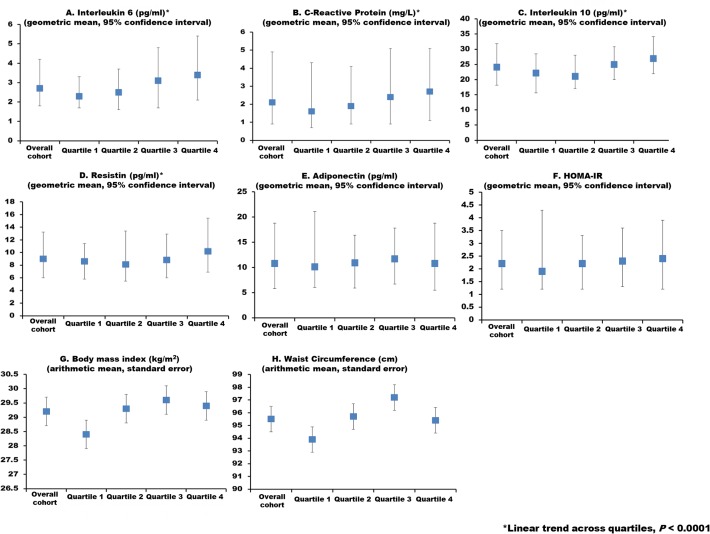
Median FGF23 concentration was 69.6 RU/ml (IQR: 53.2, 102.7). Higher quartiles of FGF23 were associated with higher mean concentrations of IL-6, IL-10, hsCRP and resistin (Ptrend<0.001 for all). There were no significant differences in HOMA-IR, adiponectin concentrations, BMI, or WC across FGF23 quartiles in the crude analyses. CKD significantly modified the relationships between FGF23 and inflammatory markers, HOMA-IR, BMI and WC (P ≤ 0.01 for all). In linear regression models adjusted for sociodemographic and clinical variables, FGF23 was positively associated with IL-6, hsCRP, IL-10, HOMA-IR, BMI and WC in individuals without CKD, but not among individuals with CKD. Additionally, FGF23 was positively associated with resistin irrespective of CKD status.
Elevated FGF23 concentrations may be considered a biomarker for decline in metabolic function among individuals with normal kidney function.
成纤维细胞生长因子23(FGF23)升高是心血管疾病的一个既定标志物。伴随心血管健康状况下降而升高的潜在原因尚不清楚。先前的研究表明,FGF23浓度与炎症和胰岛素抵抗标志物相关,但这些研究局限于关注慢性肾脏病(CKD)患者,且缺乏种族和性别多样性。本研究的目的是在一大群社区居住的成年人中检验FGF23与炎症、胰岛素抵抗和人体测量学标志物之间的关联。
在从全国性的≥45岁黑人和白人成年人中风地理和种族差异原因(REGARDS)研究中随机选取的1040名参与者中,对FGF23与炎症标志物[白细胞介素-6(IL-6)、IL-10、高敏C反应蛋白(hsCRP)]、胰岛素利用[抵抗素、脂联素、胰岛素抵抗稳态模型评估(HOMA-IR)]以及人体测量学指标[体重指数(BMI)和腰围(WC)]之间的关联进行横断面研究。检验种族和CKD状态的效应修正,并相应地分析分层模型。
FGF23浓度中位数为69.6 RU/ml(四分位间距:53.2,102.7)。FGF23较高四分位数与IL-6、IL-10、hsCRP和抵抗素的较高平均浓度相关(所有Ptrend<0.001)。在粗分析中,各FGF23四分位数间的HOMA-IR、脂联素浓度、BMI或WC无显著差异。CKD显著改变了FGF23与炎症标志物、HOMA-IR、BMI和WC之间的关系(所有P≤0.01)。在经社会人口学和临床变量调整的线性回归模型中,FGF23在无CKD的个体中与IL-