Centre for Neuroscience Studies, Queen's University Kingston, ON, Canada.
Centre for Neuroscience Studies, Queen's University Kingston, ON, Canada ; Department of Biomedical and Molecular Sciences, Queen's University Kingston, ON, Canada.
Front Neurosci. 2015 Mar 11;9:76. doi: 10.3389/fnins.2015.00076. eCollection 2015.
We examined the accuracy and characteristics of saccadic eye movements in children with fetal alcohol spectrum disorder (FASD) compared with typically developing control children. Previous studies have found that children with FASD produce saccades that are quantifiably different from controls. Additionally, animal studies have found sex-based differences for behavioral effects after prenatal alcohol exposure. Therefore, we hypothesized that eye movement measures will show sexually dimorphic results.
Children (aged 5-18 years) with FASD (n = 71) and typically developing controls (n = 113) performed a visually-guided saccade task. Saccade metrics and behavior were analyzed for sex and group differences.
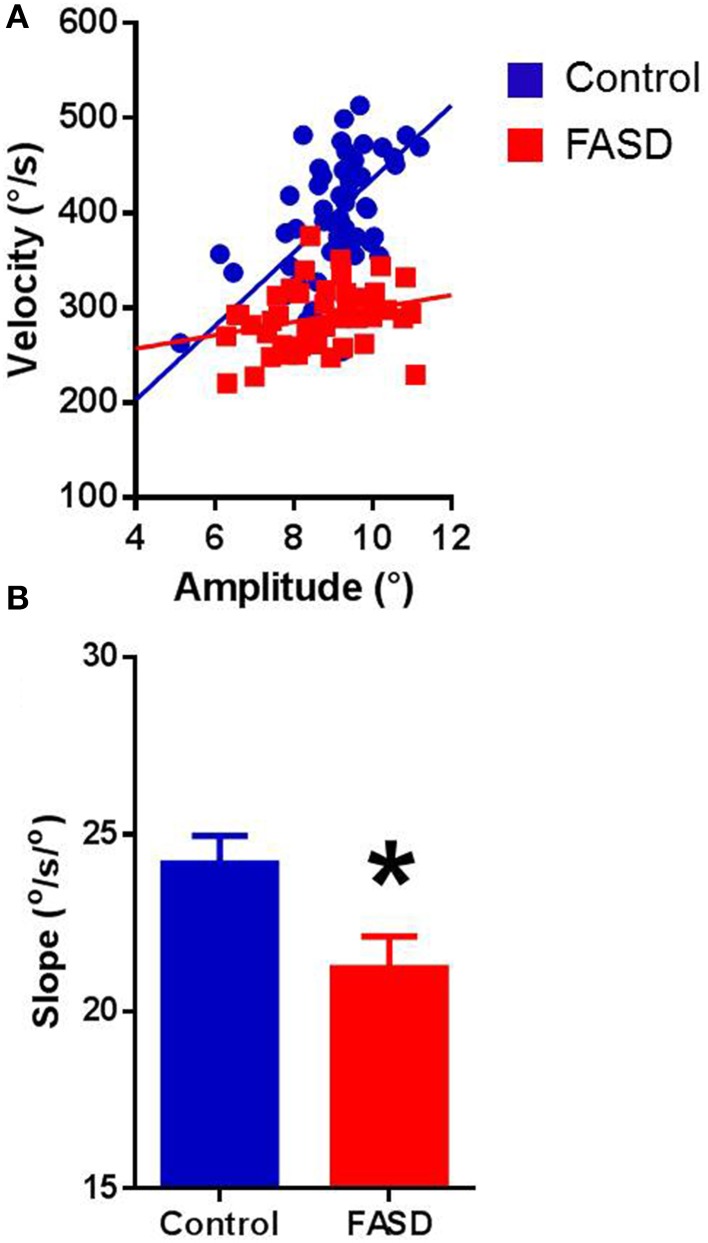
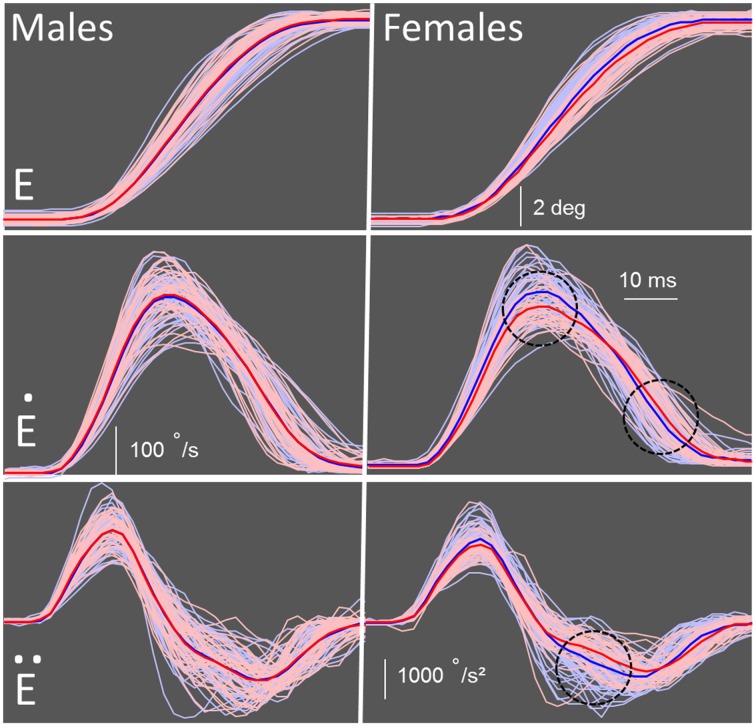
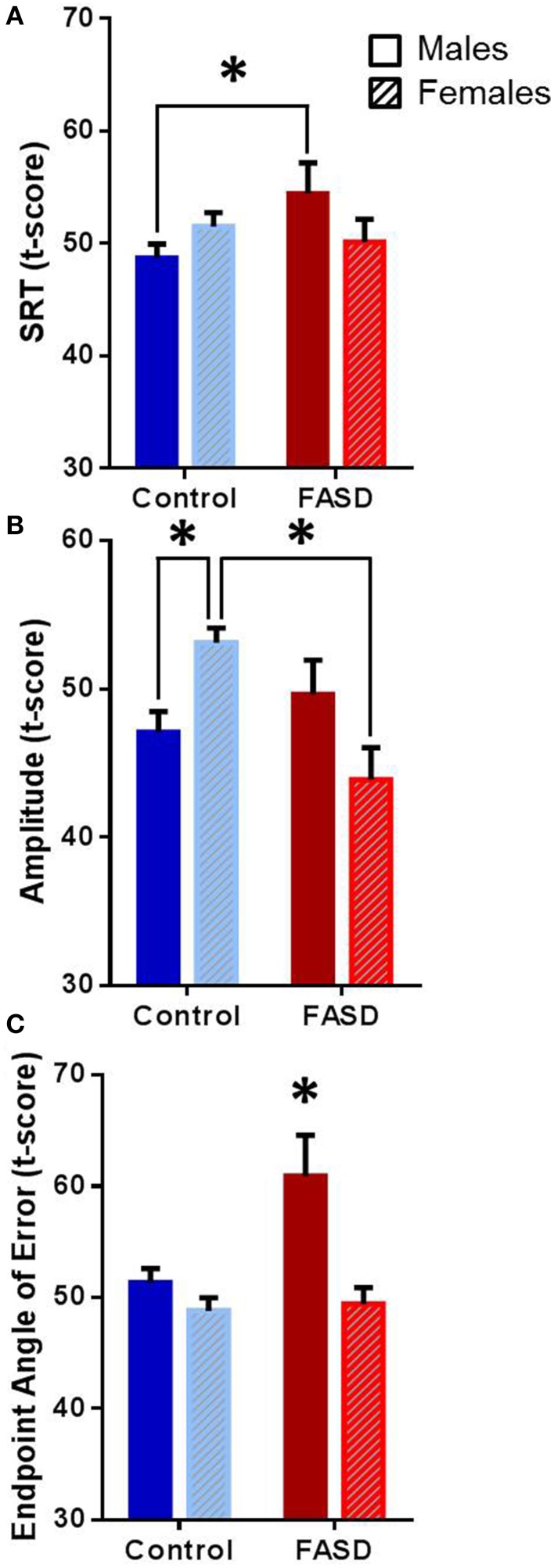
Female control participants had greater amplitude saccades than control males or females with FASD. Accuracy was significantly poorer in the FASD group, especially in males, which introduced significantly greater variability in the data. Therefore, we conducted additional analyses including only those trials in which the first saccade successfully reached the target within a ± 1° window. In this restricted amplitude dataset, the females with FASD made saccades with significantly lower velocity and longer duration, whereas the males with FASD did not differ from the control group. Additionally, the mean and peak deceleration were selectively decreased in the females with FASD.
These data support the hypothesis that children with FASD exhibit specific deficits in eye movement control and sensory-motor integration associated with cerebellar and/or brain stem circuits. Moreover, prenatal alcohol exposure may have a sexually dimorphic impact on eye movement metrics, with males and females exhibiting differential patterns of deficit.
我们研究了胎儿酒精谱系障碍(FASD)患儿与正常发育对照儿童相比,眼球运动的准确性和特征。先前的研究发现,FASD 患儿的眼球运动具有可量化的差异。此外,动物研究发现,产前酒精暴露后行为影响存在性别差异。因此,我们假设眼球运动测量结果将显示出性别二态性。
5-18 岁的 FASD 患儿(n = 71)和正常发育对照儿童(n = 113)进行了视觉引导的眼球运动任务。分析了眼球运动指标和行为,以了解性别和组间差异。
女性对照组的眼球运动幅度大于对照组男性或 FASD 女性。FASD 组的准确性明显较差,特别是男性,这导致数据的可变性显著增加。因此,我们进行了额外的分析,只包括那些第一次眼球运动成功到达目标±1°窗口内的试验。在这个限制幅度的数据集,FASD 女性的眼球运动速度显著降低,持续时间更长,而 FASD 男性与对照组无差异。此外,FASD 女性的平均和峰值减速选择性降低。
这些数据支持 FASD 患儿眼球运动控制和感觉运动整合存在特定缺陷的假设,与小脑和/或脑干回路有关。此外,产前酒精暴露对眼球运动指标可能有性别二态性影响,男性和女性表现出不同的缺陷模式。