Department of Cellular and Physiological Sciences, University of British Columbia, Vancouver, British Columbia, Canada; Laboratory of Neurobiology , Institute of Zoology, Poznan University of Life Sciences, Poznan, Poland.
Alcohol Clin Exp Res. 2014 Jan;38(1):152-60. doi: 10.1111/acer.12224. Epub 2013 Aug 5.
Previous studies on male rodents found that prenatal alcohol exposure (PAE) decreases the number of serotonin immunoreactive (5-HT-ir) neurons in the brainstem. However, data on the effects of PAE in females are lacking. In light of known sex differences in responsiveness of the 5-HT system and known effects of estrogen (E2 ) and progesterone (P4 ) in the brain, we hypothesized that sex steroids will modulate the adverse effects of PAE on 5-HT neurons in adult females.
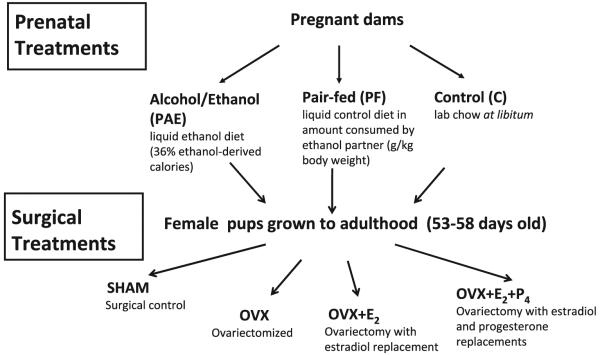
Adult females from 3 prenatal groups (Prenatal alcohol-exposed [PAE], Pair-fed [PF], and ad libitum-fed Controls [C]) were ovariectomized (OVX), with or without hormone replacement, or underwent Sham OVX. 5-HT-ir cells were examined in key brainstem areas.
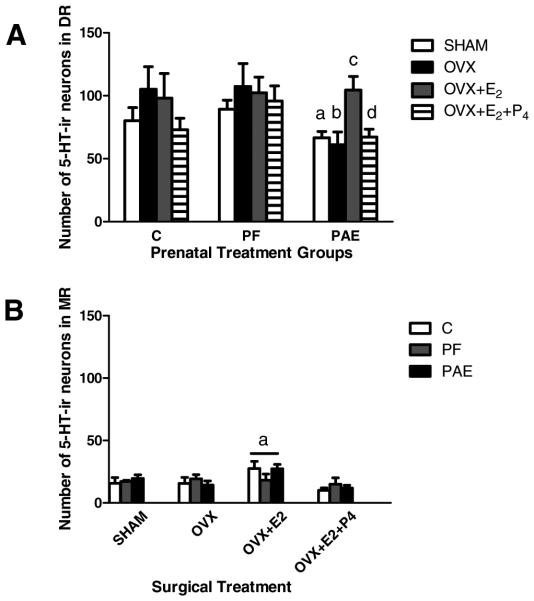
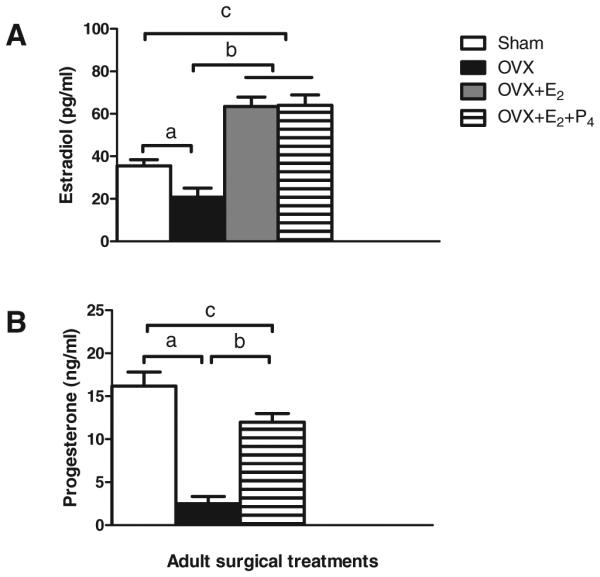
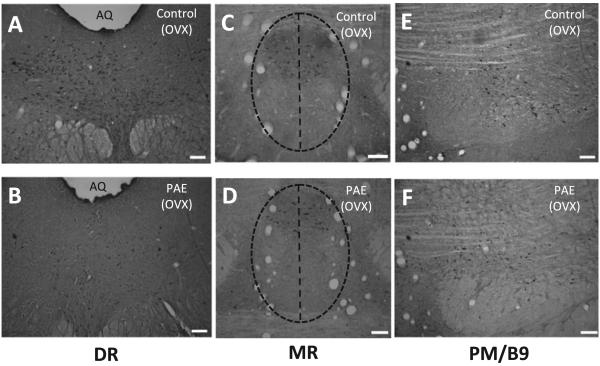
Our data support the hypothesis that PAE has long-term effects on the 5-HT system of females and that ovarian steroids have a modulatory role in these effects. Intact (Sham OVX) PAE females had marginally lower numbers of 5-HT-ir neurons in the dorsal raphe nucleus of the brainstem compared with PF and C females. This marginal difference became significant following removal of hormones by OVX. Replacement with E2 restored the number of 5-HT-ir neurons in PAE females to control levels, while P4 reversed the effects of E2 . Importantly, despite these differential responses of the 5-HT system to ovarian steroids, there were no differences in E2 and P4 levels among prenatal treatment groups.
These data demonstrate long-term, adverse effects of PAE on the 5-HT system of females, as well as differential sensitivity of PAE compared with control females to the modulatory effects of ovarian steroids on 5-HT neurons. Our findings have important implications for understanding sex differences in 5-HT dysfunction in depression/anxiety disorders and the higher rates of these mental health problems in individuals with fetal alcohol spectrum disorder.
先前对雄性啮齿动物的研究发现,产前酒精暴露(PAE)会减少脑干中 5-羟色胺免疫反应性(5-HT-ir)神经元的数量。然而,关于 PAE 对雌性的影响的数据尚缺乏。鉴于 5-HT 系统对性别的反应存在已知的性别差异,以及雌激素(E2)和孕激素(P4)在大脑中的已知作用,我们假设性激素将调节 PAE 对成年雌性 5-HT 神经元的不良影响。
来自 3 个产前组(产前酒精暴露[PAE]、配对喂养[PF]和自由喂养对照[C])的成年雌性大鼠接受卵巢切除术(OVX),或不进行激素替代,或进行假手术 OVX。检查关键脑干区域的 5-HT-ir 细胞。
我们的数据支持这样的假设,即 PAE 对雌性的 5-HT 系统有长期影响,而卵巢类固醇在这些影响中具有调节作用。完整(假手术 OVX)PAE 雌性大鼠脑干背侧中缝核的 5-HT-ir 神经元数量略低于 PF 和 C 雌性大鼠。这种微小的差异在 OVX 去除激素后变得显著。E2 的替代恢复了 PAE 雌性大鼠 5-HT-ir 神经元的数量至对照水平,而 P4 逆转了 E2 的作用。重要的是,尽管 5-HT 系统对卵巢类固醇有不同的反应,但产前处理组之间的 E2 和 P4 水平没有差异。
这些数据表明,PAE 对雌性 5-HT 系统有长期的不良影响,并且与对照雌性相比,PAE 对卵巢类固醇对 5-HT 神经元的调节作用更为敏感。我们的发现对理解抑郁症/焦虑障碍中 5-HT 功能障碍的性别差异以及胎儿酒精谱系障碍个体中这些心理健康问题的更高发生率具有重要意义。