Black Dog Institute, Sydney, Australia ; School of Medicine, University of New South Wales, Sydney, Australia ; Department of Clinical Psychology, VU University, Amsterdam, The Netherlands ; EMGO Institute for Health and Care Research, VU University and VU University Medical Center, Amsterdam, The Netherlands.
Centre for Mental Health Research, Australian National University, Canberra, Australia.
BMC Psychol. 2014 Aug 12;2(1):20. doi: 10.1186/2050-7283-2-20. eCollection 2014.
The Interpersonal-Psychological Theory of Suicidal Behavior (IPT) is supported by recent epidemiological data. Unique risk factors for the IPT constructs have been identified in community epidemiological studies. Gender differences in these risk factors may contribute substantially to our understanding of suicidal risk, and require further investigation. The present study explores gender differences in the predictors and correlates of perceived burdensomeness, thwarted belongingness and acquired capability for suicide.
Participants (547 males, 739 females) aged 32-38 from the PATH through Life study, an Australian population-based longitudinal cohort study (n=1,177) were assessed on perceived burdensomeness, thwarted belongingness and acquired capability for suicide using the Interpersonal Needs Questionnaire and Acquired Capability for Suicide Survey, and on a range of demographic, social support, psychological, mental health and physical health measures. Gender differences in the predictors of the IPT constructs were assessed using linear regression analyses.
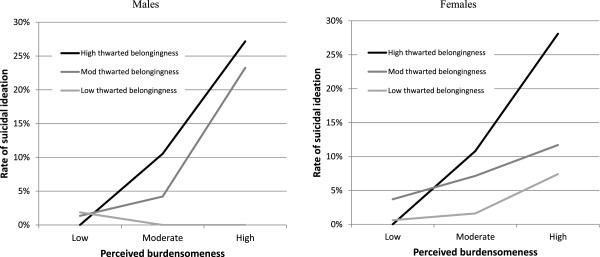
Higher perceived burdensomeness increased suicide ideation in both genders, while higher thwarted belongingness increased suicide ideation only in females. In females, thwarted belongingness was uniquely related to perceived burdensomeness, while greater physical health was significantly associated with greater thwarted belongingness in males but not in females. There were trends suggesting greater effects of being single and greater perceived burdensomeness for men, and stronger effects of less positive friendship support for women associated with greater thwarted belongingness.
Men and women differ in the pattern of psychological characteristics that predict suicide ideation, and in the factors predicting vulnerability. Suicide prevention strategies need to take account of gender differences.
自杀行为的人际心理理论(IPT)得到了最近流行病学数据的支持。在社区流行病学研究中,IPT 结构的独特风险因素已被确定。这些风险因素中的性别差异可能对我们理解自杀风险有很大的贡献,需要进一步研究。本研究探讨了预测因素和相关性在感知负担、归属感受挫和获得自杀能力方面的性别差异。
参与者(547 名男性,739 名女性)来自澳大利亚基于人群的纵向队列研究 PATH 研究,年龄在 32-38 岁(n=1177),使用人际需求问卷和获得自杀能力量表评估感知负担、归属感受挫和获得自杀能力,并评估一系列人口统计学、社会支持、心理、心理健康和身体健康指标。使用线性回归分析评估 IPT 结构预测因素的性别差异。
更高的感知负担会增加两性的自杀意念,而更高的归属感受挫会增加女性的自杀意念。在女性中,归属感受挫与感知负担有关,而在男性中,更高的身体健康与更高的归属感受挫显著相关,但在女性中则不然。有迹象表明,单身和感知负担更大对男性的影响更大,而对女性而言,友谊支持更积极与归属感受挫更大的相关性更强。
男性和女性在预测自杀意念的心理特征模式以及预测脆弱性的因素上存在差异。自杀预防策略需要考虑到性别差异。