Lo Joey Chor Yee, Lange Dirk
The Stone Centre at Vancouver General Hospital, Department of Urologic Sciences, University of British Columbia, 2660 Oak Street, Vancouver, BC, Canada V6H 3Z6.
Biomed Res Int. 2015;2015:189016. doi: 10.1155/2015/189016. Epub 2015 Mar 1.
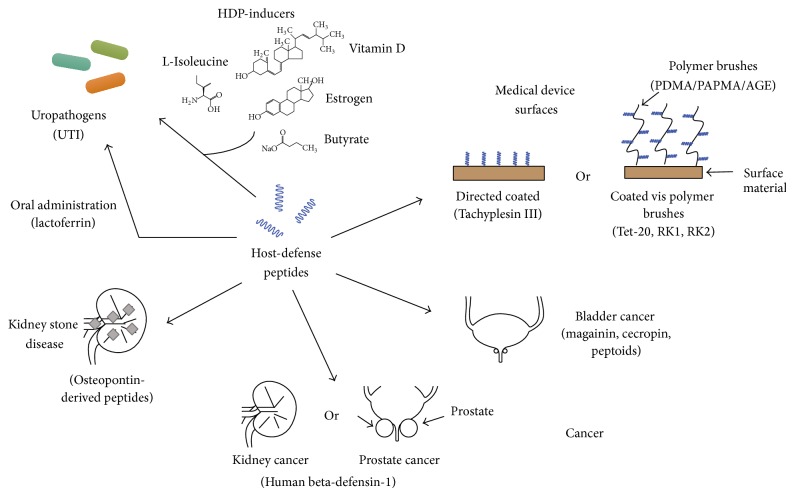
The use of antibiotics has become increasingly disfavored as more multidrug resistant pathogens are on the rise. A promising alternative to the use of these conventional drugs includes antimicrobial peptides or host-defense peptides. These peptides typically consist of short amino acid chains with a net cationic charge and a substantial portion of hydrophobic residues. They mainly target the bacterial cell membrane but are also capable of translocating through the membrane and target intracellular components, making it difficult for bacteria to gain resistance as multiple essential cellular processes are being targeted. The use of these peptides in the field of biomedical therapies has been examined, and the different approaches to using them under various settings are constantly being discovered. In this review, we discuss the current and potential applications of these host-defense peptides in the field of urology. Besides the use of these peptides as antimicrobial agents, the value of these biological molecules has recently been expanded to their use as antitumor and anti-kidney-stone agents.
随着越来越多的多重耐药病原体不断出现,抗生素的使用越来越不受青睐。一种有前景的替代这些传统药物的方法是使用抗菌肽或宿主防御肽。这些肽通常由带有净正电荷和大量疏水残基的短氨基酸链组成。它们主要靶向细菌细胞膜,但也能够穿过细胞膜并靶向细胞内成分,由于多个基本细胞过程都被靶向,使得细菌难以产生耐药性。这些肽在生物医学治疗领域的应用已经得到研究,并且不断有在各种情况下使用它们的不同方法被发现。在这篇综述中,我们讨论了这些宿主防御肽在泌尿外科领域的当前和潜在应用。除了将这些肽用作抗菌剂外,这些生物分子的价值最近还扩展到用作抗肿瘤和抗肾结石剂。