Ren Xia, Wu Xuan, Hillier Stephen G, Fegan K Scott, Critchley Hilary O D, Mason J Ian, Sarvi Sana, Harlow Christopher R
MRC Centre for Reproductive Health, The University of Edinburgh, The Queen's Medical Research Institute, 47 Little France Crescent, Edinburgh, Scotland EH16 4TJ, United Kingdom.
MRC Centre for Reproductive Health, The University of Edinburgh, The Queen's Medical Research Institute, 47 Little France Crescent, Edinburgh, Scotland EH16 4TJ, United Kingdom.
J Steroid Biochem Mol Biol. 2015 Jun;150:54-63. doi: 10.1016/j.jsbmb.2015.03.010. Epub 2015 Mar 24.
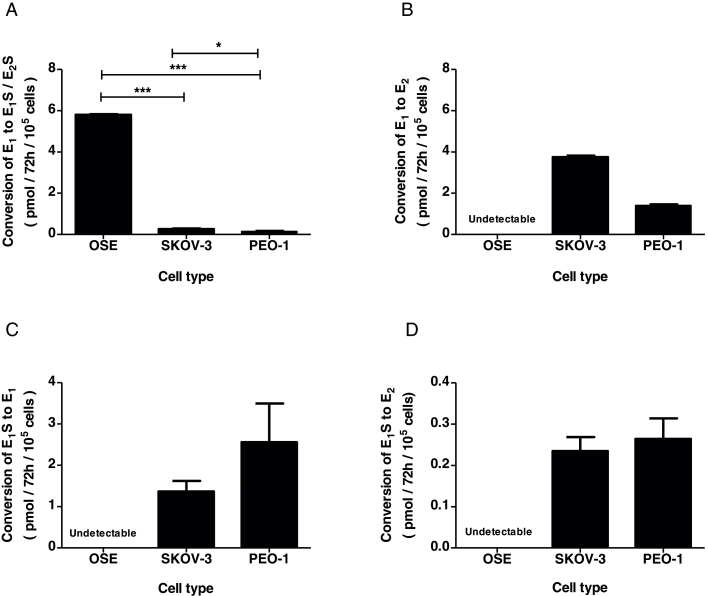
Epithelial ovarian cancer (EOC) accounts for about 90% of malignant ovarian tumors, and estrogen is often implicated in disease progression. We therefore compared the potential for gating of estrogen action via pre-receptor metabolism in normal human ovarian surface epithelium (OSE), EOC and selected EOC cell lines (SKOV3 and PEO1). Steroid sulphatase (STS), estrogen sulfotransferase (EST), 17β-hydroxysteroid dehydrogenases 2 (17BHSD2) and 5 (17BHSD5) mRNAs, proteins and enzymatic activities were all detectable in primary cell cultures of OSE and EOC, whereas aromatase and 17BHSD1 expression was negligible. qRT-PCR assay on total mRNA revealed significantly higher EST mRNA expression in OSE compared to EOC (P<0.05). Radioenzymatic measurements confirmed reduced sulfoconjugation (neutralization) of free estrogen in EOC relative to OSE. OSE cells were more effective at converting free [(3)H]-E1 to [(3)H]-E1S or [(3)H]-E2S, while EOC cell lines mainly converted [(3)H]-E1 to [(3)H]-E2 with minimal formation of [(3)H]-E1S or [(3)H]-E2S. IL1α treatment suppressed EST (P<0.01) and 17BHSD2 (P<0.001) mRNA levels in OSE and stimulated STS mRNA levels (P<0.001) in cancer (SKOV3) cells. These results show that estrogen is differentially metabolized in OSE and EOC cells, with E2 'activation' from conjugated estrogen predominating in EOC. Inflammatory cytokines may further augment the local production of E2 by stimulating STS and suppressing EST. We conclude that local estrogen metabolism may be a target for EOC treatment.
上皮性卵巢癌(EOC)约占卵巢恶性肿瘤的90%,雌激素常与疾病进展有关。因此,我们比较了正常人卵巢表面上皮(OSE)、EOC及选定的EOC细胞系(SKOV3和PEO1)中通过受体前代谢调节雌激素作用的潜力。在OSE和EOC的原代细胞培养物中均可检测到类固醇硫酸酯酶(STS)、雌激素磺基转移酶(EST)、17β-羟基类固醇脱氢酶2(17BHSD2)和5(17BHSD5)的mRNA、蛋白质及酶活性,而芳香化酶和17BHSD1的表达可忽略不计。对总mRNA进行的qRT-PCR分析显示,与EOC相比,OSE中EST mRNA表达显著更高(P<0.05)。放射酶法测量证实,与OSE相比,EOC中游离雌激素的硫酸结合(中和)减少。OSE细胞在将游离[³H]-E1转化为[³H]-E1S或[³H]-E2S方面更有效,而EOC细胞系主要将[³H]-E1转化为[³H]-E2,[³H]-E1S或[³H]-E2S的生成极少。白细胞介素1α处理可抑制OSE中EST(P<0.01)和17BHSD2(P<0.001)的mRNA水平,并刺激癌(SKOV3)细胞中STS mRNA水平(P<0.001)。这些结果表明,雌激素在OSE和EOC细胞中的代谢存在差异,在EOC中,结合雌激素的E2“激活”占主导。炎性细胞因子可能通过刺激STS和抑制EST进一步增加局部E2的产生。我们得出结论,局部雌激素代谢可能是EOC治疗的一个靶点。