Yamamoto H, Hagino Y, Kasai S, Ikeda K
Addictive Substance Project, Tokyo Metropolitan Institute of Medical Science, 2-1-6 Kamikitazawa, Setagaya-ku, Tokyo 156-8506, Japan.
Curr Mol Med. 2015;15(3):193-205. doi: 10.2174/1566524015666150330142807.
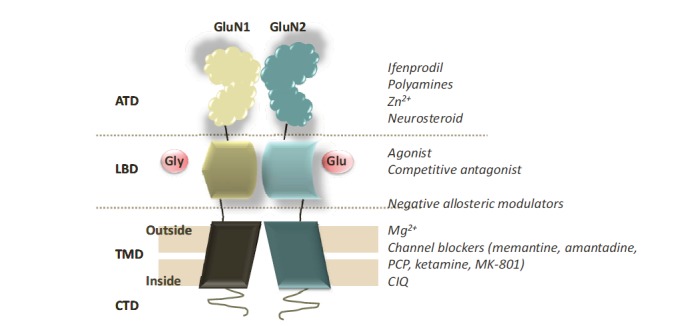
N-methyl-D-aspartate (NMDA) receptor plays important roles in learning and memory. NMDA receptors are a tetramer that consists of two glycine-binding subunits GluN1, two glutamate-binding subunits (i.e., GluN2A, GluN2B, GluN2C, and GluN2D), a combination of a GluN2 subunit and glycine-binding GluN3 subunit (i.e., GluN3A or GluN3B), or two GluN3 subunits. Recent studies revealed that the specific expression and distribution of each subunit are deeply involved in neural excitability, plasticity, and synaptic deficits. The present article summarizes reports on the dysfunction of NMDA receptors and responsible subunits in various neurological and psychiatric disorders, including schizophrenia, autoimmune-induced glutamatergic receptor dysfunction, mood disorders, and autism. A key role for the GluN2D subunit in NMDA receptor antagonist-induced psychosis has been recently revealed.
N-甲基-D-天冬氨酸(NMDA)受体在学习和记忆中起重要作用。NMDA受体是一种四聚体,由两个甘氨酸结合亚基GluN1、两个谷氨酸结合亚基(即GluN2A、GluN2B、GluN2C和GluN2D)、一个GluN2亚基和甘氨酸结合GluN3亚基(即GluN3A或GluN3B)的组合,或两个GluN3亚基组成。最近的研究表明,每个亚基的特异性表达和分布与神经兴奋性、可塑性和突触缺陷密切相关。本文总结了关于NMDA受体功能障碍及其在包括精神分裂症、自身免疫性谷氨酸能受体功能障碍、情绪障碍和自闭症在内的各种神经和精神疾病中的相关亚基的报道。最近发现GluN2D亚基在NMDA受体拮抗剂诱导的精神病中起关键作用。