Zhang Linbin, Sun Tianai, Woldesellassie Fitsum, Xiao Hailian, Tao Yun
Department of Biology, Emory University, Atlanta, Georgia, United States of America.
PLoS Genet. 2015 Mar 30;11(3):e1005073. doi: 10.1371/journal.pgen.1005073. eCollection 2015 Mar.
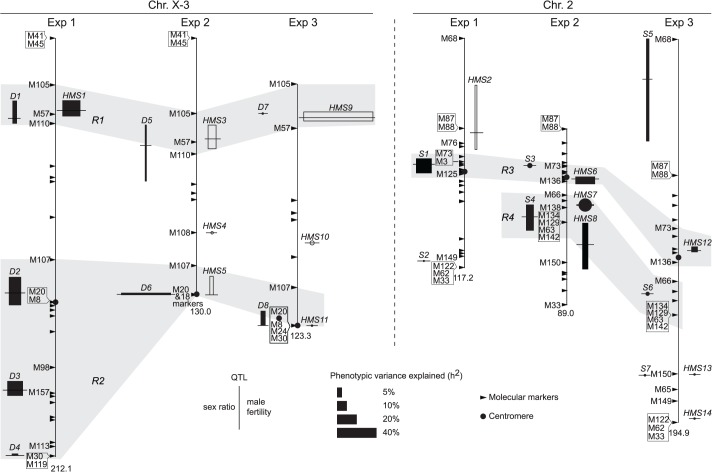
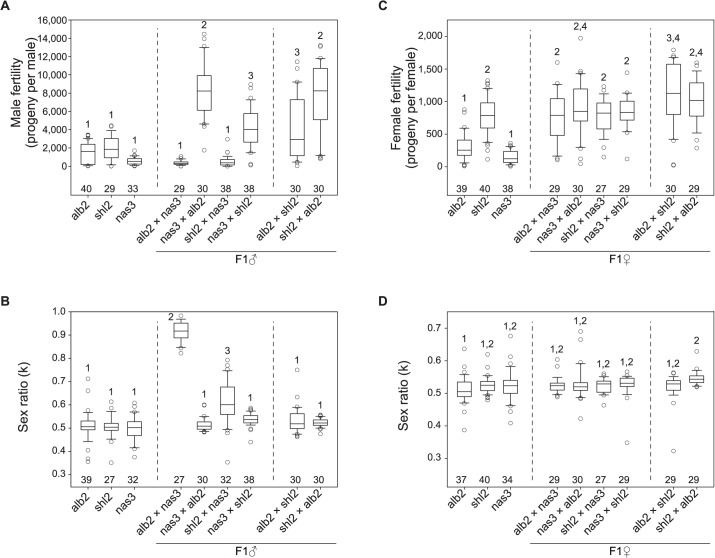
Biological diversity on Earth depends on the multiplication of species or speciation, which is the evolution of reproductive isolation such as hybrid sterility between two new species. An unsolved puzzle is the exact mechanism(s) that causes two genomes to diverge from their common ancestor so that some divergent genes no longer function properly in the hybrids. Here we report genetic analyses of divergent genes controlling male fertility and sex ratio in two very young fruitfly species, Drosophila albomicans and D. nasuta. A majority of the genetic divergence for both traits is mapped to the same regions by quantitative trait loci mappings. With introgressions, six major loci are found to contribute to both traits. This genetic colocalization implicates that genes for hybrid male sterility have evolved primarily for controlling sex ratio. We propose that genetic conflicts over sex ratio may operate as a perpetual dynamo for genome divergence. This particular evolutionary mechanism may largely contribute to the rapid evolution of hybrid male sterility and the disproportionate enrichment of its underlying genes on the X chromosome--two patterns widely observed across animals.
地球上的生物多样性依赖于物种的增殖或物种形成,即生殖隔离的进化,比如两个新物种之间的杂种不育。一个尚未解决的谜题是导致两个基因组与其共同祖先产生分歧,使得一些分歧基因在杂种中无法正常发挥功能的确切机制。在此,我们报告了对两个非常年轻的果蝇物种——米根果蝇和纳苏果蝇中控制雄性育性和性别比例的分歧基因的遗传分析。通过数量性状基因座定位,这两个性状的大部分遗传分歧都被定位到相同区域。通过基因渐渗,发现六个主要基因座对这两个性状都有影响。这种遗传共定位表明,杂种雄性不育基因主要是为了控制性别比例而进化的。我们提出,性别比例上的遗传冲突可能作为基因组分歧的一个永久动力。这种特殊的进化机制可能在很大程度上促成了杂种雄性不育的快速进化及其潜在基因在X染色体上的不成比例富集——这是在动物界广泛观察到的两种模式。